What's your Focus point 'strategy'?

Bstanley

DisNoid
Joined
Mar 1, 2001
Messages
1,241
I often snap 2 or even 3 quick pictures of a scene when I decide to take a photo. I just got back from a trip where I took a fair number of photos and I noticed that of the 3 pictures of various scenes - 1 will be noticeably out of focus. Many of these out of focus pictures were taken at high shutter speeds and/or at small apertures (f11 perhaps) so in these cases there is a very high probablility that it wasn't me shaking the camera or a DoF issue - the focus was simply off.

I used to blame this on the kit lens and slow focusing, but for this trip I ONLY used my brand new 17-55mm f2.8 IS or my 70-200 f4L IS. Not likely that they were only working correctly part of the time.

So I'm left with the Auto Focus settings on the body (Rebel XS). I'm wondering if I should stop using all 7 auto focus points and just start using the center point alone, 'cause the only idea I'm left with is that the Auto Focus system is jumping from point to point as I bang away with the shutter.

Or is there something else I'm doing so badly that it can make great glass look like it was made from a Coke bottle top?

 
Well I personally tend to use one central focus point myself, set to the 'local', or movable, spot setting. It stays center, unless I decide to move it around. Since a vast majority of my shots, I know precisely what or where I want to focus, the extra focus points serve no purpose for me. The only time I'll use the matrix/grid/wide focus area is when I'm on continuous focus shooting moving subjects while panning and want the focus system to track the action and refocus as the focal distance changes. That probably represents 2-3% of my photos - so the other 97-98% - it's center focus.
 
Unless I am shooting something fast moving where I will not have time to re-compose the shot, I always shoot center point. I always have. I do not have very many shots at all where I don't like it due to the focus. There are many other reasons, :rotfl2: but focus is not one. I personally feel that it is the best method.

P.s. I also sometimes pick the focus point other than center for tripod work. I do not let the camera pick though.
 
I use a similar focusing strategy. Single point center focus when in S-AF mode for portraits, landscape, etc. I'll switch over to C-AF using the multi point system when I'm shooting sports or other objects that need to be tracked.
 

Yeah, I learned a long time ago to NOT trust the camera to choose what to autofocus on (ie. don't let the camera select the autofocus points). Somehow, the camera NEVER knows what I'm trying to focus on! :sad2:

Because of this, I *always* take control and select my own autofocus point. Most often, it's the center autofocus point, and I will often use the "focus-and-recompose" method to shoot photos.

Sometimes, though, I might select an autofocus point near my subject. For example, if my subject's face is seen in the upper right part of my viewfinder, I'll select the autofocus point closest to that upper right section. I'd still do "focus-and-recompose", but I don't have to recompose as far.
 
I never let the camera choose my focus point. I will shift my focus points as I need to, but mostly use the center point. Many times I use the center point to focus on what I want then will lock focus and recompose.

From what I've noticed, letting the camera decide what should be the focus point is one of the biggest problems people have, but seldom think about. They do what you did, think it might be the lens or something else they did. Good catch on your part.
 
I never let the camera select focus points.

Unless there is very shallow depth of field I usually use the center focus point and recompose. The center focus point is usually the most accurate. Luckily Nikon puts several cross-type focus points in my cameras (I don't think Canon puts as many), so I get good focus even when I select another focus point. I also separate the AF from the shutter release button and assign it to the AF-On button on the back of the camera. The button isn't far from where my thumb naturally rests, so holding the button down when I want continuous focus isn't a problem. However, 99% of the time I want to lock focus, so all I have to do is let go of the button.
 
When I use auto focus I toggle through the points to put it where I want. But more often than not I use manual focus.
 
I don't mean to hijack this thread (although I agree that letting the camera pick a focus point is dodgy at best).

What do you guys mean by "focus and recompose"? I'm running an XSi and haven't done this before. Is this when you put your focus point (whichever one is activiated) on your subject and then press the "*" button near where your right thumb tends to go?

I've never done this before but it sure sounds like it's probably something I need to learn.
 
I don't mean to hijack this thread (although I agree that letting the camera pick a focus point is dodgy at best).

What do you guys mean by "focus and recompose"? I'm running an XSi and haven't done this before. Is this when you put your focus point (whichever one is activiated) on your subject and then press the "*" button near where your right thumb tends to go?

I've never done this before but it sure sounds like it's probably something I need to learn.

I am not familiar with that camera, but that is probably exposure lock, not AF lock. You can probably assign it differently, but most people lock focus with a half press of the shutter.
 
I don't mean to hijack this thread (although I agree that letting the camera pick a focus point is dodgy at best).

What do you guys mean by "focus and recompose"? I'm running an XSi and haven't done this before. Is this when you put your focus point (whichever one is activiated) on your subject and then press the "*" button near where your right thumb tends to go?

I've never done this before but it sure sounds like it's probably something I need to learn.

Using my previous example of having my subject located on the upper right section of my viewfinder. For example, if Mickey is standing on the right side (I don't want Mickey to be smack in the middle of my photo), and I want Cinderella's Castle in the background.

The "focus" part of focus-and-recompose means that you pre-focus on Mickey. I use the center focus point and pre-focus on Mickey by pressing and HOLDING the shutter button half-way (NOT all the way). This locks the focus on Mickey.

However, I didn't want Mickey to be smack in the middle of my photo. So I "recompose" by moving the camera so that Mickey is in the position I want for my photo (I wanted Mickey to be on the right). Again, my finger is still holding the shutter button half-way down. The camera's focus is still set on Mickey. This way, the camera won't refocus on Cinderella's Castle in the far background.

Once the photo is set-up the way that I want, I press the shutter button all the way down to take the photo.


This is generally how "focus and recompose" works and is probably the most common way to do it. As mentioned earlier, however, there's another way to pre-focus. Canon has an AF-ON button that you can use to pre-focus (check your camera's user's manual to see how to set this up).

"Focus and recompose" works pretty well. However, if you're using a super shallow depth of focus, like for portraits (ie. using large apertures / small f-numbers), focus-and-recompose might not give you the sharpest sharp photo. I'll let someone else try to explain this concept.

Instead, if you can, pick the autofocus point that's closest to your subject (in the above example, I'd choose an autofocus point that's in the upper right corner, since Mickey's face would be there). That way, you don't move your camera as far while you're "recomposing". You can get a sharper picture that way.
 
I wanted to check this out and see if I was alone in using mostly the center point focus. Looks like I'm in great company!

When you guys are using a wide open aperture, do you find you need to handle it differently? Does "focus and recompose" stragegy cause your focus to be off? I still have trouble with sharp focus in these situations.
 
I wanted to check this out and see if I was alone in using mostly the center point focus. Looks like I'm in great company!

When you guys are using a wide open aperture, do you find you need to handle it differently? Does "focus and recompose" stragegy cause your focus to be off? I still have trouble with sharp focus in these situations.

In those tricky situations, it is probably best to go ahead and pick the focus point you want so you don't have to re-compose. I would never let the camera pick it though, because it does not know what you are trying to do.
 
In those tricky situations, it is probably best to go ahead and pick the focus point you want so you don't have to re-compose. I would never let the camera pick it though, because it does not know what you are trying to do.

Nah, I never let the camera pick. With 3 kids, I figure if I can make the camera do what I want, then it won't bother me as much if the kids don't! :rotfl2:
 
I wanted to check this out and see if I was alone in using mostly the center point focus. Looks like I'm in great company!

When you guys are using a wide open aperture, do you find you need to handle it differently? Does "focus and recompose" stragegy cause your focus to be off? I still have trouble with sharp focus in these situations.


Yes, this is the situation I described earlier, where "focus and recompose" might not give you the sharpest photos, especially if you're using the center autofocus point.

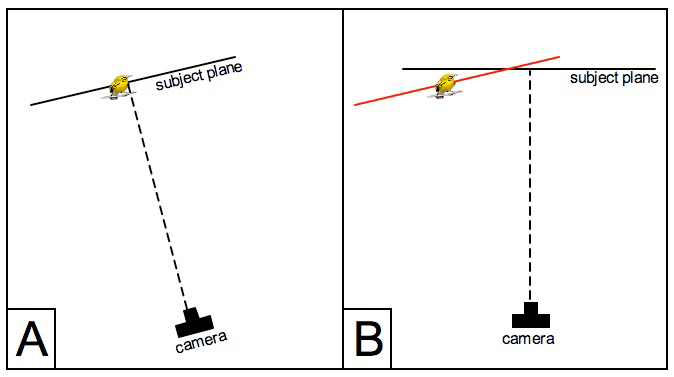
Here's an image I stole from the Internet that illustrates the reason why this is so:

recompose.jpg

In part (A), you point the camera straight onto the bird and you prefocus on the bird. Let's say the bird is, I dunno, 5 feet away from the camera when you look straight onto the bird. The camera is now pre-focused at 5 feet.

When you turn the camera to recompose, as seen in part (B), the camera is still pre-focused at 5 feet. However, the bird is no longer at the 5-foot mark in front of the camera. In fact, the bird's plane-of-focus is now at, say, 4.8 feet. So if your camera is still focused at 5 feet, the bird will be somewhat out-of-focus. You don't get the sharpest focus this way.


How do you counteract this? I alluded to one way of addressing this. Instead of always using the center autofocus point, try selecting the focus point that's closest to your subject. This should minimize the difference in plane-of-focus that occurs when you "recompose".

The other thing you can do is to use a smaller aperture (larger f-number), if the situation allows. A smaller aperture gives you a larger depth-of-field (DOF), so a larger area is in-focus. So in the above example, if you were using a smaller aperture and thus got a larger depth-of-field (say, a DOF of 1 feet), the bird would still be in-focus because now the bird falls within the DOF.

Hope that's not too confusing.
 
Here's an image I stole from the Internet that illustrates the reason why this is so:

recompose.jpg

In part (A), you point the camera straight onto the bird and you prefocus on the bird. Let's say the bird is, I dunno, 5 feet away from the camera when you look straight onto the bird. The camera is now pre-focused at 5 feet.

When you turn the camera to recompose, as seen in part (B), the camera is still pre-focused at 5 feet. However, the bird is no longer at the 5-foot mark in front of the camera. In fact, the bird's plane-of-focus is now at, say, 4.8 feet. So if your camera is still focused at 5 feet, the bird will be somewhat out-of-focus. You don't get the sharpest focus this way.


I know the math was just for illustration, and I will use the same math.

I do not believe that the front of the lens gets .2' closer to the bird by simply rotating that camera a degree or two.

The point of focus does not run on a perfectly square line infront of the lens, IMO it is in front of the lens on a 360° axis. Might appear to be a perfect line, just as the earth appears to be flat.
 
I know the math was just for illustration, and I will use the same math.

I do not believe that the front of the lens gets .2' closer to the bird by simply rotating that camera a degree or two.

The point of focus does not run on a perfectly square line infront of the lens, IMO it is in front of the lens on a 360° axis. Might appear to be a perfect line, just as the earth appears to be flat.

Yeah, this concept is a bit difficult to understand, and it's even more difficult to explain.

You are correct that the camera itself is not 0.2 feet closer to the bird. I think I might have to use some geometry and x- and y-coordinates to try to explain this. Sorry for the upcoming nerdy math...

Let's say that we've got a circle with a radius of 5 feet. My camera and I are at the center of the circle. The bird is located on the circle itself 5 feet away. In fact, the bird can be anywhere ON this circle and it will be in-focus. Since my camera is pre-focused at 5 feet, anything that's 5 feet away from me will be in-focus.

Here's where the nerdy math comes in. Let's imagine that this 5-foot circle is on a graph with x- and y-coordinates. My camera and I are located at (0,0). The bird in part (A) is located at coordinates (-1.4, 4.8).

As an aside: How did I come up with these coordinates? I used Pythagorean Theorem, where c2 = a2 + b2. Let c be the radius of 5 feet. Let b be the distance of 4.8 feet that we made up in part (B). Solving for a, we get 1.4 feet.

So even though this bird in part (A) is 5 feet away from me, it's actually 1.4 feet to my "west", and it is 4.8 feet to my "north".


When I "recompose" by moving my camera, my pre-focus distance is still 5 feet. If there was an object located at coordinates (0, 5) (ie. 5 feet directly "north" of me), then it would be in focus.

However, as we determined earlier, the bird's "y-coordinate" is 4.8 feet. It is 4.8 feet "north" of me. If my camera is pre-focused at 5 feet, this bird runs the risk of being out-of-focus in my photo because I recomposed by moving my camera. Even though the bird didn't change its position and I didn't change my position, the bird is now no longer in my camera's plane-of-focus.

In the end, this all is supposed to illustrate why focus-and-recomposing can sometimes not give you the sharpest image.

Hope I didn't make things even more confusing with all this extra math. I'm sure others can explain this concept better than I did.
 
Hey BStanley...seeing a pattern?

Yes - loud and clear! One point to rule them all :)

Also I should have clarified - the type of picture I'm talking about is really 'the snapshot'. Most of the photos I take on vacation are snapshots taken without too much prep - the camera is in P mode 80% or more of the time, the focus mode is set at 'One Shot' with all seven points left active, shift the ISO, shutter speed or aperture only if needed, adjust the zoom to get a bit wider than I need and bang the shutter button a couple or three times.

When I am trying to take a more composed picture I'll more carefully select the focus point along with all the other settings to achieve whatever it is I want to achieve.

So from now on for snapshots I'll treat focus like ISO - start with just the center focus point selected and select another one only if the conditions demand it.
 
When I'm "on the fly" on vacation, I use the center point, focus, then recompose. I don't think I've let my camera decide since I figured out who to pick for myself.


Disney Vacation Planning. Free. Done for You.
Our Authorized Disney Vacation Planners are here to provide personalized, expert advice, answer every question, and uncover the best discounts. Let Dreams Unlimited Travel take care of all the details, so you can sit back, relax, and enjoy a stress-free vacation.
Start Your Disney Vacation
Disney EarMarked Producer


DIS Facebook DIS youtube DIS Instagram DIS Pinterest DIS Tiktok DIS Twitter

Add as a preferred source on Google

Back
Top Bottom