Court to Disneyland-Study Use Of Segways

You said Disney needs to change their policy - if it is against ADA, then Disney cannot set a policy to allow only certain people to use a certain device for accessibility.

Yes, ADA changes, amends, to make things more of equal access, not the other way around. Adding descriptions to clarify (as in, the mini horses) makes it more equal access, and less of a hassle for the person using the service animal, etc.

You wanted Segways only used by certain people, those who 'deserve' to use them. I understand the safety issue. How are you determining who 'deserves' to use the Segway? A safety test? Who will be in charge of the safety test, what are the parameters, what standards will have to be met? Will there have to be proof of disability? (If so, then you have another set of standards that have to be met, BTW). How can Disney set these standards without coming into conflict with the core idea of ADA, which is nonintrusive equal access?

Telling about a disability - that's at the core of your argument too. You are trying to limit use of a mobility device. You want people to prove a disability, which would require either someone carry a "hangtag" of some sort all the time (like a label on a person, hey look, I'm disabled!) or having to explain over and over again what the disability is.

Also, I'm not a Sir, LOL!

My pardon.I did not know your gender, no insult intended

The proof is in the number of accidents and lawsuits mounting up when these segways are used in crowded areas and the areas that are preventing there use.............like crowded malls (there was cable show about it a few months ago)........end of that story!

again.............this is NOT about telling anyone, anything, its about safety in a crowded park.........especially kids safety and the use on a alternate mobile devise that is much safer.

I would also point out that the person riding the segway is just as easily going to be severely injured.

AKK
 
They have other stand up mobility scooters that are driven just like a normal scooter no balancing required. If they force Disney to accept Segways they could always offer those for rent and could set the speed control to be similar to other scooters
 
They have other stand up mobility scooters that are driven just like a normal scooter no balancing required. If they force Disney to accept Segways they could always offer those for rent and could set the speed control to be similar to other scooters

I totally agree.............ES(=standing)V..........AKK
 
Excuse my ignorance on this but can some site an ADA requirement for a non ADA approved device? It is my understanding that the company that makes Segways never intended it to be a device to be used by disabled people and have never had it approved for that type of use by any organization world wide.
 

EastYorkDisneyFan - http://www.ada.gov/regs2010/titleIII_2010/reg3_2010.html
When the ADA was revised in 2010 they included a new section under mobility devices:

Other power-driven mobility device means any mobility device powered by batteries, fuel, or other engines--whether or not designed primarily for use by individuals with mobility disabilities--that is used by individuals with mobility disabilities for the purpose of locomotion, including golf cars, electronic personal assistance mobility devices (EPAMDs), such as the Segway® PT, or any mobility device designed to operate in areas without defined pedestrian routes, but that is not a wheelchair within the meaning of this section. This definition does not apply to Federal wilderness areas; wheelchairs in such areas are defined in section 508(c)(2) of the ADA, 42 U.S.C. 12207(c)(2).

So yes, the Segway (legal name EPAMD) is mentioned in and covered by the ADA.

In response to Tonka's Skipper, the cities that I am aware that have banned Segways include San Francisco, Boston and Laguna. All of those cities cite that their exclusion of use of Segways does not pertain to someone with a qualified disability. http://alttransport.com/2011/06/segways-banned-from-boston-sidewalks/

Universal Studios, Six Flags, the San Diego Zoo all permit Segways. Please cite any mall that currently bans Segways. They are permitted in Walmarts, Targets and Costcos as well.

>>>>>>
Mobility Assistive Device Policy http://www.sandiegozoo.org/zoo/plan_your_trip/guests_with_disabilities

The Zoological Society of San Diego is dedicated to providing all of its guests with equal enjoyment of the wonderful experience offered by its Parks – The World Famous San Diego Zoo and The San Diego Zoo’s Safari Park.

The safety of our visitors is extremely important to us. The Parks are primarily pedestrian environments. By “pedestrian,” we mean any individual who moves within walking areas with or without the use of walking-assistive devices such as crutches, leg braces, wheelchairs, etc. Park attendance is often at high capacity resulting in busy pedestrian pathways. Our goal is to maintain a safe pedestrian traffic flow for all visitors while allowing for use of mobility assistive devices that do not fundamentally alter the nature of the experience the Parks provide.

In order to maintain a safe pedestrian environment and the desired pace and flow of visitor traffic, the Parks do not allow guests to bring or use most wheeled vehicles within the grounds. Bicycles, tricycles, scooters, skateboards, roller skates and similar modes of transportation are not allowed within the grounds. The Parks allow strollers as well as the following mobility assistive devices for use by guests with disabilities: wheelchairs, electric scooters, and Segways®. All Segways entering the Parks must be operated in “Turtle” mode so as not to disrupt the desired pace of the visitor traffic at the Parks and disturb other guests.
 
EastYorkDisneyFan - http://www.ada.gov/regs2010/titleIII_2010/reg3_2010.html
When the ADA was revised in 2010 they included a new section under mobility devices:

Other power-driven mobility device means any mobility device powered by batteries, fuel, or other engines--whether or not designed primarily for use by individuals with mobility disabilities--that is used by individuals with mobility disabilities for the purpose of locomotion, including golf cars, electronic personal assistance mobility devices (EPAMDs), such as the Segway® PT, or any mobility device designed to operate in areas without defined pedestrian routes, but that is not a wheelchair within the meaning of this section. This definition does not apply to Federal wilderness areas; wheelchairs in such areas are defined in section 508(c)(2) of the ADA, 42 U.S.C. 12207(c)(2).

So yes, the Segway (legal name EPAMD) is mentioned in and covered by the ADA.

In response to Tonka's Skipper, the cities that I am aware that have banned Segways include San Francisco, Boston and Laguna. All of those cities cite that their exclusion of use of Segways does not pertain to someone with a qualified disability. http://alttransport.com/2011/06/segways-banned-from-boston-sidewalks/

Universal Studios, Six Flags, the San Diego Zoo all permit Segways. Please cite any mall that currently bans Segways. They are permitted in Walmarts, Targets and Costcos as well.

>>>>>>
Mobility Assistive Device Policy http://www.sandiegozoo.org/zoo/plan_your_trip/guests_with_disabilities

The Zoological Society of San Diego is dedicated to providing all of its guests with equal enjoyment of the wonderful experience offered by its Parks – The World Famous San Diego Zoo and The San Diego Zoo’s Safari Park.

The safety of our visitors is extremely important to us. The Parks are primarily pedestrian environments. By “pedestrian,” we mean any individual who moves within walking areas with or without the use of walking-assistive devices such as crutches, leg braces, wheelchairs, etc. Park attendance is often at high capacity resulting in busy pedestrian pathways. Our goal is to maintain a safe pedestrian traffic flow for all visitors while allowing for use of mobility assistive devices that do not fundamentally alter the nature of the experience the Parks provide.

In order to maintain a safe pedestrian environment and the desired pace and flow of visitor traffic, the Parks do not allow guests to bring or use most wheeled vehicles within the grounds. Bicycles, tricycles, scooters, skateboards, roller skates and similar modes of transportation are not allowed within the grounds. The Parks allow strollers as well as the following mobility assistive devices for use by guests with disabilities: wheelchairs, electric scooters, and Segways®. All Segways entering the Parks must be operated in “Turtle” mode so as not to disrupt the desired pace of the visitor traffic at the Parks and disturb other guests.


Everything you have stated show there is real safety issues....especially in parks as crowded as a theme parks...........and some cities, including some areas in NY and some smaller cities have banned them for safety issues.

Honestly..........we have 2 sides in this.I fail to understand why some people insist that the sagways are ok even with all the proof they are dangerous in a crowd and there are different units available........safer ones! Seems with other units available .this is not a issue.


I am will now going to wait for the court case to be heard. It is my belief that even with just the limited evidence posted by various people here, it shows there is a real Safety problem......

AKK
 
[/COLOR]

The segways have been proven in crowed ares to be a safety issue with many accident and lawsuits now in effect......they have be outlawed in some areas of big cities and at least 2 shopping malls due to accidents and suits.

They can indeed if they prove to the court the safety issue!

I do not think anyone here is suggesting unregulated use of stand up mobility devices.

It is likely that with some limitations (max speed being the most obvious) that they can have a safety profile similar to electic scooters.
 
Quote from a post on the DIS Unplugged Board from today.
Since jcb covered it so completely, I decided it would be best to just quote his post from this thread.

For those that are interested, after the California federal court of appeals (let's refer to this as the "Disneyland" appeal) issued its decision, DRAFT and others provided a copy of the decision to the federal court of appeals hearing the Orlando Segway lawsuit (the "WDW" appeal). Yesterday, Disney filed a response that sharply criticized the Disneyland ruling. So far as I can tell, this is the first public comment by Disney about the Disneyland decision.

Disney's letter, written by lawyers for judges, is pretty technical. In essence, though, Disney's position is that the Disneyland decision does not affect the WDW settlement. While there is some obvious similarity, the issues in the two appeals are fundamentally different. The issue in the Disneyland lawsuit was limited to whether the ADA itself required Disney do more than permit wheelchairs. The issue in the WDW lawsuit is whether the Orlando federal court really messed up when it approved the settlement in the class action.

First, Disney says, the Disneyland decision did not address Segway safety in the theme parks. The Orlando court did, finding that Disney had proven there were significant safety risks.

Second, Disney listed five legal reasons why the Disneyland decision is "wrong" (Disney's word, not just mine). Disney isn't taking the Disneyland decision lying down.

Disney's letter doesn't say what Disney will do next in the Disneyland lawsuit. The tone of the letter suggests Disney may pursue further appeals, especially if it receives a favorable ruling in the WDW appeal. It might also decide that further appeals would not be cost effective and ask the California trial court to decide whether Segways pose too great a safety risk.

And as for the WDW appeal, the court heard argument on the appeal in late June so we could receive a decision any day - or in six month from now.
 
Thanks Sue,

It would be great if they would appeal it all the way so both on technically and substance so that we could eventually have a ruling that would be fully binding to the whole country.

This ADA issue goes way beyond powered mobility devices, to the issue of documented evidence of safety issues that can not be midigated.
 
I posted this on the thread on the Podcast Board, but thought some people may not see it there, so I am reposting it here.
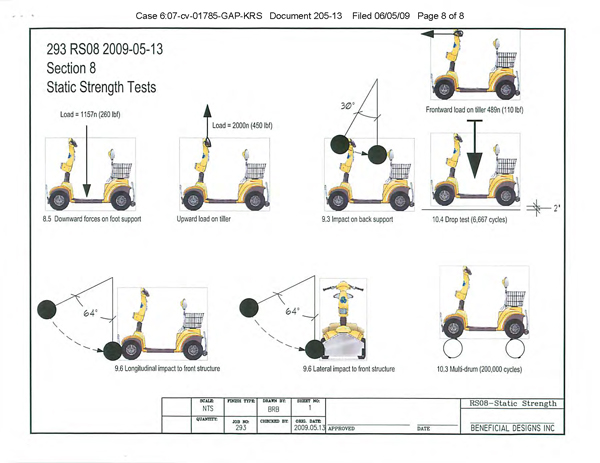
The quote from Justin Jett is from the Podcast Board thread and someone jcb posted this picture of Disney’s standing mobility device on that thread on this post.
2009-06-05-205-13-exhibit-11_Page_8.jpg

..............
As a disabled person who knows how hard it is to obtain medical mobility devices, I have a very hard time with people claiming that an off the shelf Segway is a medical mobility device, and accusing Disney of an ADA violation.

Page 112 of the Segway Getting Started Manual states:
The Segway PT has not been designed, tested or approved as a medical device. You must be able to step on and off the Segway PT unassisted, which requires physical abilities similar to ascending and descending stairs without assistance, and without holding the handrail.

Here is a link to the manual: http://www.segway.com/downloads/pdfs/Getting_Started_Manual.pdf

Please look at Page 112!! This is not perception! This is fact! The link proves it.
I am not against new technology for people with disabilities. There are some things that were designed for people without disabilities that are extremely usable by people with disabilities. The iPhone, iPod touch and iPad are wonderful examples; many people with disabilities are using them in place of dedicated (and very expensive) communication devices.
But, substituting an iPad for some other, more expensive dedicated device is does not have the potential to hurt anyone.

Power wheelchairs, ECVs and other devices designed for use by people with disabilities have safeguards to stop them quickly and safely - they basically have brakes that are on unless the user is doing something to make the device go.
With an ECV, if you let go of the throttle, it stops.
With a power wheelchair, let go of the joystick, it stops. Because they have 3 wheels or more, they are stable and can stand by themselves (as opposed to a Segway, which has 2 wheels and is kind of in a “permanent wheelie” situation while it is being operated).
The iBot wheelchair worked the same way, but to get FDA approval as a medical device, it also had to prove that when it was operating on 2 wheels, it would automatically and safely stop and come down to a stable position, with all wheels on the ground.

When I first heard about the Segway, heard that it was ‘self-balancing’ so the user did not have to balance, I could see some uses for people with disabilities.
I lurked on some forums for people with disabilities who were using Segways where people said it was wonderful for them because even though they did not have the ability to balance, the Segway “did it for them.”
Many of the people posting on those forums did not have the basic physical abilities that are in the part of the Segway manual that Justin Jett quoted and were trading tips about how to get on and off a Segway without the balance or ability to lift a foot up on the Segway platform.

A quick internet search or a search of youtube brings up many examples of people who are using various devices to get onto the Segway because they don’t have the ability to get on/off by themselves. There are videos of people who require help from one or more people to get on and off, people who use straps or bars attached to the wall or roof racks on their car to pull themselves on and lower themselves off or people using a strap under a foot to pull it up since they can’t step up with it.
(I have noticed that most of those videos disappear after someone posts a link to them - so I’m not posting any links.)

I can understand why someone who walks with difficulty or has poor balance from conditions like a stroke, MS or other conditions would want to use a Segway. Even as an able bodied person, there is something almost magical and freeing about gliding pretty effortlessly around on a Segway.
I can understand that someone who has difficulty moving would want that feeling. I remember the joy in my daughter’s face the first time she “ran” in her power wheelchair. To do something she was not otherwise able to do, to move much faster than her muscles will allow her to move. I don’t begrudge anyone that joy, but safety is more important than joy.
My son-in-law has MS, so when I first heard about Segways, I was looking at them as a possible eventual mobility device if he needed one.
But, then I actually took the Epcot Segway tour - I don’t claim to be an expert or even have that much experience after taking the tour 4 times.
But, it was enough to know that the Segway only balances within certain limits, as the manual says on page 57:
Avoiding Tips
The Segway PT balances front to back but not side-to-side.
You are responsible for maintaining side-to-side balance by leaning into turns. If you fail to actively maintain this side-to-side balance, the Segway PT can tip sideways and fall.
And even with it balancing front to back, there are many ways to get in trouble discussed in the manual. In fact, one of the biggest problems I can see with the Segway being used as a mobility device is that it is not stable. No matter what you say about it, it is a single set of wheels - kind of a high tech unicycle.

The manual is full of all sorts of warnings like this from page 2:
WARNING!
RISK OF DEATH OR SERIOUS INJURY
Whenever you ride the Segway PT, you risk death or serious injury from loss of control, collisions, and falls. To reduce risk of injury, you must read and follow all instructions and warnings in the User Materials.
The manual also warns on page 43,
You have approximately 10 seconds from the start of a Safety Shutdown to come to a controlled stop and step off. After 10 seconds, the Segway PT will immediately shut down when the Wheels reach zero speed.
If a Safety Shutdown occurs:
1. Immediately come to a controlled stop.
2. Carefully step off one foot at a time.
This is one of the reasons a rider needs to be able to get on and off without assistance and why the Segway is not a safe mobility device for some people with disabilities.
There are also warnings about environmental dangers, like this warning on page 45 of the manual,

WARNING!
Theft detection systems, such as the type used in some libraries and retail stores can interfere with the Segway PT’s ability to balance and/or cause the Segway PT to perform a Safety Shutdown. Do not ride within 5 feet (1.5 meters) of any theft detection system.
One of the Segway’s safety features is described on pages 48 and 49 (I’m just quoting the short part on page 48:
The Segway PT has four sensors located beneath the Mats. Rider Detect Sensors detect the presence or absence of a rider while the Segway PT is powered on.
and on page 50:
WARNING!
Never place anything on the Mats, except your feet. Doing so could interfere with the Rider Detection system and allow the Segway PT to travel on its own, risking running into a person or property, and causing injury or damage.
Someone mentioned on this thread that some people have added seats to Segways to make a Segway wheelchair. The ones I have seen on the internet add something over the mats to activate all 4 sensors and bypass the safety mechanism.
I wonder if the people who allowed them to be written into the ADA as Other Power Driven Mobility Devices or those professionals who are suggesting them to patients who can't step on and off unaided have read the manual?

I know there are people who are using Segways as mobility devices, and (my personal opinion) I think for those who have the ability “to step on and off the Segway PT unassisted, which requires physical abilities similar to ascending and descending stairs without assistance, and without holding the handrail,” they may be a safe device in some circumstances.
I can see them safely operating in zoos or outdoor parks, possibly stores or shopping centers (except for needing to avoid those pesky security theft security systems.)
But, not WDW - it’s too busy, too full of children and people who are already wandering into the paths of other guests because they are busy looking around. There are other, safer devices, including the one that was already pictured on this thread. Maybe not as sleek or envy inducing as a Segway, but safer.

One argument in favor of allowing Segways was that only people with their own Segways would be coming to the parks. But, once upon a time, only people with their own ECVs used them in the parks. Then companies from outside started renting them. I have no doubt (my opinion) that the same thing would happen with Segways. And, since all it would take to use it would be an assertion on the part of the user that they had a disability and were using it as a mobility device, that would be it.
 
Article here details the story about the Aug 31, 2012 ruling:
http://www.wdwinfo.com/news/General...als_Court_Upholds_Disney_s_Ban_on_Segways.htm

Basically, the Federal Appeal Court upheld that Disney did not violate the ADA in banning the use of Segways in their parks. In fact, it found that Disney had done a safety assessment that used the safety considerations written in the ADA to determine Segways in the parks would not be safe.

This covers both WDW and Disneyland Park.
 
The appeals court opinion (dated August 30, actually) can be found at http://www.ca11.uscourts.gov/opinions/ops/201112013.pdf.

Also note that this was a case out of Florida, not the Baughman case that has been pending in federal courts in California - but this decision appears to "trump" the California case, because the court reached a final decision first.


Disney Vacation Planning. Free. Done for You.
Our Authorized Disney Vacation Planners are here to provide personalized, expert advice, answer every question, and uncover the best discounts. Let Dreams Unlimited Travel take care of all the details, so you can sit back, relax, and enjoy a stress-free vacation.
Start Your Disney Vacation
Disney EarMarked Producer


DIS Facebook DIS youtube DIS Instagram DIS Pinterest DIS Tiktok DIS Twitter

Back
Top Bottom