Neapolitan Ice Cream
Delicious
- Joined
- Mar 18, 2021
- Messages
- 5,536
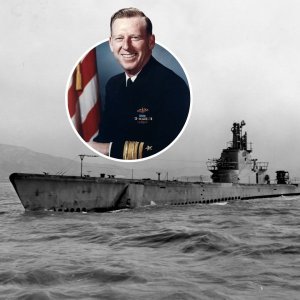
80 years ago, from 19 December 1944 to 15 February 1945, 31-year-old Commander Eugene B. Fluckey was leading the American submarine USS Barb on a perilous war patrol off the coast of China.
On January 8, 1945, he had already sunk a large enemy ammunition ship and damaged multiple other vessels during a fierce two-hour night battle with a Japanese convoy.
In late January, Fluckey’s submarine discovered an even bigger target, a concentration of over thirty Japanese ships anchored in Namkwan Harbor along the Chinese coast.
He realized that to strike and escape, USS Barb would have to race at full speed for about an hour through uncharted shallows, thick with enemy mines, rocks, and other hazards.
Fully aware of the extreme danger, Commander Fluckey nevertheless gave the order: “Battle stations, torpedoes!”
Under cover of darkness, the Barb slipped past the harbor’s patrol craft and heavy defenses and crept in to point-blank range, navigating in water barely five fathoms (30 feet) deep.
Closing to just 3,000 yards from the unsuspecting enemy fleet, Fluckey unleashed a salvo of the sub’s last forward torpedoes.
He then quickly swung the submarine around and fired four more torpedoes from the stern tubes into the clustered ships.
A series of tremendous explosions followed as the torpedoes found their marks, eight direct hits blasting apart at least six enemy ships, including a large ammunition vessel that erupted in a massive fireball, hurling shells and debris high into the night sky.
Japanese forces reacted at once: an enemy frigate opened fire and shells splashed around the Barb as a patrol aircraft roared overhead, searching for the daring attacker.
Pushing his engines to the limit, Fluckey ordered the submarine to run at flank speed (over 23 knots) and led a daring escape on the surface.
For more than an hour, the Barb weaved through the mined, rock-obstructed harbor channels at top speed, dodging enemy escorts and shallow reefs until she finally broke free into open water and safety.
Amazingly, not a single crewman was lost or injured during this operation, and later, on January 29, 1945, Fluckey sank another large Japanese freighter to cap off the submarine’s record-setting patrol.
For this extraordinary feat of “conspicuous gallantry and intrepidity” above and beyond the call of duty, Commander Eugene B. Fluckey was awarded the Medal of Honor.
He personally received the medal from Secretary of the Navy James Forrestal in a ceremony in Washington, D.C., on March 23, 1945.
Fluckey survived the war and continued his Navy service, eventually retiring as a rear admiral.
He died on June 28, 2007, in Annapolis, Maryland, at the age of 93 from complications of Alzheimer’s disease.
On January 8, 1945, he had already sunk a large enemy ammunition ship and damaged multiple other vessels during a fierce two-hour night battle with a Japanese convoy.
In late January, Fluckey’s submarine discovered an even bigger target, a concentration of over thirty Japanese ships anchored in Namkwan Harbor along the Chinese coast.
He realized that to strike and escape, USS Barb would have to race at full speed for about an hour through uncharted shallows, thick with enemy mines, rocks, and other hazards.
Fully aware of the extreme danger, Commander Fluckey nevertheless gave the order: “Battle stations, torpedoes!”
Under cover of darkness, the Barb slipped past the harbor’s patrol craft and heavy defenses and crept in to point-blank range, navigating in water barely five fathoms (30 feet) deep.
Closing to just 3,000 yards from the unsuspecting enemy fleet, Fluckey unleashed a salvo of the sub’s last forward torpedoes.
He then quickly swung the submarine around and fired four more torpedoes from the stern tubes into the clustered ships.
A series of tremendous explosions followed as the torpedoes found their marks, eight direct hits blasting apart at least six enemy ships, including a large ammunition vessel that erupted in a massive fireball, hurling shells and debris high into the night sky.
Japanese forces reacted at once: an enemy frigate opened fire and shells splashed around the Barb as a patrol aircraft roared overhead, searching for the daring attacker.
Pushing his engines to the limit, Fluckey ordered the submarine to run at flank speed (over 23 knots) and led a daring escape on the surface.
For more than an hour, the Barb weaved through the mined, rock-obstructed harbor channels at top speed, dodging enemy escorts and shallow reefs until she finally broke free into open water and safety.
Amazingly, not a single crewman was lost or injured during this operation, and later, on January 29, 1945, Fluckey sank another large Japanese freighter to cap off the submarine’s record-setting patrol.
For this extraordinary feat of “conspicuous gallantry and intrepidity” above and beyond the call of duty, Commander Eugene B. Fluckey was awarded the Medal of Honor.
He personally received the medal from Secretary of the Navy James Forrestal in a ceremony in Washington, D.C., on March 23, 1945.
Fluckey survived the war and continued his Navy service, eventually retiring as a rear admiral.
He died on June 28, 2007, in Annapolis, Maryland, at the age of 93 from complications of Alzheimer’s disease.