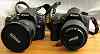
Nikon D80

This can sometimes be counter-intuitive. If you want MORE of the object in focus (higher depth of field), you need to stop "down", or close the aperture which means a HIGHER f stop. This will of course require a LONGER shutter speed, probably something like 1/15th of a second if you go with something like f/9 or f/11. If you take your ISO down to 200, you are now looking at a shutter speed of around 1/4 of a second. All of this is fine if you are on a good tripod with no wind.

You are quickly bumping of against the limitations of macro photography, available light shooting and hand-holding!

Might I suggest a great book for new photographers? Bryan Peterson has a [/B]book called "Understanding Exposure", which is a great primer for learning the ins and outs of photography. You can get it on Amazon.com, or probably any Borders. I bought it 2 years ago right after I got my D50, and I still refer to it when I am in the doldrums.

Personally I think you picked the right exposure for that subject; any more depth of field and the leaves behind the rose will start to become distracting, taking away from the rose itself. Very nice shot BTW...


I ordered it today! Thanks again!
 
does anyone know how to override the 1/200 shutter speed when using a speedlight (600) ?

Thanks for any advice!

tricia.
 

I thought the D80 sync speed was 1/250? If not, the only way I know to override it is to get some wireless triggers.
 
does anyone know how to override the 1/200 shutter speed when using a speedlight (600) ?

Thanks for any advice!

tricia.

What are you striving for?? Faster shutter speed or slower shutter speed? Assuming faster I could sell you my D70 if my DW lets me put the cash towards a D300. What is your concern with the shutter speed anyways? Sports? Fill flash?

Pat.
 
I think I am going to buy the D80. Just seems smarter (over the D40) in the long run. Anywho...

Talk to me about lenses. I think I would like an 18-135 for sure. But what about vr? What is that, exactly? Also, would like to pick up a nice lens for low light situations.

I will mostly be taking shots of the kids, new baby, kids playing sports, vacations, etc. Obviously, not going for a new profession or anything, but I certainly don't want to be changing lenses every time I turn around.

Thanks for all the help. Oh yeah, talk to me like I am 4 ... ;)
 
Welcome to the DIS Nikon Users Group! The 18-135 is a good choice; it is a good all-round zoom lens for use in decent light. I have one and find it to be very sharp. VR is Nikon's term for image stabilization. It is lens-based and involves an element or elements within the lens that shift to counteract camera shake or movement. Keep in mind that NO image stabilization will compensate for SUBJECT movement. Only a faster shutter speed or flash will do that.

Nikon makes several lenses with VR, including the 70-300VR, which several of us have. It is a very good lens for the money and produces very good results, again, with adequate lighting.

For low light work, a $110 50mm f/1.8 Nikkor will do fine. There are other good low-light primes from Nikon, Sigma, and Tamron, as well. The best bang-for-buck is the 50mm f/1.8, although there are plenty of others in various focal lengths and maximum apertures (low f/number). Prices can become prohibitive on some of the really long/fast lenses, though.

Just as an example, here is a shot of my daughter, made at lunch yesterday, with the D80 + 50mm f/1.8 using only the light coming thru the dining room window and the overhead light:

ISO 400, f/1.8, 1/60 sec exposure, PP in Photoshop Elements 5
DSC_1505copy.jpg


The D80 has the in-body focus motor screw so the 50mm will work fine with it. You may also want to consider an accessory flash, a decent bag to hold all this stuff, and some sort of decent editing software, in addition to the camera and lens(es).

~Ed
 
How do I meter off the sky? I've read the manual and I can't figure out how to do it...or if I even have a light meter within the camera. Have pity- I feel like a dope:blush:
 
You have a few different options:

(well, first off, every camera has a light meter. That is how the camera knows what settings to use)

1. Put the camera in auto or program mode, aim it towards the sky, press the shutter half way, look in the viewfinder and see what the camera chose for settings (ie, shutter speed and aperature), remember those settings, put the camera in manaual mode and manually set those settings. Be sure you have auto ISO off when you do this.

2. Aim towards the sky, press the shutter half way and also press the exposure lock button. You have options for this in your menu so check how you have it set (The default setting is that it locks both focus and exposure. I have mine set so that it only locks exposure.) You also have choices as to whether the exposure is only locked while you have that button pressed or it is locked until you unlock it by pressing the button a second time - this is the setting I prefer. The button is the button on the back of the camera just to the right of the viewfinder.

Hope that helps.
 
You have a few different options:

(well, first off, every camera has a light meter. That is how the camera knows what settings to use)

1. Put the camera in auto or program mode, aim it towards the sky, press the shutter half way, look in the viewfinder and see what the camera chose for settings (ie, shutter speed and aperature), remember those settings, put the camera in manaual mode and manually set those settings. Be sure you have auto ISO off when you do this.

2. Aim towards the sky, press the shutter half way and also press the exposure lock button. You have options for this in your menu so check how you have it set (The default setting is that it locks both focus and exposure. I have mine set so that it only locks exposure.) You also have choices as to whether the exposure is only locked while you have that button pressed or it is locked until you unlock it by pressing the button a second time - this is the setting I prefer. The button is the button on the back of the camera just to the right of the viewfinder.

Hope that helps.

The manual indicated that the camera had a light meter, and my gut told me I had one, b/c it somehow didn't make sense that I wouldn't, but I asked a fellow D80 owner and she said it didn't. That's what I get!:rolleyes:
O-kay, I tried option 1. and it worked great! I also tried 2. and the camera won't auto focus with the AE-L pressed. I have yet to go to the manual to adjust the "press to lock and press to unlock", but I will. It's still on default. Hopefully if I correct that it will auto-focus.
Thank you for your response-it was very helpful! Another mystery solved!!:banana:
 
and the camera won't auto focus with the AE-L pressed.

Check page 94 of your manual. The default setting on the D80 is that when you press your AE-L button, it locks both the exposure and the focus. So, your auto focus won't work because you have actually locked in the focus. But you can change that so the AE-L button only locks the exposure. I don't recall in the menus where it is to change that, but it had to pretty easy since I figured it out. :thumbsup2
 
Yes, your SLR has a light meter. Why are you looking to meter the sky?
 
I assume you want to focus on your subject but meter to avoid blowing out a bright sky in the background? Focus on your subject as you normally would and release the 1/2 pressed shutter- position your camera to the sky without changing focus and depress the AE-L button- while holding this button recompose your shot (already in focus) and take the picture. Just be advised your subject will likely be dark or shillouetted. Fill flash may be a better strategy for proper exposure against a bright background.
 
Yes, your SLR has a light meter. Why are you looking to meter the sky?
Just as GDad said- trying not to blow out the sky...

I assume you want to focus on your subject but meter to avoid blowing out a bright sky in the background? Focus on your subject as you normally would and release the 1/2 pressed shutter- position your camera to the sky without changing focus and depress the AE-L button- while holding this button recompose your shot (already in focus) and take the picture. Just be advised your subject will likely be dark or shillouetted. Fill flash may be a better strategy for proper exposure against a bright background.

Check page 94 of your manual. The default setting on the D80 is that when you press your AE-L button, it locks both the exposure and the focus. So, your auto focus won't work because you have actually locked in the focus. But you can change that so the AE-L button only locks the exposure. I don't recall in the menus where it is to change that, but it had to pretty easy since I figured it out. :thumbsup2


Thank you both- I figured out how to custom program the AE-L last night. I really appreciate your help!
 
You might want to check out a circular polarizer, too. That'll usually darken the skies to a nice deep blue, rather than a blown-out white.
 
I am in need of some serious help with my Nikon D80. I know, I know READ THE MANUAL. Believe me, I have. It's just that there is so, so much going on. I'm sure that there are tons of ways to get good nightime and low-light photos, so I'm not looking for *the* way; just some good hints at how to get good exposures. I use a Nikon 18-135 zoom lens because it's versatile and I don't have to change lenses. Besides, the only other ones I have are a 35-70 and 70-210 film camera set from my old 4004. :)

I recently tried to get very low light shots of my FIL and my 2 girls with a birthday cake lit with 4 candles. No tripod, no flash, auto mode :scared: and they were slightly blurry. I'm guessing that had I used my tripod (I do have one, but it's not a nice portable size for Disney.), it would have been crisp.

So, what can I do to get good photos of the spectromagic parade, illuminations, fireworks, and rides like pirates and others? I understand the "no flash" aspect/rule, but what about ISO, exposure, aperature, zoom/no zoom, other settings on the camera wheel like sports or night shot?? I most likely won't have a tripod with me. The only chance is if I buy an inexpensive monopod that is extremely compact.

One other question about exposure and the zoom of the lens. I took some photos of my DD4 at her swim lesson. I zoomed in on about 1/2 of them so that she was the focus of the photos instead of the rest of the people in the pool. Auto mode with flash. The photos were dark. However, when I zoomed back out, the photos were much brighter. I'm assuming that a longer focal length/zoom lets in much less light, so this was the reason. Correct?

I'm probably one of those people who "shouldn't" have a DSLR because I just don't know how to use it correctly. I really want to learn more, but time is limited with taking care of my kids.

I greatly thank anyone who can give me some good hints about how to take these photos.
 
Unfortunately, I am a little short on time at the moment to respond to all your questions, but will offer this quick suggestion - you need to get a 50mm 1.8 prime lens. Only costs about $100. The lens you have is a great lens, but it is not designed to handle low light situations.

I will try to reply again later with more info.


Disney Vacation Planning. Free. Done for You.
Our Authorized Disney Vacation Planners are here to provide personalized, expert advice, answer every question, and uncover the best discounts. Let Dreams Unlimited Travel take care of all the details, so you can sit back, relax, and enjoy a stress-free vacation.
Start Your Disney Vacation
Disney EarMarked Producer


DIS Facebook DIS youtube DIS Instagram DIS Pinterest DIS Tiktok DIS Twitter
Add as a preferred source on Google

Back
Top Bottom