Did the space shuttle kill society's dream of going into space?

Joined
Nov 19, 2020
Messages
108
It seems like society has become more risk averse. Most of the middle aged people I meet have no interest in going into space even if it was free. Most of the enthusiasm is coming from younger generations.

What killed our adventurous side?

What killed the dream?

Did the space shuttle disasters really have that much of impact on society?

Or have become addicted to comfort? Was Wall-E prophetic?

There is a new generation of spacecraft.


And hopefully they will be safer.
 
People here won't like the answer to what killed adventure. Let's just say it was government red tape, and the guy at the top that decided the mission of NASA wasn't to explore and innovate, but "outreach."

An aborted launch by NASA would take weeks to solve and re-try (see ULA for example). SpaceX has aborted launches and launched later the same day. They almost had a weekend with 3 launches a while back!

It has taken 3 billionaires (yes, with some government funding) to actually push this thing along, and the advances in the past 5 years alone have been unbelievable. Our household is excited by this all, and I have 3 kids that are avid space fans. We went to I think 4 launches last year, and watched 6 total from Florida. We went to KSC and Huntsville in just the past couple months... having kids interested in math, engineering, and science is pretty cool to me.
 

I think some people thing
k there are better uses of public money, like finding a cure for cancer.
Then you should love where SpaceX is taking us. They are targeting getting the cost of a launch from $152 million to $2 million, a feat the government would never even conceive. Right now, they are still at about $50-60mil per launch, but that's a huge improvement. Nuclear fueled rockets are on the horizon, which will dramatically change the game.
 
I think some people thing
k there are better uses of public money, like finding a cure for cancer.

There is plenty of money being spent on that. The vast majority of federal government spending goes to defense, debt payments, and entitlements. The rest of the spending doesn't amount to much.
 
In some ways it did by being too successful and outliving it's operational lifespan by a lot. The Shuttle could only go into orbit - keeping it operational meant no return trips to the moon and beyond. We just for some reason stuck with orbital missions for a long time. It was a great program though! I don't think it had anything to do with the general attitude toward space exploration in general. I think that was affected by more Earthbound things.
 
There is plenty of money being spent on that. The vast majority of federal government spending goes to defense, debt payments, and entitlements. The rest of the spending doesn't amount to much.
Actually the vast majority of Federal Spending goes to entitlements. Defense and debt interest together are less than one half of entitlements. Broken down by percentages entitlements are 62.6 percent. Non defense discrectionary is 13.3 percent Defense Discretionary 12.2 percent ( i believe this is where NASA is funded) and debt servicing 11.7 percent. That was for FY 2020
I don;t know that society as a whole was ever terribly invested in space travel-the scientists, engineers and mathemeticians were and still are. The average Joe watched the moon landing on TV because it was what was on TV but a good percentage did not and do not believe it ever happened. There was a great deal of temporary interest around the difficult ( Apollo 13) or the Tragic ( Challenger) but again that was influenced by media coverage in a age with out stream services that let people look away.
 
We can learn all we need to learn with unmanned missions that are far cheaper and far less dangerous. What killed manned missions? Automation did. They're cheaper, just as effective if not more, and there is absolutely no reason to send a man instead other than vanity.
 
I think more people will be interested in space/discovery when it becomes a much more accessible goal. Even then the first thing to come through would be private space flights, and those will be very limited and far too expensive for most of us. Way beyond the idea where we can just venture out to new worlds without worrying about fuel and supplies, like Star Trek.

And even in the future, will people still be as thrilled about space travel when they finally achieve the means?

Decades ago, people would have marveled at the idea of our smart phones. Fast forward to now and we take them for granted, and they are covered in fingerprints and have cracked screens. So eventually, if we got to the point where space travel was so common that we commuted to stations orbiting nearby planets in our solar system, we'll probably dread the long travel times, and Mars station might be as "glamorous" as Atlanta Airport. If this forum is still around by then, I'm sure someone would still be asking if the thrill is gone from space travel.

And aren't there still plans to mine the moon? So apart from researchers, corporations are going to be interested in space. Corporations and grungy interiors, the future is going to look like ALIEN or Blade Runner more than Star Trek.
 
Last edited:
Being risk averse is something that increases with age

Some people don't go chasing waterfalls, they may prefer to stick to the rivers and the lakes that they're used to.
And they'll tell the younger generation, "I know you're going to have it your way or nothing at all, but I think you're moving too fast."

giphy.gif
 
I think now that we know that real space tourism wont happen for the majority of people in the next twenty, thirty years. That is not something to get excited about. I dont think it is risk, it is extremely expensive, there is nothing to do. The only thing you get is to say you have done it. And as we saw in the big bang theory, that gets old really fast.

If there is something that killed it, it is knowledge. And too many movies.
 
NASA has its own funding separate from the DoD, currently about .48 percent of the federal budget, it was over 4% during the Apollo era. NASA obviously interacts quite a bit with the DoD especially the Air Force

I think part of the issue is people not being aware of all of the contributions that NASA has made that have improved our lives - camera phones, dust busters, memory foam, wireless headphones. The list goes on. Perhaps if NASA was more demonstrative about all their achievements, people would be more interested in the space program in general.
 
I agree with jsmith in that I'm not sure society in its entirety actually had a dream of going into space. This is not meant as a put down - I know many find it fascinating and there is much have learned (and continue to learn) from space exploration, but looking at what initially prompted the space race, it was the need to counter the threat presented by the technologies being advanced by the Soviets. The U.S. collectively rallied around that cause, and we certainly gained much from it, but I think maybe once that mission was accomplished, perhaps it lost some of its motivation?
I'm up for adventure, but this just does not appeal to me.
 
Back to add... if you haven't been to Kennedy Space Center to see Atlantis on display, you really should dedicate a half day to just go visit. When they lift the screen to reveal the shuttle, and it's just a couple feet away from you, it will give you goosebumps. You can't appreciate how massive this thing is, until you see it up close like that. It really was inspiring.
 
If there is something that killed it, it is knowledge. And too many movies.
I agree with this. I'm still incredibly excited about space, even though I grew up in Central Florida and watching shuttle launches was a common occurrence. But I feel like it's no longer exotic to the average person, which leads to boredom. I mean, we all walk around with the entire combined knowledge of the human race in our back pockets, and we spend most of our time sharing cat videos and memes. I definitely think knowledge is a GREAT thing, but the more knowledge we have, the less most of us care, unfortunately.
 
Back to add... if you haven't been to Kennedy Space Center to see Atlantis on display, you really should dedicate a half day to just go visit. When they lift the screen to reveal the shuttle, and it's just a couple feet away from you, it will give you goosebumps. You can't appreciate how massive this thing is, until you see it up close like that. It really was inspiring.

Really? Haven't been there but I did see Endeavour at the California Science Center. Also saw it from NASA Ames during the goodbye tour on a Shuttle Carrier Aircraft where it was a grand tour of the West Coast. It even specifically went over Disneyland. It's not that big. Maybe the size of a 737.


The remarkable thing about a real Space Shuttle is how dirty it looks after being in space and going through reentry. The tiles looks brownish. I hear they don't clean them because they really can't take it and it wasn't necessary. There's a photo of the prototype Space Shuttle Enterprise next to Discovery Discovery was noticeably stained while Enterprise looks relatively pristine. Enterprise was dropped a few times from the 747, but was never in space or did high temperature reentry. Discovery is now on display in Virginia, while Enterprise was sent to the Intrepid Air and Space Museum on the former USS Intrepid in NYC.

641233main_Enterprise-Discovery_full_full.jpg


Endeavour had a pretty long journey since there's no runway near downtown Los Angeles. It had to go about 12 miles from LAX.


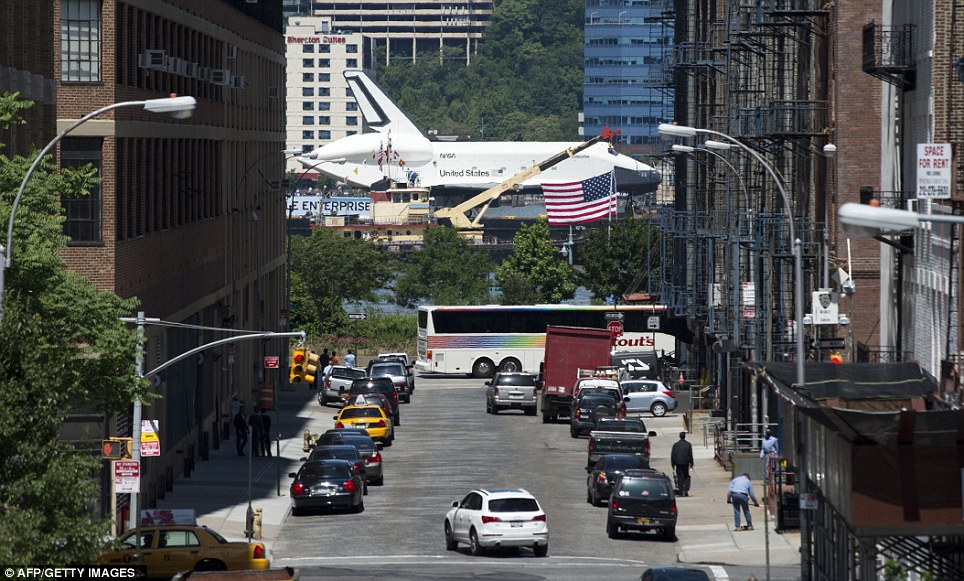
Enterprise had to be transported from JFK Airport by barge.


article-2155446-137B46F8000005DC-374_964x581.jpg
 
Last edited:


Disney Vacation Planning. Free. Done for You.
Our Authorized Disney Vacation Planners are here to provide personalized, expert advice, answer every question, and uncover the best discounts. Let Dreams Unlimited Travel take care of all the details, so you can sit back, relax, and enjoy a stress-free vacation.
Start Your Disney Vacation
Disney EarMarked Producer


DIS Facebook DIS youtube DIS Instagram DIS Pinterest DIS Tiktok DIS Twitter

Back
Top Bottom