Yay! My 300th post!
Mirror lock-up is important when you're using relatively slower shutter speeds, like between 1/60 - 1/2 second, but I believe that even slower shutter speeds can benefit from mirror lock-up. So even that 30-second exposure can benefit from mirror lock-up, although I think the benefit might be a little less.
When you press the shutter button, there's a mirror inside your dSLR that needs to move up before the camera takes the picture. This mirror movement can cause tiny vibrations in the camera that will affect the sharpness of your photo, especially if you're using slower shutter speeds and/or if you're using a less-sturdy tripod. A less-than-sturdy tripod can actually make those vibrations worse!

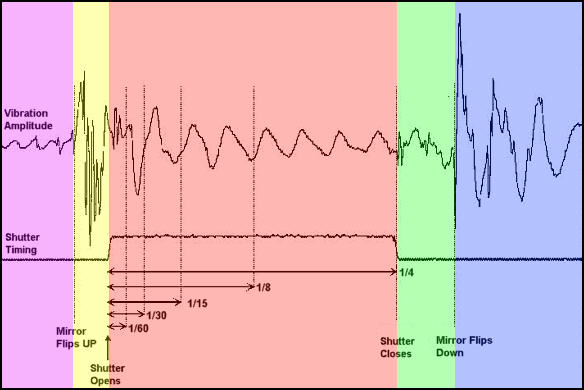
Here's a graphic from BobAtkins.com that shows the duration of the vibrations when the mirror goes up. It takes a little time to understand this graph, but it's well worth it.
The yellow area is where the mirror goes up, and the red area is where the camera is taking a 1/4-second exposure.
The graph shows that there's very minimal vibration in the first 1/60 second. However, there's a whole lot of vibration going on between 1/60 and 1/4 seconds.
When you use mirror lock-up, (1) the mirror goes up first and stays up, (2) the camera pauses to let the vibrations settle down while the mirror is still in the up position, and then (3) you hit the
remote shutter again to take the photo
without vibrations. After that, the mirror comes back down, and any vibrations from the mirror coming down will not affect the exposure cuz the exposure is already finished.
So, the mirror lock-up feature is very useful for taking sharper photos using slower shutter speeds and a tripod, such as low-light photography and macro photography. Also, be sure to use a remote shutter, too.
Oh, it's also useful for cleaning your sensor using your tongue, too.

For more information about mirror lock-up:







 the delay is still right around a second with both the shutter release button or a wireless remote.. My vibrating hands make no difference (that I can tell) as far as the delay time goes. I did the laser pointer test from around 15ft away against a white-ish wall and at first glance, there really wasn't much of a difference if I had Exposure Delay on or off. However, when I zoomed in as much as I could on each picture and compared the two, I did see a difference in the reflection of the laser. The ED does seem to make for a better shot. I have so much going on this week but I'm hoping to take some close ups with the 55-200 for comparison and I'll post the results later on.