ND Filters

DPK400

Can't get enough School
Joined
Jun 8, 2011
Messages
96
I shoot mainly sports so I haven't needed a neutral density filter before. (Well I've needed one, just not for sports...) I'm headed to the most magical place on earth and would like to pick one up for some fireworks and HDR shots I've got planned. I've been doing research on various forums and talking with colleagues and I am trying to gauge the effectiveness of the Fader ND filters. In theory, they seem to work quite well and very convenient since there is a great deal of light control in a single filter. However, I am reading conflicting reviews on their use with UWA lenses.

Does anyone have any brand of fader ND in use with your UWA lenses? Have you experienced any issues?

Thanks in advance for your help!
 
I don't know about those, but I am not sure that you would need a ND filter for those situations. For fireworks where you want to get a really long exposure, you can make the aperture really small to get a long exposure and you can also use bulb mode and then cover the lens with something black while you do not want it exposing (i.e. in between explosions). I have heard of people taking multiple minutes of exposure in one shot without overexposing it using this method. Then for HDR, I cannot really think of a need for one either since most HDR shots call for a large DOF meaning you would not be using a wide open aperture and should be able to control everything you need with the shutter speed.

I am not trying to discourage you using a ND filter. I just want to make sure that you are not spending money on something you might not need.
 
I don't know about those, but I am not sure that you would need a ND filter for those situations. For fireworks where you want to get a really long exposure, you can make the aperture really small to get a long exposure and you can also use bulb mode and then cover the lens with something black while you do not want it exposing (i.e. in between explosions). I have heard of people taking multiple minutes of exposure in one shot without overexposing it using this method. Then for HDR, I cannot really think of a need for one either since most HDR shots call for a large DOF meaning you would not be using a wide open aperture and should be able to control everything you need with the shutter speed.

I am not trying to discourage you using a ND filter. I just want to make sure that you are not spending money on something you might not need.

Yeah, the ND would be mostly for the fireworks and any shots that I would need to slow down the shutter. I'm just torn between having to buy 4 or 5 ND filters or buying the variable one. In particular, I've read differing reviews on their effectiveness with UWA lenses.
 
If you are worried about the wide angles, have you considered the Cokin system? I have it for a ND, graduated ND, and a fun red/blue polarizing one. It is really nice for the graduated one, but it would definitely help with wide angle problems.
 

If you are worried about the wide angles, have you considered the Cokin system? I have it for a ND, graduated ND, and a fun red/blue polarizing one. It is really nice for the graduated one, but it would definitely help with wide angle problems.

I'm mostly worried about excessive vignette with the thick filter in place. The Cokin system is nice, but cumbersome for my needs. I don't shoot landscapes all that often and wouldn't get used most of the year except for special occasions.

Since I'm headed down to Disney, I am looking to enhance my existing gear with some degree of landscape gear (some lightweight carbon travel tripod legs, filter, and possibly a new lens). I fully plan on taking all the so-called cliche shots. :)
 
Let me ask this. Since the fireworks are the main reason for it, how wide do you plan on shooting them? You have to be really close for a true wide angle to come into play. I would think that you would need to be at least as close as the statue. I think Gdad on here did a fisheye shot from that location that turned out well. I am also pretty sure that he was able to de-fish it from there without losing anything important, so it was wider than needed. So, if you plan on being a little farther back then you might be out of the wide angle focal lengths anyway.
 
For fireworks where you want to get a really long exposure, you can make the aperture really small to get a long exposure and you can also use bulb mode and then cover the lens with something black while you do not want it exposing (i.e. in between explosions).
That will work for parts of the show, but if you want to capture the grand finale of Wishes or IllumiNations, an ND filter is the way to go. I've tried shooting ~20 second exposures with my smallest apertures and lowest ISO (even going to lower than my rated base ISO of 200), and I still get a blown-out, unusable mess. An ND filter -- specifically a variable one -- allows me to shoot for up to a minute and a half at base ISO and f/11 - f/16.

Scott
 
That will work for parts of the show, but if you want to capture the grand finale of Wishes or IllumiNations, an ND filter is the way to go. I've tried shooting ~20 second exposures with my smallest apertures and lowest ISO (even going to lower than my rated base ISO of 200), and I still get a blow-out, unusable mess. An ND filter -- specifically a variable one -- allows me to shoot for up to a minute and a half at base ISO and f/11 - f/16.

Scott

This is good to know. Which Variable ND do you have?
 
This is good to know. Which Variable ND do you have?
I don't recall exactly which I have. I got it on eBay for around $100, so it isn't one of the really high-end ones. However, I'm pleased with what I've got from it so far. I bought it mostly for fireworks shots, although I can envision other uses. I think it can be adjusted to block between two and eight stops of light. You won't want to take it to the extreme dark end; there are strange cross-shaped artifacts at the darkest setting. I believe that is something that happens with the high-end, high-dollar versions as well.

You also probably won't find it all that useful for HDR, unless you intend to go to a full manual process and shoot on "bulb." Most (all?) DSLRs (do we really need that "D" anymore? We didn't call the film versions FSLRs ... but I digress) have a maximum timed shutter speed of 30 seconds. Especially if you shoot HDR at night, as I do, you'll find that you may have to increase ISO to get your longest exposure down to 30 seconds. Of course, I bracket nine exposures, one stop apart, in most cases. I usually only process five of those (-4,-2, 0, +2, +4). But I do that without the ND filter, at base ISO and usually at apertures around f/8 or f/11. At night, sometimes only a higher ISO -- or the bulb setting -- will let me get the longer exposures I need. I've shot for HDR as high as ISO 1600, but noise can become an issue at such settings. I always go for the base ISO if at ll possible. I have heard of people who increase ISO only for the exposures that would otherwise exceed 30 seconds, but I haven't tried that myself.

One more thing -- if you do decide to get a variable ND, get one that will fit your largest lens in terms of filter diameter. You can get step-down rings to make it fit your smaller lenses. Much less expensive than buying a different filter for every size lens!

Scott
 
I don't recall exactly which I have. I got it on eBay for around $100, so it isn't one of the really high-end ones. However, I'm pleased with what I've got from it so far. I bought it mostly for fireworks shots, although I can envision other uses. I think it can be adjusted to block between two and eight stops of light. You won't want to take it to the extreme dark end; there are strange cross-shaped artifacts at the darkest setting. I believe that is something that happens with the high-end, high-dollar versions as well.

You also probably won't find it all that useful for HDR, unless you intend to go to a full manual process and shoot on "bulb." Most (all?) DSLRs (do we really need that "D" anymore? We didn't call the film versions FSLRs ... but I digress) have a maximum timed shutter speed of 30 seconds. Especially if you shoot HDR at night, as I do, you'll find that you may have to increase ISO to get your longest exposure down to 30 seconds. Of course, I bracket nine exposures, one stop apart, in most cases. I usually only process five of those (-4,-2, 0, +2, +4). But I do that without the ND filter, at base ISO and usually at apertures around f/8 or f/11. At night, sometimes only a higher ISO -- or the bulb setting -- will let me get the longer exposures I need. I've shot for HDR as high as ISO 1600, but noise can become an issue at such settings. I always go for the base ISO if at ll possible. I have heard of people who increase ISO only for the exposures that would otherwise exceed 30 seconds, but I haven't tried that myself.

One more thing -- if you do decide to get a variable ND, get one that will fit your largest lens in terms of filter diameter. You can get step-down rings to make it fit your smaller lenses. Much less expensive than buying a different filter for every size lens!

Scott

Higher should ISOs "reduce" the amount of time the shutter needs to remain open? If you increase the ISO, the sensor becomes more sensitive to light and thus increases the shutter speed rather than decreasing it.

The use I can see for the ND and HDR would be outdoor, full sun HDRs where I needed a very slow shutter speed (i.e. water flowing or waterfalls.)
 
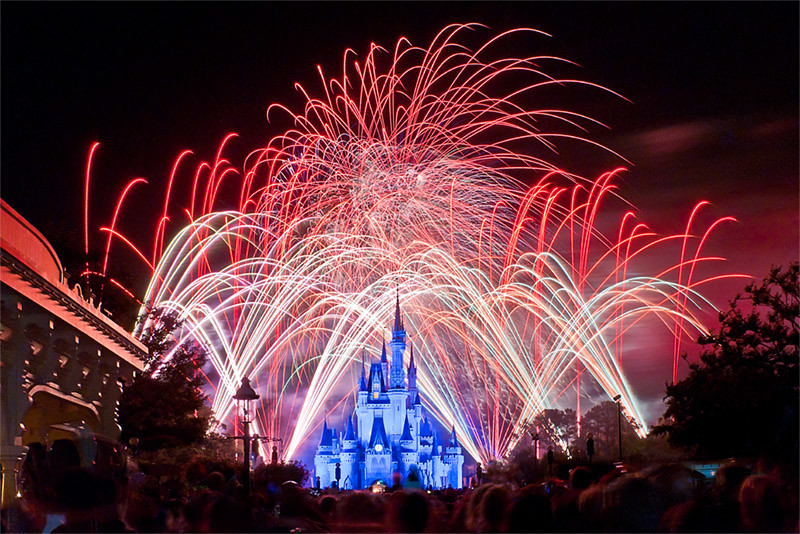
Here's one of my best shots from my first attempt at using the variable ND for Wishes (if I do say so myself).


Wishes April 2 2011 Flickr by Scott S. Baxter, on Flickr

I had the filter set to as dark as I could get without the artifacts showing up. This is a 70-second exposure at ISO 200 and f/11, shot with my Sigma 10-20 at 20 mm. I used the UWA because it can be hard to judge just how high the fireworks are going to go in the frame until after the show begins, but as it turned out I could have used my 18-135. I was standing maybe 20 feet back up Main Street from Casey's Corner when I shot this. Hope to get a little closer next time!

Scott
 
Higher should ISOs "reduce" the amount of time the shutter needs to remain open? If you increase the ISO, the sensor becomes more sensitive to light and thus increases the shutter speed rather than decreasing it.
Yes -- at a base ISO of 200, a straight nine-exposure bracket can sometimes give you a +2, +3, and +4 that are all 30 seconds. The camera knows you need more time to truly get the over-exposures you seek, but it can't give it to you on any mode other than manual. In those cases, I think it may be better to raise the ISO rather than go to full manual (unless that's the way you prefer to work anyway). Really long exposures have their own noise problems. Better and more manageable to deal with higher ISO, at least up to a point.

I also recommend turning off long-exposure noise reduction. With the long exposures used with an ND filter for Wishes, you'll miss half the shots you might take. Better to deal with noise in post-production, in my opinion. I also turn it off for HDR for the same reasons; at night, shooting can just become interminable. YMMV.

Scott
 
I have purchased a Variable ND from Genus (http://www.bhphotovideo.com/c/product/676824-REG/Genus_GL_GNDF_77_77mm_ND_Neutral_Density.html) and tried shooting it with my 11-16mm Tokina lens this last week. That lens has a 77mm thread for filters. The Variable ND that I have has basically two filters stacked on to each other and they are allowed to twist causing the mutliple adjustments. The good thing about the one that I have is that even though the base is 77mm to attach to the camera the second ring is bumped up to 82mm (i think - I know that it is bigger because my lens cap does not fit on the outside. This is a small set back but I usually don't use my lens cap that much) This bump up in diameter allows angle of view to increase and not cause as much vignetting. I have taken some shots and did not notice that much. There was a slight bit of the corners that got caught by the filter but it was not really a vignette issue but rather just the filter getting in the view. This was only a small section of the corner and not annoying at all, it was easialy cropped out. One thing that noticed though is that there are markings on the filter to incidate the max and min areas of the Variable part. You don't want to go outside those areas. If you try to stretch the darkness just a litte more then you get a weird cross look to the shot. I guess they put those marks on for a reason. :-). So far I have really liked using it. I got to shoot some mid-day shots of the fountain at EPCOT to get that nice soft water look and it turned out okay. I did try to push the max just a little and thought I got away with it but ended up with that cross patturn in the shots. This was my fault more than the filters so I guess I am not upset. I just thought I could get away with another 1/2 stop and paid the price. All in All I like this filter for the UWA lens and have not had any issues yet. (at least ones that are the filters fault). Hope this helps because I know I was worried when I bought this for the exact same reasons. Happy Shooting.
 
I have purchased a Variable ND from Genus (http://www.bhphotovideo.com/c/product/676824-REG/Genus_GL_GNDF_77_77mm_ND_Neutral_Density.html) and tried shooting it with my 11-16mm Tokina lens this last week. That lens has a 77mm thread for filters. The Variable ND that I have has basically two filters stacked on to each other and they are allowed to twist causing the mutliple adjustments. The good thing about the one that I have is that even though the base is 77mm to attach to the camera the second ring is bumped up to 82mm (i think - I know that it is bigger because my lens cap does not fit on the outside. This is a small set back but I usually don't use my lens cap that much) This bump up in diameter allows angle of view to increase and not cause as much vignetting. I have taken some shots and did not notice that much. There was a slight bit of the corners that got caught by the filter but it was not really a vignette issue but rather just the filter getting in the view. This was only a small section of the corner and not annoying at all, it was easialy cropped out. One thing that noticed though is that there are markings on the filter to incidate the max and min areas of the Variable part. You don't want to go outside those areas. If you try to stretch the darkness just a litte more then you get a weird cross look to the shot. I guess they put those marks on for a reason. :-). So far I have really liked using it. I got to shoot some mid-day shots of the fountain at EPCOT to get that nice soft water look and it turned out okay. I did try to push the max just a little and thought I got away with it but ended up with that cross patturn in the shots. This was my fault more than the filters so I guess I am not upset. I just thought I could get away with another 1/2 stop and paid the price. All in All I like this filter for the UWA lens and have not had any issues yet. (at least ones that are the filters fault). Hope this helps because I know I was worried when I bought this for the exact same reasons. Happy Shooting.


I have the Tokina as well. Right now, I've got a super thin UV filter on it for protection. The downside of the thin filter is that it doesn't have threads on it for the ND. So I will have to take it off to use it.

Did you shoot through the range of the lens with the Variable ND on? I can see some relatively significant vignette with just the UV on at 11mm.

I'm glad you posted. Having someone with the same lens makes it much easier to decide! I think I will either pick up the 2-8 stop filter or both the 2-8 stop filter and the 9-12 stop filter. Though realistically, I will probably just get the former since I won't use it on a weekly basis.

Great info, thanks for the post!
 
I wanted to show you first hand some shots with the Tokina and the variable ND. The first shot is an un-cropped photo of the area. This is taken at full 11mm as wide as it goes. As you can see it has very minor vignetting. A little crop and it would be fine. Just take the shot knowing this and it would be okay. I also posted the same shot to show the "weird" banding you can get from this filter. I would not worry about this as a norm though. It was completely my fault as I was trying to get a little less light and turned the filter beyond the recommended max setting. I tried to fix this in post in the first shot but it still causes some small banding in the sky. It was a good learning experience and I am still happy with the filter. I just need a little more time with it. I was kind of in a rush with using this as I was taking shots while the rest of the family was having ice cream. Missed out on that too. Oh what we go through to try and get the shot.

GmuG81


10f2gV
 
Not sure why I cannot get the pictures to show. Here are the direct links.

http://flickr.com/gp/photogineer/10j400

http://flickr.com/gp/photogineer/10f2gV

So this is at ND8 and you were still only able to stop down to 1/2 second at f22? Must have been a super bright day! Makes me wonder if I need the 9-12 stop one as well. I'd like to try my hand at some water and waterfall shots in the meantime and I may only have a chance during the day. Hmmm, this is making me think. Thanks so much for the examples. The first shot looks a little like there is some minor exposure differences across the photo from the smaller image but it's harder to see the larger the image it seems. Do you notice it or am I just seeing things?
 
Yea it was a very bright day. So I could only pull off a 1/2 sec even at f22. You are not seeing things. There is some variable exposures on the "good" shot again not the filter's fault. I just pushed it to much and got that banding. I tried to fix it in post but it still shows up.


Disney Vacation Planning. Free. Done for You.
Our Authorized Disney Vacation Planners are here to provide personalized, expert advice, answer every question, and uncover the best discounts. Let Dreams Unlimited Travel take care of all the details, so you can sit back, relax, and enjoy a stress-free vacation.
Start Your Disney Vacation
Disney EarMarked Producer

New Posts


DIS Facebook DIS youtube DIS Instagram DIS Pinterest DIS Tiktok DIS Twitter

Add as a preferred source on Google

Back
Top Bottom