photo_chick
Knows a little about a lot of things, a lot about
- Joined
- Mar 1, 2007
- Messages
- 5,123
That last one... was it really that bright or did the camera choose to increse the exposure to make the image brighter than what was actually there?
No... It wasn't bright at all. It was a very dark corner. The camera jacked up the iso ridiculously high. Obviously, a very noisy image. But I don't know if most cameras would have gotten any image. My dslr's iso doesn't go that high. Without a tripod to allow a long shutter, I doubt I would have gotten anything with the dslr.
See, this is where the camera not being able to think makes a huge difference and it really drives home my point. The camera chose to overexpose the image rather than capture what is actually there because it doesn't know any better. If you want to capture POTC you want to get a shot of what it really looks like on the ride, not what it looks like when the work lights are on.
Havoc, can you post the EXIF data for the photos?
Yes and no. In this case -- all that I could see with my naked eye, was pitch blackness with a little blur from the clock. So it is just an example of extreme low light --- what the camera can pick up, where the human eye sees almost nothing. It was so dark, I couldn't see the controls of the camera.
The first 2 pictures are more realistic representations of low light, capturing the feel of the real lighting.
The 3rd picture is simply a practically no-light situation. It's a lousy picture. Horrible noise. Not composed in any way (it was too dark to compose anything, all I could do was aim at the clock and shoot). The picture was merely taken to test the extreme limits of the camera.
I'll post them this weekend, I did identical shots with my slr, using automatic and manual settings to the best of my ability. The stark differences are amazing.
I think you're missing my point.
My 50D with a fast prime will pick up more than my eyes can see as well. It is impressive to see that kind of ISO range in a point and shoot.
Havoc, can you post the EXIF data for the photos?
You're right, I am missing your point. I never questioned whether a top of the line interchangeable lens system, in the hands of an expert, could produce better results.
This is not what I'm saying either. At all. As far as the rest of that post... still missing my point. But I hope by now the OP gets what we've been saying.

But this particular camera we have been discussing, on generally automated settings, will perform well in the low light situations that the OP was requesting. And will indeed capture images that were not previously possible for amateurs without specialized photographic knowledge.
I am looking for the camera with the best low light pictures. We are attending MVMCP this year and nighttime parade & fireworks pictures are a must. I also take a lot of pictures indoors. I would like a camera that could get some decent dark ride photos with no flash. My kids are young & never sit still so I would like a camera where I can get action shots!
Hope it's ok that I jump into this very lively discussion of the Sony RX100 and point-and-shoot cameras in general.
I think it's clear that the RX100 is perhaps the best point-and-shoot camera that has come around in the market. And sounds like it can take great pictures most of the time on Auto.
But I wanted to comment on 1 thing and bring it back to the OP's request:
I looked back at what the OP was actually requesting. This has already been quoted several times in this thread...
I looked back at the EXIF data of the low-light photos that havoc315 posted. In those 3 photos, the camera chose shutter speeds of 1/13 to 1/6 sec!!! Certainly, if you had a tripod, those shutter speeds wouldn't matter.
But for dark-ride photos with no flash and for young kids running around, those shutter speeds are WAY TOO SLOW! Those slow shutter speeds will not only cause motion blur, but also blurring from camera shake (hand-holding the camera at slow shutter speeds).
Because of the tremendous low-light challenges for dark-ride photos and for young kids running indoors, I think these are situations that NO point-and-shoot camera can do very well. Why not? Let's go back to basics and look at the exposure triangle. These are the 3 things that make each and every photograph: aperture, shutter speed, and ISO.
For these low-light situations, you need a large aperture (small f-number) so that more light gets into the camera. For the Sony RX100, if you use the widest angle (ie. don't zoom in the lens), then you get a respectably large aperture of f/1.8 - this will get lots of light into the camera. However, if you decide to use the zoom, the aperture becomes lots smaller, eventually down to f/4.9. If you do the math, that's 7.4x LESS LIGHT that goes into the camera!
For action photos, you need medium to fast shutter speeds. In the case of low-light action photos, you need shutter speeds that are slow enough to let enough light into the camera, but fast enough to prevent motion blur and blur from hand-holding the camera. For dark rides and for indoor running kids, the SLOWEST shutter speed I'd consider is maybe 1/40 to 1/60 sec. If I can get away with shutter speeds of 1/100 - 1/125 in low-light situations without pictures being too dark, then that's what I'd personally start with.
Again, the sample pictures you took with the Sony RX100 look great, but have slow shutter speeds of 1/6 - 1/13 sec. These shutter speeds are WAY too slow for even "It's a Small World", where the lighting is better than most other dark rides.
Finally, for low-light photos, you'd need high ISO so that the camera sensor is more sensitive to light. Sounds like the Sony RX100 can go up to ISO 25,600. And with super-high ISOs, you run the risk of introducing lots of "noise" into the photo.
While the Sony RX100 sounds like the best point-and-shoot camera on the market right now (with a price tag of $648 to match it), I still don't think it meets the OP's needs for good dark-ride photos and good "kids running around indoors" photos, especially on AUTO. I don't think ANY point-and-shoot camera can meet those requirements.
Those pictures look really great to me. My only hesitation with the Sony RX100 is the cost. I guess my question is, if high quality pictures are mostly due to the photographer if I learn more can I get a less expensive camera and still get quality shots?
This can't be understated.See, this is where the camera not being able to think makes a huge difference and it really drives home my point. The camera chose to overexpose the image rather than capture what is actually there because it doesn't know any better. If you want to capture POTC you want to get a shot of what it really looks like on the ride, not what it looks like when the work lights are on.
First of all I want to thank everyone for sharing their knowledge and expertise.
Phew! I have to say that a lot of this is way over my head! I definitely have a lot to learn about photography. But I am certainly willing!
Those pictures look really great to me. My only hesitation with the Sony RX100 is the cost. I guess my question is, if high quality pictures are mostly due to the photographer if I learn more can I get a less expensive camera and still get quality shots? Based on hakepb's TR I am leaning toward the Sony GX 30v because the pics are great and the camera is considerably less costly.
I am definitely willing to learn as much as I can to improve my shots! Any suggestions on ways to learn more is greatly appreciated!
And again thanks to all for the comments and information!
I am now lusting after a Sony RX-100 as a nice pocketable camera for the times I don't feel like lugging the D700 around. Would have come in handy at Hershey Park last week when I left the DSLR home...This can't be understated.
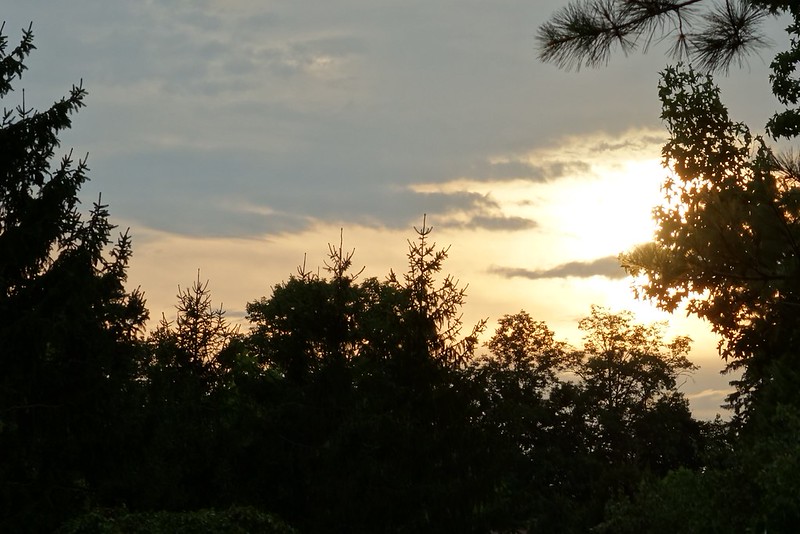
Could one be sacrificing richness for brightness when allowing the camera to make decisions for you?
Lets take the chair/window shot at sunset.
Yes, nice and very bright. But was that really what your eyes saw? Sunset = rich colors. I dont see any real colors there. Is what you want a bright image or is what you want a rich, colorful image? If you keep a camera on Auto and this is what it gives you, is this really the ideal?
This, to me, is sunset, in all its beautiful glory. Also taken with a point and shoot.
![]()
Now perhaps you really didn't have an orange glow in your living room when you took the shot. I get that not all sunsets are like that. But I'm illustrating a point that's an important one for users on Auto. Going back to photo_chicks post, is it preferable to get pics at WDW that are bright, or that capture the essence of the atmosphere? That is up to each individual photographer.