Just Upgraded, Looking for Advice

cosine4

Mouseketeer
Joined
May 17, 2006
Messages
259
I just upgraded from my Sony H9 to a Nikon D5000 :) and have a few questions.

1. Is there a good website for Nikon tutorials? I know how to do most of the basics just looking for something to get me to the next level.

2. Before our next Disney trip I would like to get a wide angle lens but don't want to drop $400 on the Sigma 30mm just yet. Is there a decent wide angle lens for under $200?

3. Do the "wide angle converters" or "zoom converters" work well? These are the lenses that attach to your normal lens. Some of them are pretty cheap so I wouldn't be out much if it didn't work well, but that also tells me that they might not work well.

4. Is there a good reference to learn some of the ins and outs of the DSLR world? For example I have an 18-55mm f/3.5 - f/5.6 and a 55-200mm f/4-5.6G but don't really know what the numbers mean (I have a basic understanding but want more). I am an MS in Mechanical Engineering so the more technical the better :)

5. What accessories do you recommend before a big trip (Disney and a cruise)? I have a Lowpro bag and the two lenses mentioned. I plan to get a remote trigger, lightweight tripod or gorilla pod (or just lug my heavy one), and a wide angle lens. I want to get a speed light but want to wait until I can get a nice one, will I be disappointed with out one? Right now I am using the strap that came with it, and may be interested in something more comfortable. I have fibromyalgia so comfort is important, any recommendations?

I would post some pics but I don't have anything other than 400 pics of random things in my house and the kids in their PJs playing Wii :lmao:
 
As far a reference book I would (like many others) recommend Bryan Peterson's 'Understanding Exposure'. It's an easy read and full of good information. As far as a lightweight tripod, I received for Christmas a Cullman Magic 2. It folds flat and is 5" x 13" and weighs (according to my bathroom scale) 3.2 lbs. It has a ballhead and converts to a monopod. While it isn't an everyday tripod, for travel it is very, very good. Before my next (June, 2010) WDW trip, I will also be purchasing a gorillapod, because both myself and DW will be shooting (we both have Pentax K10d's). As far as a strap, I would recommend the Black Rapid Strap. They have four models to fit your needs. I'm not a Nikon shooter, so I will leave that up to our Nikon experts.
 
Welcome to the Nikon family. :)

You already have 18mm on your kit lens, so I'm not sure the Sigma 30mm makes sense for you. (Unless you want it for the wider aperture--just know that it will NOT give you a wider angle of view than what you have now). If you want something wider than 18mm, you'll need a Tokina 11-16 or Sigma 10-24 or similar. (All over $400.)

I would, however, suggest a faster lens. There is a Nikon 35mm 1.8 lens for around $200 that will autofocus on your D5000, or there is a 50mm 1.8 lens for around $125 that will NOT autofocus on the D5000. Again, these won't give you a wider angle of view than what you already have, but they're great for low-light and for shallow-depth-of-field.

On our September trip I brought an 18-105mm lens and the 35mm 1.8, plus a cheap tripod and remote shutter release. (And plenty of memory, spare battery and charger, and bag, of course.) That was a nice, lightweight kit and covered my Disney shooting needs pretty well. The only thing I really missed was more "reach" on the safari, but you'll have longer reach with your 200mm lens.

I also second the recommendation of Understanding Exposure by Bryan Peterson. For a beginner, that $20 book will help your photography much more than any lens. :)
 
.
I just upgraded from my Sony H9 to a Nikon D5000 :) and have a few questions.

1. Is there a good website for Nikon tutorials? I know how to do most of the basics just looking for something to get me to the next level.

http://www.nikondigitutor.com/index_eng.html
www.youtube.com


2. Before our next Disney trip I would like to get a wide angle lens but don't want to drop $400 on the Sigma 30mm just yet. Is there a decent wide angle lens for under $200?

Nikon 35mm 1.8 $199

3. Do the "wide angle converters" or "zoom converters" work well? These are the lenses that attach to your normal lens. Some of them are pretty cheap so I wouldn't be out much if it didn't work well, but that also tells me that they might not work well.

Not sure. I have thoughts but I don't want to give out bad information. Hopefully someone will chime in on that one.


4. Is there a good reference to learn some of the ins and outs of the DSLR world? For example I have an 18-55mm f/3.5 - f/5.6 and a 55-200mm f/4-5.6G but don't really know what the numbers mean (I have a basic understanding but want more). I am an MS in Mechanical Engineering so the more technical the better :)

I'm still learning :surfweb:

5. What accessories do you recommend before a big trip (Disney and a cruise)? I have a Lowpro bag and the two lenses mentioned. I plan to get a remote trigger, lightweight tripod or gorilla pod (or just lug my heavy one), and a wide angle lens. I want to get a speed light but want to wait until I can get a nice one, will I be disappointed with out one? Right now I am using the strap that came with it, and may be interested in something more comfortable. I have fibromyalgia so comfort is important, any recommendations?

The Black Rapid strap is supposed to be really nice. I used the strap it came with for 6 days at the parks this month without a problem. Keep in mind when I was there it was COLD so I had a hooded sweatshirt on among other layers of clothing. I had the strap going on the outside of my hood. I don't think I'd want several days of that rubbing on my neck.

I would post some pics but I don't have anything other than 400 pics of random things in my house and the kids in their PJs playing Wii :lmao:
 

Just read NLD's post about the wider lens. I need to start drinking coffee BEFORE I open up my laptop. Friends don't let friends type uncaffeinated.

I wish I had some friends...... :surfweb:
 
Is there a good reference to learn some of the ins and outs of the DSLR world? For example I have an 18-55mm f/3.5 - f/5.6 and a 55-200mm f/4-5.6G but don't really know what the numbers mean (I have a basic understanding but want more). I am an MS in Mechanical Engineering so the more technical the better :)

The numbers you mention refer to the focal length and aperture for your lens. Because you're an engineer, I'm sure you're craving a lot of numbers and math, so I'll try to keep this as technical as possible. However, keep in mind that if you ask around, a great majority of photographers will not know or even care to know the math details of focal length and aperture.

Aperture
The f-numbers refer to the aperture of your lens. Smaller f-numbers give you larger apertures. Conversely, larger f-numbers give you smaller apertures.

When your lens gives you a range of apertures (ex. f/3.5 - f/5.6), it means that it's a variable-aperture lens. The first aperture (f/3.5) is the maximum aperture you can have at the widest end of the zoom. The second aperture (f/5.6) is the maximum aperture you can have at the longest end of the zoom. So at 55mm, you can't get a larger aperture than f/5.6. Anywhere in between 18mm and 55mm, you'll get some other maximum aperture between f/3.5 and f/5.6.

There are lenses that keep the same maximum aperture throughout the entire range of focal lengths. These are "constant aperture zoom" lenses. Examples of these lenses include: 17-55mm f/2.8, 70-200mm f/2.8, or 200-400mm f/4. These "constant aperture zoom" lenses usually cost a lot more than variable aperture zoom lenses.

Traditionally, f-numbers (or f-stops) were listed as:

f/1.4 - f/2 - f/2.8 - f/4 - f/5.6 - f/8 - f/11 - f/16 - f/22 - etc​

With each f-stop, you double or halve the amount of light coming into the camera. So f/2.8 will let in double the amount of light compared to f/4. As another example, f/5.6 will let in a quarter of the light compared to f/2.8. As an engineer, you'll probably notice that the f-stops are all in a sequence of powers of √2 (the square root of 2).

Here's a diagram from Wikipedia that illustrates the aperture sizes and their corresponding f-numbers:

500px-Aperture_diagram.svg.png

Nowadays, camera manufacturers give you the ability to change the aperture in 1/3-stops. That's why you see additional aperture numbers, such as f/4 - f/4.5 - f/5 - f/5.6, etc.

As an engineer, you MUST be asking yourself, "Where does this f-number come from?!?!?!" Here's the equation, according to Wikipedia:

d3dde849cf30fe0eed0a8cd345fbd3fa.png

where N is the f-number, f is the focal length, and D is the diameter of the entrance pupil (which is closely related to the diameter of the actual aperture itself, but not quite).

This equation also helps to explain why lenses with the same f-number seem to get larger and larger as you go up in focal length. For example, compare the 50mm f/1.8 lens to the 200mm f/2 lens. They both have approximately the same aperture. But the 200mm lens is sooooo much more humongous compared to the 50mm lens! The above equation tells us that to achieve the same aperture, the 200mm lens requires a much larger diameter.


Canon-EF-50mm-f-1.8-II-Lens.jpg
Canon-EF-200mm-f-2-L-IS-USM-Lens-b.jpg


Can you say "lens envy"?

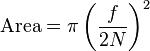
Since the above equation gives you the diameter, you can undoubtedly calculate the area of the aperture (A = π * r^2)! The area of the aperture (opening) is given by the following formula:

adcd8400b9cff8f5ae4ff1cac2074b07.png

where f is the focal length and N is the f-number. As an engineer, you're probably good with ratios, so you'll understand what I'm trying to describe next. For a given focal length (ie. keeping focal length constant), if you go up to the next larger f-number (N), the area of the aperture will be cut in half. So if you go from f/2.8 to f/4, the area of the aperture will be cut in half.

Conversely, if go to the next smaller f-number, you'll get double the area of the aperture. So if you go from f/2.8 to f/2, the area of the aperture will double.

Mathematically, this explains why going up / down each f-stop lets you halve / double the amount of light into your camera.

Here are the links to the Wikipedia articles that describes the math in great detail: http://en.wikipedia.org/wiki/F-number and http://en.wikipedia.org/wiki/Aperture


Focal length:
The numbers 18-55mm on your lens refer to the focal length. In your case, you've got a zoom lens, which means that you can change your focal length from 18mm to 55mm and anything in between.

There are certain lenses that have a fixed focal length, and these are called "prime lenses." If you've been lurking on this message board, you've undoubtedly seen several prime lenses being recommended here, such as the 30mm f/1.4 lens, the 50mm f/1.4 lens, the 50mm f/1.8 lens, etc. Because they have fixed focal lengths, you cannot do any zooming on "prime lenses." Oftentimes, people jokingly say that these lenses make you "zoom with your feet", meaning that you have to get physically closer or farther to your subject to achieve a "zoom" effect.

The smaller focal length number indicates a wider angle of view, or a wide-angle view. A larger focal length number indicates a narrower angle of view, sometimes considered "telephoto."

Here's an image I stole from the Internet that shows the angles of view for different focal lengths:

14209_46_1.jpg

In general, focal lengths:
  • less than 35mm are considered "wide angle"
  • greater than about 70 or 80mm are considered "telephoto"
  • between 35 to about 70-80mm are considered "normal"

Of course, your inner geek is probably STILL unsatisfied, "Where does the focal length number come from?!?!?!" By definition, the focal length is the distance from the lens to the film / sensor when focusing on an object at a distance of infinity.

Here's the diagram and the equation (from http://www.paragon-press.com/lens/lenchart.htm):


tree.gif


formula.gif


As you can see from the above equation, as the object distance approaches infinity, the "1/Obj" fraction essentially becomes 0. In this case, the focal length = the image distance.

What happens if you focus on something closer than a distance of infinity? Remember that we keep "1/focal length" the same. According to the equation, "Obj" gets smaller, which makes the "1/Obj" fraction get larger. This means that the "1/Image" fraction must get smaller, making "Image" a larger number. So ultimately, this equation shows that the "image distance" (ie. the distance from lens to film) gets longer as you focus on something nearby.

You may have noticed this on your lens. As you turn the focus ring, you can actually see some of the glass move up or down the barrel of the lens.


Hopefully, my explanation of aperture and focal length was as riveting as your mechanical engineering textbooks. Try bringing up these equations at your next photography club meeting, and you'll definitely be the life of the party! :)
 
3. Do the "wide angle converters" or "zoom converters" work well? These are the lenses that attach to your normal lens. Some of them are pretty cheap so I wouldn't be out much if it didn't work well, but that also tells me that they might not work well.

5. What accessories do you recommend before a big trip (Disney and a cruise)? I have a Lowpro bag and the two lenses mentioned. I plan to get a remote trigger, lightweight tripod or gorilla pod (or just lug my heavy one), and a wide angle lens. I want to get a speed light but want to wait until I can get a nice one, will I be disappointed with out one? Right now I am using the strap that came with it, and may be interested in something more comfortable. I have fibromyalgia so comfort is important, any recommendations?

3. A complete waste of your money. Those have no business being on a DSLR and it is horrible that they are even marketed that way. They simply do not have the resolving power to get a decent shot on a DSLR. They are questionable for a p&s as it is. They were originally designed for camcorders which have extremely low resolutions compared to a camera.

5. A lens cleaning pen, a Giottos rocket blower for sensor cleaning and other dust removal, and a circular polarizer filter. I do not believe that an external flash is a must, but they are handy for character shots. If you get one, I recommend a Gary Fong diffuser to go with it.
 
Not to be a downer, but you may want to bring your P&S that you are comfortable with just in case. The learning curve is huge if it's your first time using a DSLR. I remember after my first trip with DSLR my husband kept asking me why my photos with the P&S were coming out better! (And I had years of exerience with an SLR using film, but still had no clue!) That was a bummer. Now my photos with DSLR are much better but I still get some winniers and some real losers since I'm still learning myself :rolleyes1 like when I forget to adjust ISO after coming off a dark ride into bright sunlight, etc.
Seriously, if it's your first trip w/DSLR, the P&S can be priceless to capture the shots you just don't understand how to get yet. I really hate reading people's reports on their trips in which their photos are blurry and they don't know why (in manual focus mode and don't know how to get it to Auto focus mode, etc). That's sucks when that happens and if that's all they have, then they have no back-up options just in case. HTH and I hope you have a great trip!:goodvibes Good luck and have fun with your DSLR.
 
Thanks for all of the replies this is great info!

I am planning to buy the Nikkor 35mm f/1.8 lens sometime before my May trip, just need to convince my wife that I need this TOO! lol

I downloaded the Nikon iPhone app. I actually had it a while back but deleted it to make room for mind numbing games before I had a chance to get into it, I then forgot all about it :)

disneyboy, that is exactly what I was looking for! Now I can visualize what is happening better! :worship:

ukcatfan, I figured that was going to be the case but wanted to get an experienced opinion.

DisneySuiteFreak, both of my kids have a camera that we usually take, one P&S that is pretty good for outdoor shots and a HD Video camera. Also my previous camera (Sony H9) has M - A - S - I - P modes of shooting just like a DSLR that I was very comfortable using. Plus I am planning on taking some photo weekends prior to leaving to get more comfortable with it. If I miss a few shots its not that big of a deal, I have about 8,000 pictures from Disney World from our 4 trips in the past year :earsboy:

Again thanks for all of the great advise!:thanks:
 
disneyboy2003, I just wanted to say that your post was one of the most in depth I've seen about Photography in Geek Speak, and I really appreciate it. I don't think any of the books I've read was as in depth as what you wrote.:thumbsup2


Disney Vacation Planning. Free. Done for You.
Our Authorized Disney Vacation Planners are here to provide personalized, expert advice, answer every question, and uncover the best discounts. Let Dreams Unlimited Travel take care of all the details, so you can sit back, relax, and enjoy a stress-free vacation.
Start Your Disney Vacation
Disney EarMarked Producer


DIS Facebook DIS youtube DIS Instagram DIS Pinterest DIS Tiktok DIS Twitter

Add as a preferred source on Google

Back
Top Bottom