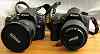
D90 or D7000

My experience with the D7000 thus far has been much more in line with Gdad's (and almost every single review out there thus far) than it has with rossb's. I've noticed gains in high ISO performance and dynamic range. That, plus the litany of added features and controls made it a no-brainer for me.

I've shot them side by side, tripod mounted, with the same lens and I've yet to see a significant difference which favors the D7k. I've tried low light, bright light, with flash, and without flash. I could take two pics, strip the EXIF, size them the same, post them, and I doubt that most people could consistently pick the D7k over the D90. I've yet to see an online review that performed a side by side test like that with the same lens at the same time. Please post a link if you have one.

That being said, I think that the D7k body is better. It has a better feature set. I've taken over 3000 exposures with mine. One thing I noticed at Disney was that the D7k meter was much more likely to indicate LO when shooting at night. I don't remember seeing my D90 go to LO so quickly. It literally dropped from 1/15 @ ISO 1250 to LO and when I took the shot the camera picked 1/10 (with the meter blinking LO) and the exposure was good. I found this to be annoying when I was shooting handhelds at night. Ken Rockwell said the following about the D7k meter:

The one thing that is broken with the new 2,016-segment meter, is that it no longer can read down to less than moonlight, as just about every other NIkon since the FE has been able to do.

The D7000's meter is more than good enough to shoot in any sort of light in which you can read or see things, but if you like to shoot out in the dark outside at night, the D7000 hits ISO 6,400, and then stops at 1/6 of a second.

This is good enough for shooting under full moonlight, but not in darkness that's darker than this. For shooting in darker darkness, we'll have to dial-in compensation, or, duh, go to manual exposure as I often do anyway.

The D7000 more than meets its specifications to meter down to LV 0; the catch is that we've all gotten used to Nikon's cameras metering down perfectly in darkness many stops darker than specified.
 
The only review/test I can find that relies on real data instead of subjective "it looks better" is DXOMark's sensor tests. According to the data there is no significant difference in dynamic range between the D7000 and D90 for any ISO they both can use. The D7000 *is* better at ISO 100, which the D90 does not have.
If we choose to ignore the data and prefer to believe the seat-of-the-pants tests that is of course our choice.

One other thing the DXOMark tests show is that Canon has really dropped the ball on dynamic range of their sensors. Even Canon's FF sensors are well behind Nikon's APS-C sensors in this regard.
 
The only review/test I can find that relies on real data instead of subjective "it looks better" is DXOMark's sensor tests. According to the data there is no significant difference in dynamic range between the D7000 and D90 for any ISO they both can use. The D7000 *is* better at ISO 100, which the D90 does not have.
If we choose to ignore the data and prefer to believe the seat-of-the-pants tests that is of course our choice.

One other thing the DXOMark tests show is that Canon has really dropped the ball on dynamic range of their sensors. Even Canon's FF sensors are well behind Nikon's APS-C sensors in this regard.

Maybe I am a simpleton, but in looking at the DXOMark tests, it appears to me that the D7000 *does* perform better.

http://www.dxomark.com/index.php/en...0/(brand)/Nikon/(brand2)/Nikon/(brand3)/Nikon

Am I looking at the wrong comparison, or interpreting it incorrectly? I see those as marked gains, especially as compared to the D700.
 
Why would you sell the Tamron 18-270? Everything I've heard about that suggests it's an excellent lens that performs very comparably to the Nikon 18-200 VR (except with 70mm extra). I am considering selling the 18-200 my wife uses to get it, in fact.
It is an OK lens, and I have been happy with it on most of the siutations for the year I have had it, but in full zoom on light photos, such as the sky, it has rings in the photo. On darker backgrounds or mixed, it is perfect. Only when taking a photo of say a bird in flight with a blue sky behind it. Also, since the f stop is more than the Nikon, it doesn't do as well IMO when in full zoom and low light situations. Again, it is a good lens, especially for a walk around and not have to change it out, but there are just a couple things that lead me to believe I would be happier with the Nikon 70-300 VR.
 

It is an OK lens, and I have been happy with it on most of the siutations for the year I have had it, but in full zoom on light photos, such as the sky, it has rings in the photo. On darker backgrounds or mixed, it is perfect. Only when taking a photo of say a bird in flight with a blue sky behind it. Also, since the f stop is more than the Nikon, it doesn't do as well IMO when in full zoom and low light situations. Again, it is a good lens, especially for a walk around and not have to change it out, but there are just a couple things that lead me to believe I would be happier with the Nikon 70-300 VR.

Can't really speak to the 'rings' in the photo (do you have a filter on the lens?), but neither the 70-300 VR nor the 18-105 is going to fare much better in low light situations. If that's what you're looking for, you might want to consider different lenses entirely.
 
Take a closer look, at the graphs showing dynamic range, SNR, and tonal range. There are many reasons to choose a D7000 over a D90 but dynamic range (at any ISO the D90 covers) is not one of them.

Then compare the dynamic range to a Canon 7D!
 
Take a closer look, at the graphs showing dynamic range, SNR, and tonal range. There are many reasons to choose a D7000 over a D90 but dynamic range (at any ISO the D90 covers) is not one of them.

Then compare the dynamic range to a Canon 7D!

That is interesting-

What is up with the D7000 ISO 100 sensitivity? Looks the same as 200.

http://www.dxomark.com/index.php/en/Camera-Sensor/Compare-sensors/(appareil1)/619%7C0/(appareil2)/680%7C0/(appareil3)/441%7C0/(onglet)/0/(brand)/Canon/(brand2)/Nikon/(brand3)/Nikon
 
The only review/test I can find that relies on real data instead of subjective "it looks better" is DXOMark's sensor tests. According to the data there is no significant difference in dynamic range between the D7000 and D90 for any ISO they both can use. The D7000 *is* better at ISO 100, which the D90 does not have.
If we choose to ignore the data and prefer to believe the seat-of-the-pants tests that is of course our choice.

One other thing the DXOMark tests show is that Canon has really dropped the ball on dynamic range of their sensors. Even Canon's FF sensors are well behind Nikon's APS-C sensors in this regard.

Maybe I am a simpleton, but in looking at the DXOMark tests, it appears to me that the D7000 *does* perform better.

http://www.dxomark.com/index.php/en...0/(brand)/Nikon/(brand2)/Nikon/(brand3)/Nikon

Am I looking at the wrong comparison, or interpreting it incorrectly? I see those as marked gains, especially as compared to the D700.
According to DXOMark, the D90 has a dynamic range of 12.5, the D7000 has 13.9. If you don't care about an extra 1.4 stops of range, that's up to you... ;)

Sensor variation will play into it. For what it's worth, the Pentax K-x, with the same sensor as the D90, also gets 12.5 and the K-5, with the same sensor as the D7000, gets 14.1. (The highest DXOMark has ever tested.) It may have an advantage in that it can go down to 80 ISO, but it may be that their D7000 may have been capable of doing even better, depending on the quality of the particular sensor going into it.

Some other DR numbers, for comparison:
Canon 7D: 11.7
Olympus E3: 10.3
Sony A55: 12.4 (using the same sensor but shooting through a translucent mirror)

So, you can see that it pretty much kills all other APS and 4/3rds sensors. How about FF?

Nikon D700: 12.2
Nikon D3X: 13.7
Canon 5D Mk2: 11.9
Canon 1D Mk4: 12
Nikon D3s: 12
Sony A900: 12.3

Now, of course, there are lies, damn lies, and statistics. But, the point being - the high ISO is terrific on the sensor but the DR is what is really amazing. Try deliberately underexposing a photo - to the point that it's mostly black - and then bring up the exposure in the Raw image with both the 12mp and 16mp sensor. You'll find much more detail retained in the 16mp sensor.
 
Take a closer look, at the graphs showing dynamic range, SNR, and tonal range. There are many reasons to choose a D7000 over a D90 but dynamic range (at any ISO the D90 covers) is not one of them.

Then compare the dynamic range to a Canon 7D!

Interesting. I didn't click on that link before. At their respective lowest ISOs, it looks like the D7000 has significantly better dynamic range. Since I shoot 75% of my shots at the lowest ISO (broad daylight and nighttime tripod mounted), I view this as pretty important.

Still, not much (if at all) better through the entire spectrum. Just better where it matters most. ;)
 
Take a closer look, at the graphs showing dynamic range, SNR, and tonal range. There are many reasons to choose a D7000 over a D90 but dynamic range (at any ISO the D90 covers) is not one of them.

Then compare the dynamic range to a Canon 7D!
"...at any range the D90 covers" is the key word. At ISO 200, the D7000 is beating it by almost half a stop. Drop to ISO 100 and you'll get 13.87 vs 12.52. Again, if you're not interested in almost an extra stop and a half of DR...
 
...and again, sensor variation may play into it. Add the K-5, with the same sensor, to the DR graph, and you'll see that it beats the D90 consistently. You'll also find that the D90 significantly overrated its ISO - at 1600, it's actually only 1125 ISO, the D7000 is 1269, and the K-5 is 1417. I would assume those a more a choice of the software rather than the sensor itself.

Anyway, it's quite possibly that they got a particularly good K-5 and a not quite as good D7000 - and maybe a particularly good D90, too. Pull a couple more off the shelf and you might get different numbers.
 
"...at any range the D90 covers" is the key word. At ISO 200, the D7000 is beating it by almost half a stop. Drop to ISO 100 and you'll get 13.87 vs 12.52. Again, if you're not interested in almost an extra stop and a half of DR...

Oh, I am and would gladly take another 1.5 stops! It's just that it is only available at ISO 100 and for landscape photography on a tripod that is just fine but for most real-world photography I use ISO higher than that. My point is that a lot of well-meaning people on this board quote the hype without explaining the facts behind it and this may mislead those who do not understand enough to actually look up the whole story.

As for the half stop, nice but not really very significant. The bigger question is why the manufacturers won't give us ISO 50, 25, etc. and let us decide if we want to use tripods and get some really good DR numbers.
 
But, the point being - the high ISO is terrific on the sensor but the DR is what is really amazing. Try deliberately underexposing a photo - to the point that it's mostly black - and then bring up the exposure in the Raw image with both the 12mp and 16mp sensor. You'll find much more detail retained in the 16mp sensor.

This is true- even when you accidentally underexpose. ;)

And interesting when compared to the D700- since that full frame sensor seems to be particularly gifted at pulling highlights back from oblivion. I am finding the D7000 a little prone to blowing out unrecoverable highlights and usually shoot it a little pulled back -.3 or -.7 ev just because I know I can push the raw file easily if needed. I don't know if that is the sensor or just how they have the camera and metering setup- but the two cameras definitely use their respective dynamic range differently.
 
The bigger question is why the manufacturers won't give us ISO 50, 25, etc. and let us decide

I agree 100%- I wish they were pushing the low end the way they do the high end. Never mind the ND filter- I'll take ISO 25- or 10 or 6- why not?
 
This is true- even when you accidentally underexpose. ;)

And interesting when compared to the D700- since that full frame sensor seems to be particularly gifted at pulling highlights back from oblivion. I am finding the D7000 a little prone to blowing out unrecoverable highlights and usually shoot it a little pulled back -.3 or -.7 ev just because I know I can push the raw file easily if needed. I don't know if that is the sensor or just how they have the camera and metering setup- but the two cameras definitely use their respective dynamic range differently.
I can say that with the wedding I shot, I left the camera at -.3 EV for most of it (or maybe even -.7) because I've been paranoid over time about blowing highlights... I'm going through the photos now (almost 1,100, so it's taking a little while!) and I am just astounded by the sensor. Most of the church photos were at 3200 ISO and I can bring up the exposure, do some fill light to bring out detail in the black suits, etc, and do little to no noise reduction even in the darkest areas. I love my K-7 but its Samsung sensor would have not been able to do nearly as well in this environment. I probably would have ended up using the K-x for much of the darker shooting.

In the limited testing I've done, and the church photos with the stained glass windows in the background, I've been able to pull back a good amount of detail from the highlights but it's definitely easier to pull it from the blacks.

Did I mention that I think that this is a really amazing sensor? :lmao: Hats off to Sony. (Of course, Nikon won't admit that it's a Sony sensor but I don't think there's much question that it is...)

 
Oh, I am and would gladly take another 1.5 stops! It's just that it is only available at ISO 100 and for landscape photography on a tripod that is just fine but for most real-world photography I use ISO higher than that. My point is that a lot of well-meaning people on this board quote the hype without explaining the facts behind it and this may mislead those who do not understand enough to actually look up the whole story.

As for the half stop, nice but not really very significant. The bigger question is why the manufacturers won't give us ISO 50, 25, etc. and let us decide if we want to use tripods and get some really good DR numbers.

I guess I must use the camera differently than you (obviously everyone has their own uses), but I am on the minimum ISO, like I said, 75% of the time. Oddly, I am at the other end of the spectrum the other 20% of the time. I would say I'm at ISO 400-1250 for only around 5% of my shots.

I guess it's a YMMV, but for me the logical comparison is between ISO 100 on the D7000 and ISO 200 on the D90. Why compare ISO 200 on both if you will, in actual shooting, be using ISO 100 on one of them?

This is true- even when you accidentally underexpose. ;)

And interesting when compared to the D700- since that full frame sensor seems to be particularly gifted at pulling highlights back from oblivion. I am finding the D7000 a little prone to blowing out unrecoverable highlights and usually shoot it a little pulled back -.3 or -.7 ev just because I know I can push the raw file easily if needed. I don't know if that is the sensor or just how they have the camera and metering setup- but the two cameras definitely use their respective dynamic range differently.

With both the D90 and D7000 I always underexpose by -.7. On bright, cloudy days, sometimes I go all the day down to -1. Even metering the sky, I get highlights I can't recover (easier to increase exposure than recover highlights, anyway).
 
Did I mention that I think that this is a really amazing sensor? :lmao: Hats off to Sony. (Of course, Nikon won't admit that it's a Sony sensor but I don't think there's much question that it is...)

:faint:

Glad you like your new camera!

:rotfl:
 
Looks like Santa is going to come through for me (I've been SUCH a good girl) and I'll have it in plenty of time to be able to get to know and love it before my trip to WDW at the end of January.
Available fom Roberts Imaging in Indianapolis--I've used them before for my 24-70 and was very pleased. Plus, if any problems, my sister lives in Indy and I can have her handle any issues personally. THey must have just gotten the shipment in. They were out of stock this morning.
 
Looks like Santa is going to come through for me (I've been SUCH a good girl) and I'll have it in plenty of time to be able to get to know and love it before my trip to WDW at the end of January.

Congrats!
 
:faint:

Glad you like your new camera!

:rotfl:
I've never said anything bad about their sensors. (At least, their APS sensors!) Their bodies... well, if I were a Sony shooter, I'd be pretty peeved that after a few years, there's still not an A700 replacement, especially one with this sensor functioning at full capacity, not through a mirror. But that's a topic for a different discussion. :teeth:
 

New Posts


Disney Vacation Planning. Free. Done for You.
Our Authorized Disney Vacation Planners are here to provide personalized, expert advice, answer every question, and uncover the best discounts. Let Dreams Unlimited Travel take care of all the details, so you can sit back, relax, and enjoy a stress-free vacation.
Start Your Disney Vacation
Disney EarMarked Producer


DIS Facebook DIS youtube DIS Instagram DIS Pinterest DIS Tiktok DIS Twitter

Add as a preferred source on Google

Back
Top Bottom