benefits of full frame cameras

jann1033

<font color=darkcoral>Right now I'm an inch of nat
Joined
Aug 16, 2003
Messages
11,553
with more good crop specific lenses becoming available do you think the benefits of full frame are still worth the cost?
 
I don't have a full-frame camera, but I'll tell you what I've read. Other full-framers out there should be able to chime in with better information than mine.

When people ask about full-frame vs. crop-frame cameras, I don't think they're comparing the lens selections between the two. Usually, folks compare the image quality and/or features of different cameras.

Specifically for Canon cameras, the big debate right now is between Canon's 5D Mark II (full frame camera) vs. Canon's 7D (crop frame). To get everyone else who's reading this up-to-speed, the Canon 5D Mark II came out last year and the Canon 7D came out just a couple months ago. The difference in cost between the 2 cameras is about $1000 difference.

In terms of image quality, the Canon 7D apparently has gotten better compared to the 50D, 40D, etc. But folks who have both the 5DII and the 7D seem to say that the 5DII still has the better image quality because it's full-frame. Plus, the 5DII can handle higher ISOs better than the 7D also because it's full-frame.

Because the 7D is brand-spankin' new, it's got lots of bells & whistles that didn't make it on the 5DII. The Canon 7D has two "DIGIC 4" processors (vs 1 processor on every other DSLR camera), allowing it to take pictures at 8 frames-per-second, while the Canon 5DII can only shoot 3.9 frames-per-second. The 7D also has a new autofocus system, can control external flashes wirelessly, has a built-in electronic level, etc. None of these features made it onto the Canon 5D Mark II last year.

People seem to agree, though, that the 7D is great for sports & wildlife photography because of the higher frames-per-second and because the crop sensor giving the perceived "extra reach". The 5DII is better for landscapes and portraits.

I'm not sure I answered your question, especially regarding the selection of crop-specific lenses. And looking back, I don't think I even came close to answering your question. Plus, I don't even own either of these cameras, so you can pretty much disregard everything I've written above. :)
 
Having a full frame camera automatically makes you cooler than someone with a crop camera. They are much more expensive, so they are obviously much better. Most of the pros use full frame cameras and pros take better pictures than amateurs, so full frame cameras are obviously much better. Why would you only want a part frame camera when you could have a full frame camera?

Full frame cameras also have crop cameras built into them. You just have to set up a preset in Lightroom to doing the cropping for you. OK, on Canon cameras you can't use the EF-S lenses on a full frame camera, but none of those are L lenses, so you wouldn't want to use them anyway. You're not going to look cool using a Canon lens without a red or green ring around the end.

Seriously (well, as serious as I can be), I always struggle with questions with phrases like "worth the cost". That's an entirely subjective question. Presumably FF cameras are worth the cost to those that buy them and are not worth the cost to those that do not.

FF cameras have advantages. The larger sensor gathers more light, so with comparable sensor and processing technology, you'll get less noise per unit area of the picture. The larger sensor size also allows you to have more pixels with the same pixel density. The pictures taken by full frame cameras need less magnification than do those taken with smaller smaller sensors, so image problems are less noticeable. Because they have larger imaging areas, they have correspondingly larger mirrors and either larger or brighter viewfinders.

FF camera have disadvantages. They cost more. They are bulkier and heavier. The increased sensor size causes lower maximum flash sync speeds. They use larger and heavier lenses. Compared with APS-C cameras using full frame lenses, they suffer from using the softer and more vignette prone edges of those lenses.

One thing that I've noticed with photography is that there is a steep diminishing returns curve. A $100 camera will take OK pictures in good conditions. A $400 p&s camera will take much better pictures in most conditions. An $1,000 DSLR system will take somewhat better pictures in good conditions and much better pictures in difficult conditions. A $2,500 DSLR system will take slightly better pictures in good conditions and significantly better pictures in difficult conditions. A $10,000 DSLR system will take pictures that are hardly any better under good conditions but will still outperform under more difficult conditions. With each step, the dollars go up faster and the improvements go up slower.

We all have to decide where we want to be on that price/performance curve. For most photographers, today's full frame cameras don't make economic sense. For some people, they do. I think people should ask themselves where the optimum place to spend their photography money is. In many (most?) cases, the money would be better spent on training, lenses, lighting equipment, and even photo processing software rather than more expensive camera bodies.
 
At the risk of throwing an opinion into the FF/crop debate again (it went very sour last time), I think the main advantages of FF are...
1. Noise if the pixel count is low enough
2. Depth of field
3. Lenses do not need to be as sharp or free from CA/PF because not every photo is cropped, hence emphasizing lens defects
4. Wide-angle lenses are not as "stressed" (ie, 16mm vs 10mm for fisheye) so less likely to suffer from things like PF and other common bugaboos of very wide lenses

Disadvantages are obvious:
1. Size
2. Weight
3. Cost
4. Need larger, heavier, more expensive lenses to equal effective focal length, especially for telephotos (50-135mm vs 70-200mm, anyone?)
5. Some have absurdly large megapixel counts, making bulky files that stress your memory cards and your hard drive
6. You lose the ability to use the many (depending on your camera line) attractive crop-only lenses, at least without having to crop them after the fact
7. Using "all" the lens means that with some lenses, you deal with some issues that are cropped off on crop-sensor DLSRs, like corner sharpness, vignetting, etc

Overall - I'm sorry, but I still don't buy the notion that FF automatically means superior image quality. I think you (I mean anyone, not specifically you) willl do better with image quality by improving your lenses and post-processing skills than going FF.

I'm not saying no one should use it, but I think that in many ways it's been thought of as a mandatory progression, which I just don't agree with. After all, why stop there? Why not get a medium-format or large-format camera? Back in the film days, 35mm was in the "sweet spot" of cost, quality, and availability, leaving larger film sizes for the professionals who had specific needs and smaller ones to the mom-and-pop snappers. Crop-sensor DSLRs are in that place now... IMHO.

I've felt that some of the advantages that some feel they are getting with a FF camera as as much due to the more advanced AF, metering, etc that they get on those cameras. The 7D has brought a chunk of those into an APS camera so it helps eliminate some of those differences, and now you're seeing such debates. IMHO Nikon made a mistake by making such a minor refresh on the D300; the camera that was more or less the top dog in crop-sensor DSLRs now looks like a much tougher sell against the 7D, to say nothing of the K-7.

There have been more rumors of a FF Pentax maybe coming next year, perhaps with a 14mp sensor... intriguing, but would I buy one? Well, I probably would just because I love the smell of a new DSLR ;) but I might not, either. It would need to offer dramatically better levels of noise control than a crop-sensor camera (and remember that a good bit of the crop-sensor noise improvements have been due to software-based noise reduction) - like at least as good and hopefully better than D700 levels, and be relatively small and light but still with a rock-solid built, like they did with the K-7. Beyond that, my main interest in FF would be for better use of my old film lenses, especially much older ones that show a little more CA or PF, and for less PF in my fisheyes. Since the sensor is not going to be as demanding, the old lenses will look even better.
 

I have recently bought myself a Canon 5D Mk II, to supplement or replace my 350D.

Apart from leaving me feeling slightly nauseous about how much money I spent on a camera, I am very hapy with my choice.

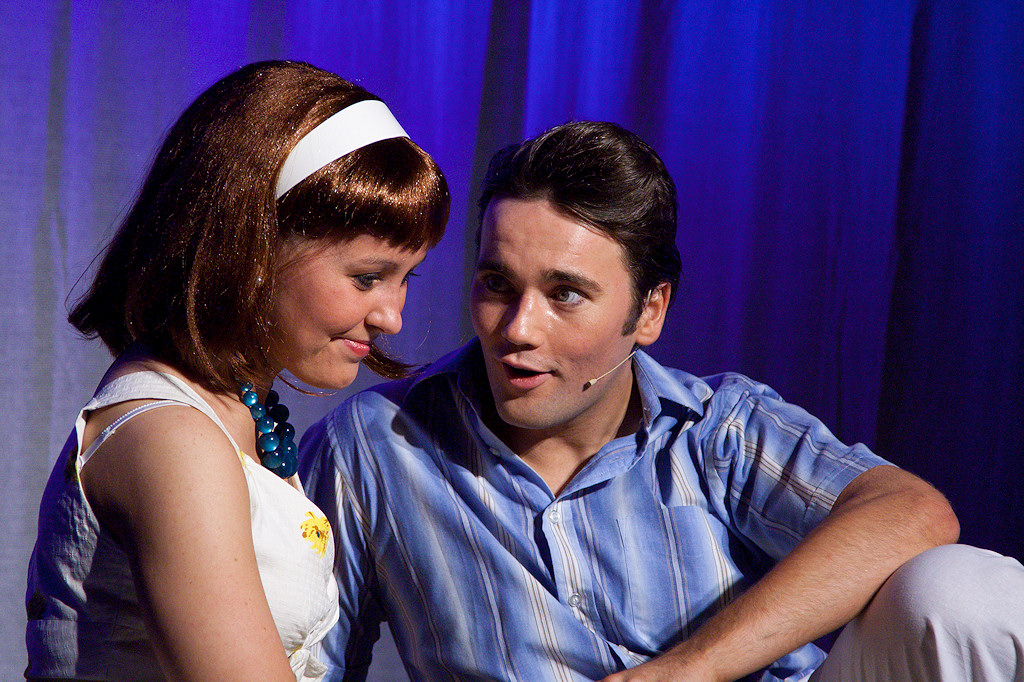
The kind of photographs I mainly take are stage shots. Here is an example of a picture from "Summer Holiday", by Theatre Guild in Glasgow:


which is not bad, but if you look in, for example, the shadowed areas of the guy's face there is a lot of noise. This is the ISO1600 picture after import to Lightroom, colour balance, export, a noise reduction pass using Neat Image, and sharpening. Slightly over-sharpened, if the girl's hair is anything to go by

Here is an ISO 1600 photograph from the first (and so far only) show I shot with the 5D - My Fair Lady, the Falkirk Bohemians:


This has been imported to Lightroom with default noise handling (in fact it was the Lightroom 3 Beta, so no luminance noise reduction at all), and exported with "normal" sharpening. And hardly any visible noise

The shallower depth of field is also noticeable, though that can be a double-edged sword.

So far I am very pleased with the 5D, even if it does feel slightly like a child's toy compared to the 350D (everything is big and chunky). But if you're not normally shooting low-light shots, the benefits would be considerably more limited.

regards,
/alan
 
Presumably FF cameras are worth the cost to those that buy them and are not worth the cost to those that do not.

One thing that I've noticed with photography is that there is a steep diminishing returns curve. A $100 camera will take OK pictures in good conditions. A $400 p&s camera will take much better pictures in most conditions. An $1,000 DSLR system will take somewhat better pictures in good conditions and much better pictures in difficult conditions. A $2,500 DSLR system will take slightly better pictures in good conditions and significantly better pictures in difficult conditions. A $10,000 DSLR system will take pictures that are hardly any better under good conditions but will still outperform under more difficult conditions. With each step, the dollars go up faster and the improvements go up slower.
We all have to decide where we want to be on that price/performance curve. For most photographers, today's full frame cameras don't make economic sense. For some people, they do. I think people should ask themselves where the optimum place to spend their photography money is. In many (most?) cases, the money would be better spent on training, lenses, lighting equipment, and even photo processing software rather than more expensive camera bodies.

good advice, that "steep diminishing returns curve" seems to be logarithmic with camera costs!
 
I agree with Groucho here, there is nothing inherently superior about a FF sensor. A FF sensor with the same pixel pitch as a sensor of any other size will have the same noise (and other) characteristics, it will just have more image area.

Where the FF sensor really shines is that we have so many legacy lenses (and camera bodies) from 35mm that are designed for that size sensor. However, this is changing as new designs are created from the ground up for the smaller sensors. I was concerned about buying a APS-C lens, thinking that format was a dead end. No more, the economics of wafers/sensors and the proliferation of APS-C lenses has convinced me that this format has staying power and that it may even be FF that loses the evolutionary battle.

Think about it, FF costs 3 times as much as APS-C, sensor yields are much lower (defects are higher due to the larger real estate), more memory, more processing power… all add to the cost. In return, image quality is only slightly better and not at all noticeable in most cases! No wonder APS-C sells maybe 50:1 (or even more) than FF. FF is not a big money maker for the manufacturer and we don’t have to finish the book to know how that story ends! ;) If anything, the trend is now to smaller sensors such as Micro 4/3, that give good quality with less size.

Still, I want the field of view that a 12mm lens gives on FF!!! But not enough to actually buy them….
 
I agree with Groucho here, there is nothing inherently superior about a FF sensor. A FF sensor with the same pixel pitch as a sensor of any other size will have the same noise (and other) characteristics, it will just have more image area.

Where the FF sensor really shines is that we have so many legacy lenses (and camera bodies) from 35mm that are designed for that size sensor. However, this is changing as new designs are created from the ground up for the smaller sensors. I was concerned about buying a APS-C lens, thinking that format was a dead end. No more, the economics of wafers/sensors and the proliferation of APS-C lenses has convinced me that this format has staying power and that it may even be FF that loses the evolutionary battle.

.
actually looking at the 7d vs 5d was what got me thinking any way( so dangerous)

but the bold part and much of what groucho said was pretty much my thinking as well. i was steering clear of crop lenses till i read an article that reasoned basically use the lens made for your body type for best results.... ( duh). i love my one and only crop lens( tamron 17-50) which made me wonder, would i ever really need a ff now that there are good lens choices for crops? and some of the better bells and whistles features seem to be trickling down more to the lowly crop sensored versions

i do agree with Mark though as well , FF do probably make you look way more cool/ professional but personally i need much more than a FF camera to even make a dent in my uncoolness. me slupping around in flipflops, my old faded gray teeshirt and jeans that are too big just doesn't scream "cool professional photographer" no matter what camera i'm using :rolleyes1:rotfl2:
 
with more good crop specific lenses becoming available do you think the benefits of full frame are still worth the cost?

With me being literally within minutes of the UPS guy handing me my new 5D MKII, I curse you for starting this thread:)

I cannot argue with what has been posted. I expect the benefits of ISO, image detail, low light, etc. Will not dramatically change my photography. Will need a bigger boat, I mean computer, to process.

For me, I am a two DSLR kinda guy. Why? Because I am sitting at the beach and a flock of birds go by and I want to shoot tele. Then the kids are playing and I want to shoot wide. Swapping lenses says "HELLO" to junk on my sensor.

Crops and telephotos work good for nature. The full frame will give me some extra umph in low light, portrait, and landscape. I expect the slow focus will keep me from using it in sports.

I do feel blessed to be able to "gear up". Full frames are holding value where older model crops can be had for cheap. I say buy a late model crop used or refurb and spend on the full frame.

Best of both worlds.

Hah...doorbell just rang. Gotta run.
 
i do agree with Mark though as well , FF do probably make you look way more cool/ professional but personally i need much more than a FF camera to even make a dent in my uncoolness. me slupping around in flipflops, my old faded gray teeshirt and jeans that are too big just doesn't scream "cool professional photographer" no matter what camera i'm using :rolleyes1:rotfl2:
Looking really uncool is cool for photographers. I've never met a really good photographer who looked even vaguely normal.
 
With me being literally within minutes of the UPS guy handing me my new 5D MKII, I curse you for starting this thread:)

I cannot argue with what has been posted. I expect the benefits of ISO, image detail, low light, etc. Will not dramatically change my photography. Will need a bigger boat, I mean computer, to process.

For me, I am a two DSLR kinda guy. Why? Because I am sitting at the beach and a flock of birds go by and I want to shoot tele. Then the kids are playing and I want to shoot wide. Swapping lenses says "HELLO" to junk on my sensor.

Crops and telephotos work good for nature. The full frame will give me some extra umph in low light, portrait, and landscape. I expect the slow focus will keep me from using it in sports.

I do feel blessed to be able to "gear up". Full frames are holding value where older model crops can be had for cheap. I say buy a late model crop used or refurb and spend on the full frame.

Best of both worlds.

Hah...doorbell just rang. Gotta run.
i agree about the 2 bodies, just wondering which body to get sometime:rotfl: it would be interesting to see some of the same shots taken with both bodies to compare since i am guessing you will be wanting to play with your new one anyway:rotfl:
 
Looking really uncool is cool for photographers. I've never met a really good photographer who looked even vaguely normal.
so wonder which came first, the abnormal looks or the photography... or maybe the looks come from constantly having a camera attached to your eye and thereby losing touch with reality:rotfl:
 
so wonder which came first, the abnormal looks or the photography... or maybe the looks come from constantly having a camera attached to your eye and thereby losing touch with reality:rotfl:

It's because photographers are inherently anti-social people. They use cameras as something to hide behind. That's why more serious photographers (who are consequentially more anti-social) use bigger cameras. At the far extreme, they even hide their heads under black hoods. Cool normal people just take pictures with their phones and call it good.
 
It's because photographers are inherently anti-social people. They use cameras as something to hide behind. That's why more serious photographers (who are consequentially more anti-social) use bigger cameras. At the far extreme, they even hide their heads under black hoods. Cool normal people just take pictures with their phones and call it good.

So staring at the wall and watching a flashing light on a charging battery of a new camera is not normal. Uncool. I am confused.
 
It's because photographers are inherently anti-social people. They use cameras as something to hide behind. That's why more serious photographers (who are consequentially more anti-social) use bigger cameras. At the far extreme, they even hide their heads under black hoods. Cool normal people just take pictures with their phones and call it good.

So how is it that some "uncool" photographers end up getting models to pose "provocatively" for them? Is it cuz of their big cameras? :confused:
 
i agree about the 2 bodies, just wondering which body to get sometime:rotfl: it would be interesting to see some of the same shots taken with both bodies to compare since i am guessing you will be wanting to play with your new one anyway:rotfl:

I, too, would be interested in seeing how your 2 bodies compare (camera bodies, that is...). :)

There have already been several side-by-side comparisons of images between the Canon 7D and the 5D Mark II. I wonder if your own comparisons would match some of these:

There are other 7D vs 5DII comparisons floating around on the Web, too.
 
i only have one body ( ok one each, an old worn out physical one and a newer and much better working 40d:rotfl:) but would like another some day( of both kinds ;))....test batches numbers 1 and 3 seem to make the 5d the winner to me for sure. the images just look better although the light could be different due to the different angle of the wagon on batch number 1. number 2 test i just don't think is a fair fight using the 50mmf1.4 lens vs the 28-135. i'm not sure how much the sharpness/lack of it is due to the lens in that case.

so all in all from those tests at least ,i think you spent your money wisely, the 5d still has an advantage to me.
 

New Posts


Disney Vacation Planning. Free. Done for You.
Our Authorized Disney Vacation Planners are here to provide personalized, expert advice, answer every question, and uncover the best discounts. Let Dreams Unlimited Travel take care of all the details, so you can sit back, relax, and enjoy a stress-free vacation.
Start Your Disney Vacation
Disney EarMarked Producer


DIS Facebook DIS youtube DIS Instagram DIS Pinterest DIS Tiktok DIS Twitter

Add as a preferred source on Google

Back
Top Bottom