MarkBarbieri
Semi-retired
- Joined
- Aug 20, 2006
- Messages
- 6,173
We just got back from a trip to the frozen wastelands of the north (Colorado). The kids had a great time sledding.
Here are some shots I took along with a few tips for taking sledding pictures.

Get down low. I know that laying in the snow isn't the most comfortable thing in the world, but the perspective will really improve your shots. This shot was taken in AV mode at f/4, which left me a shutter speed of 1/1250. A high shutter speed will freeze the action.

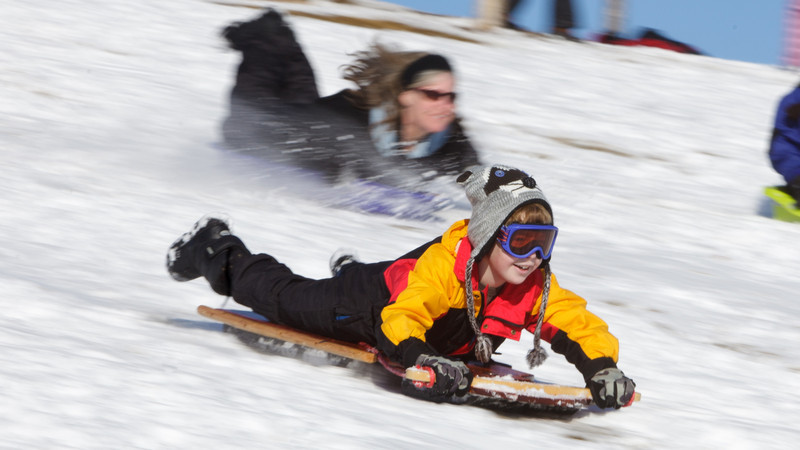
Sometimes you don't want to freeze the shutter speed. You want to show some motion blur so that the picture shows the speed of the sledder. In this shot, I used shutter priority and set a shutter speed of 1/40. I panned along with the sledder and fired several shots as he approached and went past.
I would recommend trying shutter speeds from 1/40 to 1/120. The slower the shutter speed, the more motion blur you'll get, but you'll also have fewer keepers. Most shots will come out blurry because you didn't track your subject perfectly.
If it is really bright, you'll end up with tiny apertures at those shutter speeds. Any time your aperture goes over about f/11, you are starting to lose sharpness. If you can, try using a lower ISO rather than letting it use a smaller aperture. If you already at your lowest ISO, consider a neutral density filter or a polarizing filter. The other problem with shooting at high f-stops is that the dust on your sensor will be very visible and it will stand out against the blurred background.

If you want to shoot someone at a particular spot, like this jump, consider pre-focusing. I focused on the top of the jump and had my camera positioned to shoot just as he went over it. I find that is more reliable than letting the AF muck about during the shot. It's really easy to pre-focus if you move your AF-Start function off of your shutter button and put it on another button. I can't stress how much better that arrangement works for almost any kind of action photography.
The snow can really mess with your exposure. Your camera's meter doesn't understand the difference between white, grey, and black. It thinks that white is brighly lit grey and black is poorly grey. When it sees that white snow, it will try to lower the exposure level so that the snow looks grey. You might have to fight that by dialing in exposure compensation. Of course, if you do that, your exposure level might still vary between shots with mostly snow and shots with mostly a person in a dark snowsuit. If the lighting conditions are the same everywhere you are shooting, you can just switch to manual and take a few test shots to get the settings that work for you.
To be honest, I mostly just shot with no exposure compensation and then fixed the underexposure in Lightroom. Noise in the shadows tends to increase when you boost exposure in post production, but since I was shooting at ISO 50 or 100, it wasn't really an issue.

Make sure that there is someone else there that can handle your camera for you so that you can get in on the fun.
Here is a video of our trip. Here is a link to all of the pictures.
Here are some shots I took along with a few tips for taking sledding pictures.
Get down low. I know that laying in the snow isn't the most comfortable thing in the world, but the perspective will really improve your shots. This shot was taken in AV mode at f/4, which left me a shutter speed of 1/1250. A high shutter speed will freeze the action.
Sometimes you don't want to freeze the shutter speed. You want to show some motion blur so that the picture shows the speed of the sledder. In this shot, I used shutter priority and set a shutter speed of 1/40. I panned along with the sledder and fired several shots as he approached and went past.
I would recommend trying shutter speeds from 1/40 to 1/120. The slower the shutter speed, the more motion blur you'll get, but you'll also have fewer keepers. Most shots will come out blurry because you didn't track your subject perfectly.
If it is really bright, you'll end up with tiny apertures at those shutter speeds. Any time your aperture goes over about f/11, you are starting to lose sharpness. If you can, try using a lower ISO rather than letting it use a smaller aperture. If you already at your lowest ISO, consider a neutral density filter or a polarizing filter. The other problem with shooting at high f-stops is that the dust on your sensor will be very visible and it will stand out against the blurred background.
If you want to shoot someone at a particular spot, like this jump, consider pre-focusing. I focused on the top of the jump and had my camera positioned to shoot just as he went over it. I find that is more reliable than letting the AF muck about during the shot. It's really easy to pre-focus if you move your AF-Start function off of your shutter button and put it on another button. I can't stress how much better that arrangement works for almost any kind of action photography.
The snow can really mess with your exposure. Your camera's meter doesn't understand the difference between white, grey, and black. It thinks that white is brighly lit grey and black is poorly grey. When it sees that white snow, it will try to lower the exposure level so that the snow looks grey. You might have to fight that by dialing in exposure compensation. Of course, if you do that, your exposure level might still vary between shots with mostly snow and shots with mostly a person in a dark snowsuit. If the lighting conditions are the same everywhere you are shooting, you can just switch to manual and take a few test shots to get the settings that work for you.
To be honest, I mostly just shot with no exposure compensation and then fixed the underexposure in Lightroom. Noise in the shadows tends to increase when you boost exposure in post production, but since I was shooting at ISO 50 or 100, it wasn't really an issue.
Make sure that there is someone else there that can handle your camera for you so that you can get in on the fun.
Here is a video of our trip. Here is a link to all of the pictures.