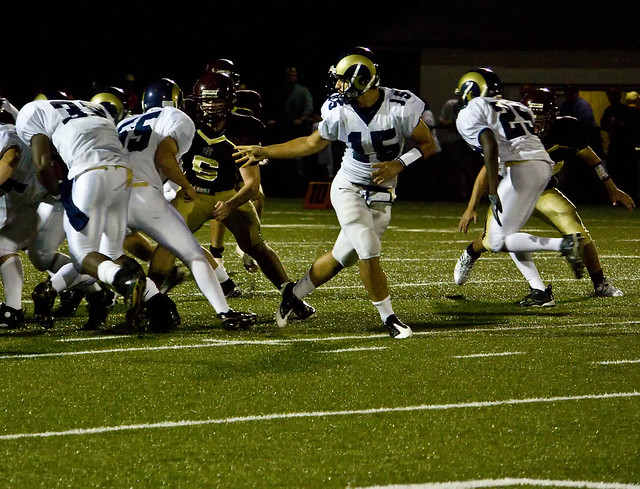
Need some help...

Jitzy

Mouseketeer
Joined
Aug 8, 2008
Messages
387
Both of our boys play high school sports. Needless to say, we have a lot of night games. How do I take good action shots? Should I keep my camera on the sports setting? The action shots of them are streaky with the stadium lights. It's very frustrating!

Oh, and I should mention the type of camera! Canon rebel xs

Thanks!
 
What lens do you have on it?

Some basic things to do are increase the ISO (which can result in noisy images) and invest in faster glass. If you're shooting with a variable aperture lens, you can try getting closer to the action so that you're shooting from the faster end of the glass, rather than using the zoom and losing a few stops.

Other than that, there isn't a whole lot you can do. Sports, especially night sports, is one of the most costly sides of photography.
 
The action shots of them are streaky with the stadium lights. It's very frustrating!


Thanks!

By streaky I am guessing you mean that your subjects are a blurr?

shutter 1/500th or faster, max aperture, and raise ISO till you get decently exposed images. Depending on lens, it might mean raising ISO to levels that might cause unacceptable noise levels but this is the only way. Yes faster lens allows you to shoot at maybe ISO 400-800, high school lighting varies.
 
You've got 2 challenging conditions going on. Taking sports pictures is pretty challenging. Night photography (or, low-light photography) is pretty challenging. So when you combine the two (night-time sports photography), you can imagine how hard that can be.

Probably the reason why your sons are "streaky" in your photos is because your camera is selecting a very slow shutter speed. Your camera selects a slow shutter speed because it sees a low-light environment. A slow shutter speed lets more light into the camera, giving you a proper exposure (ie. a picture that's not too dark and not too bright).

However, for sports photography, you want just the opposite of that...you want a FAST shutter speed. A fast shutter speed freezes the action so that you don't get blurring or "streaking" from motion. However, fast shutter speeds may sometimes mean darker pictures, since it lets less light into the camera.

So how do you take photos of night-time sports? As with ALL photos, we go back to the 3 components of the exposure triangle: shutter speed, aperture, and ISO. As you probably already learned in your beginning photography class, the proper exposure of every single photo depends on these 3 components.

  • Shutter speed - as already mentioned above, you'll need a FAST shutter speed for sports photography. I'd probably go with 1/500 sec at the very minimum. Ideally, I'd try 1/1000 sec or faster.
  • Aperture - aperture is the size of the opening in the lens of the camera. The larger the aperture, the more light comes into the camera. The smaller the aperture, the less light enters the camera. As you might suspect, in a low-light situation, we want as much light to enter the camera as possible. So in low-light situations, we want large apertures.

    Aperture settings are a little confusing. A large aperture is represented by a small f-number (such as f/2.8)! Conversely, a small aperture is represented by a large f-number (such as f/16).

    In low-light sports photography, ideally, you'll want an aperture that's f/2.8 or larger (f-number of 2.8 or smaller). In this case, a larger aperture allows you to use faster shutter speeds.

    I'm not sure what lens you're using. Not all lenses can get to a large aperture of f/2.8. For example, if you had the Canon 70-300mm f/4.0-5.6 lens, then your largest aperture is f/4.0 when you're not zoomed in. It's f/5.6 when you're zoomed in all the way. These are not quite ideal apertures for nighttime sports photography.

    What's the difference between f/2.8 and f/4.0? f/2.8 lets in TWICE the amount of light into the camera as f/4.0.

    How about compared to f/5.6? f/2.8 lets in FOUR TIMES as much light into the camera as f/5.6.
  • ISO - ISO sets the sensitivity of the camera's sensor to light. A low ISO (like ISO 100) gives low sensitivity to light, which is great in bright daytime settings. A high ISO (like ISO 800, 1600, 3200, etc) makes the sensor highly sensitive to light, which is best for low-light situations.

    Unfortunately, high ISO photos can suffer from "noise" or "graininess", which are tiny random specs that appear throughout the photo. There are computer programs that can remove much of the noise in high ISO photos.

    For nighttime sports photography, you'll want to go with a minimum ISO of 800, or perhaps ISO 1600. In this case, a higher ISO allows you to use faster shutter speeds.

So, for night-time sports photography, you'll need (1) fast shutter speeds, (2) large apertures (small f-numbers), and (3) high ISOs.

These are the 3 components of the "exposure triangle." These 3 components are all interrelated. You can see how changing one component allows you to change the other 2, and vice versa.

If you had all the money in the world, you buy the Canon 70-200mm f/2.8 lens. This lens gives you the larger aperture you'll need (f/2.8) AND allows you to zoom in on the action. You can find this lens for $2300 (link). This is one of the workhorse lens that professionals (and rich parents) use for nighttime sports photography.

A slightly more economical option would be the Canon 100mm f/2.0 lens. This is a "prime lens", meaning that it doesn't zoom. Your view through this lens (ie. your focal length) will always be 100mm. This might be good if you find yourself a little farther away from the action. The maximum aperture of f/2.0 lets LOTS of light into your camera. In fact, f/2.0 lets in TWICE as much light enter the camera as f/2.8 (which, in turn, lets you use faster shutter speeds). This lens runs about $474. (link)

Hope that all made sense. Nighttime sports photography is very, very tough. However, it's not impossible. Hope that helps. :)
 

If you had all the money in the world, you buy the Canon 70-200mm f/2.8 lens. This lens gives you the larger aperture you'll need (f/2.8) AND allows you to zoom in on the action. You can find this lens for $2300 (link). This is one of the workhorse lens that professionals (and rich parents) use for nighttime sports photography.

The IS version goes for over two grand, but IS is not needed for sports since you already covered the need for fast shutter speeds. The non IS version goes for around $1000 used, and the Sigma non IS versions are acceptable used can be had for about $550.

BUT even that lens requires sideline access, you would need something longer to attempt to shoot from the other side of the fence.

Yes sports are not cheap.
 
Both of our boys play high school sports. Needless to say, we have a lot of night games. How do I take good action shots? Should I keep my camera on the sports setting? The action shots of them are streaky with the stadium lights. It's very frustrating!

Oh, and I should mention the type of camera! Canon rebel xs

Thanks!

What lens are you using? If the action shots are "streaky" it's probably because the shutter speed is too low. To get good pics you will need to learn more about aperture/shutter speed/ISO !
(And it helps to get a lens with a larger aperture)

this HS night time football pic is with a Canon XSi and Canon 55-250IS lens ($150)

f5 - Shutter speed 1/320 - ISO 1600
(exposure increased in post processing)

3948308398_681ffea67e_z.jpg
 
You didn't mention your images looking blueish, but another thing to consider is White Balance. Make sure you have the correct white balance setting for the lights (tungsten perhaps?).

This won't help with the streaking, but once everything comes together, it will help with the finished product.

Other good lenses to consider would be the primes 135mm f2.0 and the 200mm f2.8. These aren't as expensive as the IS lenses listed above but should do a good job for what you want to do.
 
I actually used to just put my nice DSLR away once the sun set. At that time all I had was my kit lens and a variable aperture all in one lens.

How close are you able to get to the sidelines? The primes Frantasmic mentioned might be the best bet.
 
Night shots might be a bit iffy, but an ISO tweak might fix it with the 300mm f4.0 L used lens that B&H has in its used department currently.

This lens would give you really good shots in the light.
 
My son's game last night was much better. I'm still going to have to figure out the aperture. Also, I'm taking pictures from the stands, no sideline pass for Mom!

I did increase the ISO, but with that lost the quick sports mode setting because that's automatic. My lens is 55-250.

I've got a lot more studying to do!
 
I probably wouldn't choose sports mode for a night game. I'd put the ISO as high as I could, then use shutter priority. Pick a starting point and experiment. Keep speeding up as fast as you can push it and still have a reasonable exposure.
 
My son's game last night was much better. I'm still going to have to figure out the aperture. Also, I'm taking pictures from the stands, no sideline pass for Mom!

I did increase the ISO, but with that lost the quick sports mode setting because that's automatic. My lens is 55-250.

I've got a lot more studying to do!


Another thing to try is to use shutter priority (Tv is the setting I believe Canon uses). Set your ISO to its highest (1600 or 3200) and set your shutter for 1/250. The camera will then choose the f/stop. This will at least give you the stop action. The images might be a little dark, but you can always add some exposure compensation once you get them on the computer.

Sports at night is VERY challenging. Notice those pro's on the sidelines with the great big huge white lenses. Those are the $5000 and up lenses and have an Aperture that goes down to f/2.8 and can focus as fast as your eye.

Your lens at 250mm only goes down to f/5.6. Thats the same difference between ISO 200 and 800 or a shutter speed of 1/60th and 1/250th.

Also the Pro and upper end college stadiums/arena's are lighted for TV camera's and are much brighter. Local high school venue's don't need that much lighting so it makes it that much harder for getting good action shots at night or indoors.
 
Another thing to try is to use shutter priority (Tv is the setting I believe Canon uses). Set your ISO to its highest (1600 or 3200) and set your shutter for 1/250. The camera will then choose the f/stop. This will at least give you the stop action. The images might be a little dark, but you can always add some exposure compensation once you get them on the computer.

Sports at night is VERY challenging. Notice those pro's on the sidelines with the great big huge white lenses. Those are the $5000 and up lenses and have an Aperture that goes down to f/2.8 and can focus as fast as your eye.

Your lens at 250mm only goes down to f/5.6. Thats the same difference between ISO 200 and 800 or a shutter speed of 1/60th and 1/250th.

Also the Pro and upper end college stadiums/arena's are lighted for TV camera's and are much brighter. Local high school venue's don't need that much lighting so it makes it that much harder for getting good action shots at night or indoors.

On the XS, she's only going to get 1600 ISO.

OP, I'd try this and if it doesn't work, it's time to put the camera away and just watch. What sport is it? Does he have any games during the daylight or right before the sun sets? When my son played soccer I only had the Xsi and a variable aperture zoom. I photographed the earlier games where I had some daylight, but put it away once I lost the light.

If he only plays at night, maybe you can come during practice and get some photos from the sidelines.
 
Right now it is Lacrosse season. It is so much fun to watch, but taking the pictures is so hard. The boys are fast and the ball is so small. It zips around like crazy!

I'm also working on the context of the pictures. If you focus on individuals, then you lose the fact that it's a game. I could just pose him on the field and be done with it!!! Yet, if you are too far back, the ball is practically invisible.

Still working on it. I increased the ISO to 1600. That seems to be as high as it goes. It made it a little better, but I'm not sure that it didn't make the pictures seem less sharp. Have a game tomorrow evening that starts at 5:30. With the time change, it might be a non issue tomorrow.

Thanks for all the help and information. A lot to learn out there if you take the camera off the automatic setting!
 
I'm also working on the context of the pictures. If you focus on individuals, then you lose the fact that it's a game. I could just pose him on the field and be done with it!!! Yet, if you are too far back, the ball is practically invisible.

This is where you need to decide whether you want to watch the game or shoot the game. The investment in time and money to shoot sports both day and night is significant.

My greatest asset I can be to my daughters allstar cheer team and my sons football team is I would rather shoot than watch and have the equipment to do so. 99% of the moms/dads don't even bring their cameras anymore.


Good luck.


Disney Vacation Planning. Free. Done for You.
Our Authorized Disney Vacation Planners are here to provide personalized, expert advice, answer every question, and uncover the best discounts. Let Dreams Unlimited Travel take care of all the details, so you can sit back, relax, and enjoy a stress-free vacation.
Start Your Disney Vacation
Disney EarMarked Producer

New Posts


DIS Facebook DIS youtube DIS Instagram DIS Pinterest DIS Tiktok DIS Twitter

Add as a preferred source on Google

Back
Top Bottom