DOF or Focal Point issue? Need some help!

DoleWhipDVC

Mouseketeer
Joined
Jul 17, 2010
Messages
210
So as I glean through the pics from the summer, I notice that some taken with the 50mm 1.8 have my subjects in and out of focus. If I have a shot of, say, three people lined up shoulder to shoulder, the person on the left is sharp and the person on the right is blurred. The one in the middle is fairly focused.

Also, at times all my subjects are blurred under lower light conditions. I wasn't moving and niether were they. Is the 50 prime the possible culprit due to something I'm obviously not aware of in its characteristics, or am I forgetting something in my settings? All shots are clear overall and the light levels (ISO) are appropriate for the conditions. I can see everything, but not all subjects are focused. Oh, the background of the shots look fine.

Any help to get me on the right track is appreciated. :confused3
 
From what you describe, it looks like you were using too large of an aperture, which made your depth of field very very small.

When you use a large aperture (a small f-number, such as f/1.8), your depth of field can potentially be very very small. So if all the people in your photo aren't lined up in the exact same plane of focus, some of them may appear slightly out of focus, especially if their face happens to be just a few inches behind or in front of everyone else's.

That's why with a large group photo, you should try using smaller apertures (larger f-numbers, such as f/5.6 or f/8 for example). Using smaller apertures gives you larger depths of field, so that everyone's faces can be in-focus.

I know that you probably wanted to use a larger aperture such as f/1.8 to either blur the background or let more light into the camera. However, with larger apertures come smaller depths of field. Sometimes, the depth of field can be so razor-thin that if you focus on a person's eyes, their nose may not be in focus. So that's something to watch out for.

Check out an online depth of field calculator, such as http://www.dofmaster.com/dofjs.html. There's even an app for that for your smartphone.


The other thing you mentioned was blurred faces in low light conditions. Even though your subjects may have stood "perfectly still", people always have a slight bit of movement. That's why, for example, you cannot handhold your camera for a 1 second shutter speed without introducing some blur, even though you may have tried to hold the camera as still as you possibly could.

Typically, when you ask people to hold still, your camera should probably be set to a shutter speed of about 1/60 or faster. If you used a slower shutter speed to let more light into the camera (such as for low light conditions), you run the risk of introducing motion blur when your subjects move.

I'm actually being conservative with the 1/60 shutter speed. You may be able to have some success with a slightly slower shutter speed such as 1/30 or 1/40, but I would only use these slower shutter speeds if needed.


Also, you mentioned that the background was fine. Did the camera inadvertently focus on the background and not on your subjects? Make sure that you are using a single focus point, and focus on your subjects' face or eyes. Do NOT let the camera select the autofocus point for you. The camera *always* selects the wrong thing to focus on!!!


I can't see what is going on in your pictures nor can I examine the EXIF data in your photos, but based on what you describe, I suspect this is probably what is going on.
 
Disneyboy, you are my hero for giving such an AWESOME explanation about what probably happened.

Dolewhip, you are making amazing progress so I know you have a good grasp on the ISO, APERTURE and SHUTTER SPEED triangle. I'm going to put the following out there for all of the people that are just getting into their NEW DSLR's

A lot of people who are just learning about their new, more advanced DSLR cameras are becoming aware that when shooting INDOORS in the AUTO setting the camera defaults to setting the ISO, Aperture and Shutter Speed to what I call the muddling middle. This is where the ISO is higher and can introduce 'grain' to your pictures, the Aperture is wide open and can cause the depth of field to be short and the shutter to be slow introducing blur.

Especially when shooting indoors, this means that the Aperture will open wide up to let in the light. If your subject is close that means that your depth of field (better way to think about it is width of clarity ) will be really short. Add to that those slower shutter speeds 1/60, 1/30 or longer and you get the muddling middle.

The way to get around this "shooting indoors in the kinda dark for a camera" is to get a bounceable flash on your camera and use it in these situations. Adding another source of light will allow you to bring Aperture, Shutter speed and ISO into more favorable settings. "Bouncing a flash" is where, instead of having the flash aimed directly at your subjects, you aim it at the ceiling and have the light bounce off of that to illuminate your subject.

If you are using the pop up flash on your camera it will shoot straight at your subject and introduce a light pattern that is to harsh on the subject in the front and possibly make weird shadows in the back. When you bounce the light off of the ceiling you get a softer, overall illumination that doesn't look so harsh.

Usually you have to buy an accessory flash unit that will fit in your 'hot shoe' and is adjustable to overcome this problem but I have seen some accessories that are sold that you can put on your pop up flash that will redirect the light. I don't know much about those types of things so I'll just recommend looking into purchasing an adjustable hot shoe flash.

So, I hope that helps. Taking pictures indoors in low light conditions is just plain hard unless you manipulate the Aperture, Shutter speed and ISO and can add an additional source of light. Really understanding how these things impact your results is key to getting better pictures.

Photography is the gift that keeps giving with respect to the need to keep acquiring new knowledge. The pay off is that you will start to see better results with your pictures.

Good luck!

~Marlton Mom
 
From what you describe, it looks like you were using too large of an aperture, which made your depth of field very very small.

When you use a large aperture (a small f-number, such as f/1.8), your depth of field can potentially be very very small. So if all the people in your photo aren't lined up in the exact same plane of focus, some of them may appear slightly out of focus, especially if their face happens to be just a few inches behind or in front of everyone else's.

That's why with a large group photo, you should try using smaller apertures (larger f-numbers, such as f/5.6 or f/8 for example). Using smaller apertures gives you larger depths of field, so that everyone's faces can be in-focus.

I know that you probably wanted to use a larger aperture such as f/1.8 to either blur the background or let more light into the camera. However, with larger apertures come smaller depths of field. Sometimes, the depth of field can be so razor-thin that if you focus on a person's eyes, their nose may not be in focus. So that's something to watch out for.

Check out an online depth of field calculator, such as http://www.dofmaster.com/dofjs.html. There's even an app for that for your smartphone.


The other thing you mentioned was blurred faces in low light conditions. Even though your subjects may have stood "perfectly still", people always have a slight bit of movement. That's why, for example, you cannot handhold your camera for a 1 second shutter speed without introducing some blur, even though you may have tried to hold the camera as still as you possibly could.

Typically, when you ask people to hold still, your camera should probably be set to a shutter speed of about 1/60 or faster. If you used a slower shutter speed to let more light into the camera (such as for low light conditions), you run the risk of introducing motion blur when your subjects move.

I'm actually being conservative with the 1/60 shutter speed. You may be able to have some success with a slightly slower shutter speed such as 1/30 or 1/40, but I would only use these slower shutter speeds if needed.


Also, you mentioned that the background was fine. Did the camera inadvertently focus on the background and not on your subjects? Make sure that you are using a single focus point, and focus on your subjects' face or eyes. Do NOT let the camera select the autofocus point for you. The camera *always* selects the wrong thing to focus on!!!


I can't see what is going on in your pictures nor can I examine the EXIF data in your photos, but based on what you describe, I suspect this is probably what is going on.

So if I understand you correctly, since I can't change the aperture on the 1.8 you suggest going with another lens which allows smaller f stops. I can do that with no problem. You're right, I used the 1.8 to get more light in and avoid using a flash. I didn't realize the DOF was an issue for the 1.8 opening. I do understand the basics f stop influence on DOF, but not enough to know how different focal lengths also have an impact. Thanks for the info :thumbsup2
 

You can change the aperture on the 50mm 1.8 lens. F/ 1.8 is the widest your aperture will open.... it can definitely go smaller, and you can absolutely use those smaller apertures!

However, if you use a smaller aperture, you're going to have to compensate to still get your subjects correctly exposed--either increase ISO, decrease shutter speed (which becomes a problem if you go to slow on the ss--motion blur), OR add more light to the scene.

The bottom line is that something has to give. It would be lovely if we could take pictures in low-light with low ISO, fast shutter speeds, and lots of depth of field (high f stop #).... but we can't. If we did, it will give us very dark, underexposed photos.


If you were already at the highest usable ISO for your camera, and the slowest shutter speed you could get without motion blur, AND you were using f/ 1.8..... then the best option is to add more light to the scene and use a smaller aperture (higher f #). If you were already at highest ISO and slowest possible shutter speed and you just use a smaller aperture (without adding light), your photo is going to be darker.
 
Disneyboy, you are my hero for giving such an AWESOME explanation about what probably happened.

Dolewhip, you are making amazing progress so I know you have a good grasp on the ISO, APERTURE and SHUTTER SPEED triangle. I'm going to put the following out there for all of the people that are just getting into their NEW DSLR's

A lot of people who are just learning about their new, more advanced DSLR cameras are becoming aware that when shooting INDOORS in the AUTO setting the camera defaults to setting the ISO, Aperture and Shutter Speed to what I call the muddling middle. This is where the ISO is higher and can introduce 'grain' to your pictures, the Aperture is wide open and can cause the depth of field to be short and the shutter to be slow introducing blur.

Especially when shooting indoors, this means that the Aperture will open wide up to let in the light. If your subject is close that means that your depth of field (better way to think about it is width of clarity ) will be really short. Add to that those slower shutter speeds 1/60, 1/30 or longer and you get the muddling middle.

The way to get around this "shooting indoors in the kinda dark for a camera" is to get a bounceable flash on your camera and use it in these situations. Adding another source of light will allow you to bring Aperture, Shutter speed and ISO into more favorable settings. "Bouncing a flash" is where, instead of having the flash aimed directly at your subjects, you aim it at the ceiling and have the light bounce off of that to illuminate your subject.

If you are using the pop up flash on your camera it will shoot straight at your subject and introduce a light pattern that is to harsh on the subject in the front and possibly make weird shadows in the back. When you bounce the light off of the ceiling you get a softer, overall illumination that doesn't look so harsh.

Usually you have to buy an accessory flash unit that will fit in your 'hot shoe' and is adjustable to overcome this problem but I have seen some accessories that are sold that you can put on your pop up flash that will redirect the light. I don't know much about those types of things so I'll just recommend looking into purchasing an adjustable hot shoe flash.

So, I hope that helps. Taking pictures indoors in low light conditions is just plain hard unless you manipulate the Aperture, Shutter speed and ISO and can add an additional source of light. Really understanding how these things impact your results is key to getting better pictures.

Photography is the gift that keeps giving with respect to the need to keep acquiring new knowledge. The pay off is that you will start to see better results with your pictures.

Good luck!

~Marlton Mom

Always glad to hear from you mom, and thanks for taking the time (and your compliment). I do have a 430EXII speedlight and have used it to bounce light. In fact, now that you mention it, in October I was shooting at a karate tournament with the 50mm 1.8. I used the 1.8 because I wanted to go without flash if possible. The event was in a convention hall and even the 1.8 wasn't getting good light. So I slapped on the speedlight but angled the head away so I didn't blind anyone. I then shot at 1/250 because I think that's the default speed of a flash unit. Almost all of those shots came out with good freeze of the action AND sharp focus throughout the frame. I didn't use the flash at Disney because I though the light was sufficient in the restaurant lobby areas. So would you recommend using the flash and bouncing the light whenever I go for the 50mm 1.8 indoors (so long as flash is appropriate)? Would this solve the DOF focus issue by providing more light at a faster speed?
 
So would you recommend using the flash and bouncing the light whenever I go for the 50mm 1.8 (so long as flash is appropriate)? Would this solve the DOF focus issue by providing more light at a faster speed?

This is certainly one option (adding more light), as I mentioned above.

HOWEVER, it's not necessarily correct to say you should always have to add flash.

Depth of field is also impacted by how far away YOU are from your subject. It's possible to get a lot in focus at f/1.8 if you're far away from the subject.

Likewise, it's possible to get shallow depth of field with a smaller aperture if you're very close to your subject and the background is far away from the subject.
 
You can change the aperture on the 50mm 1.8 lens. F/ 1.8 is the widest your aperture will open.... it can definitely go smaller, and you can absolutely use those smaller apertures!

However, if you use a smaller aperture, you're going to have to compensate to still get your subjects correctly exposed--either increase ISO, decrease shutter speed (which becomes a problem if you go to slow on the ss--motion blur), OR add more light to the scene.

The bottom line is that something has to give. It would be lovely if we could take pictures in low-light with low ISO, fast shutter speeds, and lots of depth of field (high f stop #).... but we can't. If we did, it will give us very dark, underexposed photos.


If you were already at the highest usable ISO for your camera, and the slowest shutter speed you could get without motion blur, AND you were using f/ 1.8..... then the best option is to add more light to the scene and use a smaller aperture (higher f #). If you were already at highest ISO and slowest possible shutter speed and you just use a smaller aperture (without adding light), your photo is going to be darker.

I truly seem to forget that I can go smaller with my lenses but not larger. Seriously, I've made this error before and I don't know why I keep doing it! Oh, amature... that's right :goodvibes Between you and Marlton Mom's answers, it seems adding a bit of light with my speedflash will help tons. I'll keep shooting and try to pay attention to what I'm doing - and the results. Thanks for your help :thumbsup2
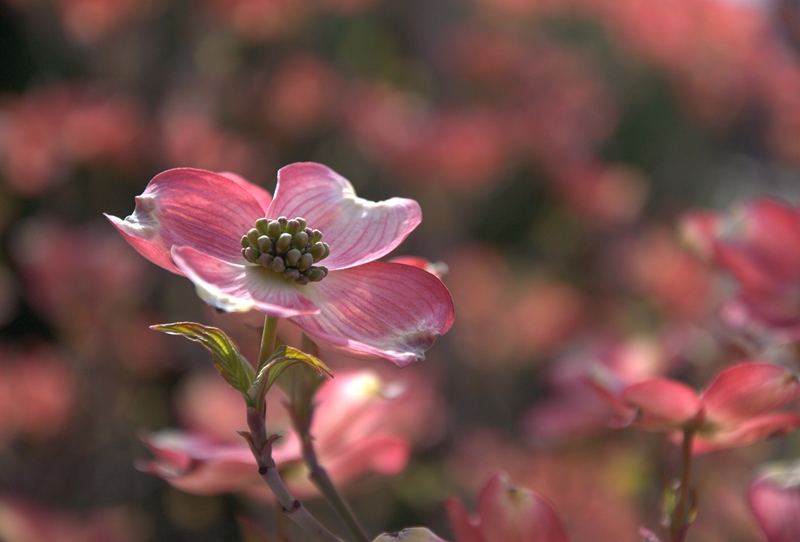
 
Here's an example of how DOF is about more than just the aperture (f #):

This was shot at f/5.6 at 105mm:


Embrace by nicole_lynn_, on Flickr

For that shot, I was as close as possible to the flower and the background flowers were several feet away.

In comparison...

This was also shot at f/5.6 at 105mm:


Full Bloom by nicole_lynn_, on Flickr

There's still only one flower in the plane of focus, but clearly the background (other flowers) are much less blurred than in the first photo. That's because in this photo, the background flowers were much closer to my subject flower.
 
So if I understand you correctly, since I can't change the aperture on the 1.8 you suggest going with another lens which allows smaller f stops. I can do that with no problem. You're right, I used the 1.8 to get more light in and avoid using a flash. I didn't realize the DOF was an issue for the 1.8 opening. I do understand the basics f stop influence on DOF, but not enough to know how different focal lengths also have an impact. Thanks for the info :thumbsup2

What is it that makes you think you can't change the f/stop on that lens?

I've used my 50mm f/1.8 lens many times for portraits. It is RAZOR sharp from about f/4-f/10 and even at other f/stops it is very sharp.

Depth of field is most certainly an issue at f/1.8. Even if each person was lined up shoulder to shoulder, but each one of their heads were each tilted different only 1 person will be in focus.

When you that lens I HIGHLY recommend using single point focus and choose the focus point yourself (when taking a picture of a person always focus on the eyes unless you want a different look). The camera will almost always get it wrong. At that kind of f/stop you want the eye to be in focus, but the camera could choose the nose instead and it would ruin the image.
 
So would you recommend using the flash and bouncing the light whenever I go for the 50mm 1.8 indoors (so long as flash is appropriate)? Would this solve the DOF focus issue by providing more light at a faster speed?

Yes it would help. Basically as long as you have anything within a reasonable range to bounce the light back you will do a lot better using a flash, pointed at the ceiling.

Let's say you were outdoors with no ceiling, the bounce back would be non existent because there would be nothing to reflect the light off of so then the flash is a no go. Indoors with a ceiling of some sort is how you need to think. In most cases you should aim the flash up so the light is distributed across the ceiling but in some cases you can use a flash diffuser accessory and point your flash straight at your subject.

Now we'll talk about the 3 amigos, Shutter Speed, Aperture and ISO when using flash. Usually the shutter speed defaults to 1/60 when using a flash because that's the way the camera is set up. But when using a flash you have to think that you can manipulate the Shutter Speed, Aperture and ISO AND THE STRENGTH OF THE FLASH OUTPUT. To manipulate the strength of the flash output you have to manipulate the flash compensation settings, which depending on your camera (if you have this feature) can add or subtract the amount of light the flash is outputting.

So lets say you wanted to take a picture indoors, bouncing the flash but the extra light from the flash still looks too harsh. The you would decrease the flash output by adjusting your flash compensation to lower.

You really have to play around with your camera and flash and practice finding and adjusting the settings and seeing how that affects your picture because most of the time when you take a picture indoors you realize that it needs adjusting and you have to do it on the fly while your subjects wait for you to adjust the camera settings.

The other thing you could do is to move further away from your subject, adjust the aperture or if your camera will allow it, adjust the shutter speed when using a flash.

So now you have these 4 things to manipulate to get the picture exposure that you want, Flash, Shutter Speed, Aperture and ISO.

When taking pictures indoors you always have to deal with varying levels of light based on illumination of the room, the reflectivity of the light based on the set up of the room and the distance you are from your subject, based on the size and set up of the room.

Practice using a flash in different available light situations, at different distances from your subject and try different flash exposure compensations and Shutter Speed, Aperture and ISO settings to see how they affect your picture.

Using a Flash does not mean you have to have the harsh lighting that is the hallmark of so many UNADJUSTED flash pictures. If you learn how to dial in just the right amount you can get great pictures without the harsh shadows and light.

There has been a lot of debate about how it's best never to use flash, especially at something like the Disney Electrical light parade that happens at night (I forget the name!). One of the best shot's I've ever seen of that parade was taken by Mom2RTK and what she did was augment the light emanating from the lit up float by dialing down her flash using her flash compensation settings and just using a touch of flash to highlight the dark corners.... so you see the flash, despite it's tawdry reputation can really be your friend if you know how to tame it and apply it properly!

Good luck and happy practicing.

~Marlon Mom
 
What is it that makes you think you can't change the f/stop on that lens?

I've used my 50mm f/1.8 lens many times for portraits. It is RAZOR sharp from about f/4-f/10 and even at other f/stops it is very sharp.

Depth of field is most certainly an issue at f/1.8. Even if each person was lined up shoulder to shoulder, but each one of their heads were each tilted different only 1 person will be in focus.

When you that lens I HIGHLY recommend using single point focus and choose the focus point yourself (when taking a picture of a person always focus on the eyes unless you want a different look). The camera will almost always get it wrong. At that kind of f/stop you want the eye to be in focus, but the camera could choose the nose instead and it would ruin the image.

The reason I continue to forget that my 1.8 can be adjusted is that I'm an idiot. Since the focal length is fixed, I was thinking the f stop was not adjustable. I also had an extensive conversation about f stops when I purchased my Tamron 10-24mm. I was reminded by many people that the stated f stop is the maximum setting but I could always make it smaller. Why didn't this translate to the 50mm? See the previous explanation :lmao:
In any event, your info sounds great and makes good sense. I'll keep working on it and use your advice to improve. Thanks for your insight.
 
Here's an example of how DOF is about more than just the aperture (f #):

This was shot at f/5.6 at 105mm:


Embrace by nicole_lynn_, on Flickr

For that shot, I was as close as possible to the flower and the background flowers were several feet away.

In comparison...

This was also shot at f/5.6 at 105mm:


Full Bloom by nicole_lynn_, on Flickr

There's still only one flower in the plane of focus, but clearly the background (other flowers) are much less blurred than in the first photo. That's because in this photo, the background flowers were much closer to my subject flower.

You know, the more I try to learn the more I realize I don't know diddly. This stuff can actually get fairly discouraging. There is sooo much to figure out. I guess a person can either hang it up or push ahead. I guess I just have to keep plugging away! Thanks for your help, great pictures by the way!
 
Yes it would help. Basically as long as you have anything within a reasonable range to bounce the light back you will do a lot better using a flash, pointed at the ceiling.

Let's say you were outdoors with no ceiling, the bounce back would be non existent because there would be nothing to reflect the light off of so then the flash is a no go. Indoors with a ceiling of some sort is how you need to think. In most cases you should aim the flash up so the light is distributed across the ceiling but in some cases you can use a flash diffuser accessory and point your flash straight at your subject.

Now we'll talk about the 3 amigos, Shutter Speed, Aperture and ISO when using flash. Usually the shutter speed defaults to 1/60 when using a flash because that's the way the camera is set up. But when using a flash you have to think that you can manipulate the Shutter Speed, Aperture and ISO AND THE STRENGTH OF THE FLASH OUTPUT. To manipulate the strength of the flash output you have to manipulate the flash compensation settings, which depending on your camera (if you have this feature) can add or subtract the amount of light the flash is outputting.

So lets say you wanted to take a picture indoors, bouncing the flash but the extra light from the flash still looks too harsh. The you would decrease the flash output by adjusting your flash compensation to lower.

You really have to play around with your camera and flash and practice finding and adjusting the settings and seeing how that affects your picture because most of the time when you take a picture indoors you realize that it needs adjusting and you have to do it on the fly while your subjects wait for you to adjust the camera settings.

The other thing you could do is to move further away from your subject, adjust the aperture or if your camera will allow it, adjust the shutter speed when using a flash.

So now you have these 4 things to manipulate to get the picture exposure that you want, Flash, Shutter Speed, Aperture and ISO.

When taking pictures indoors you always have to deal with varying levels of light based on illumination of the room, the reflectivity of the light based on the set up of the room and the distance you are from your subject, based on the size and set up of the room.

Practice using a flash in different available light situations, at different distances from your subject and try different flash exposure compensations and Shutter Speed, Aperture and ISO settings to see how they affect your picture.

Using a Flash does not mean you have to have the harsh lighting that is the hallmark of so many UNADJUSTED flash pictures. If you learn how to dial in just the right amount you can get great pictures without the harsh shadows and light.

There has been a lot of debate about how it's best never to use flash, especially at something like the Disney Electrical light parade that happens at night (I forget the name!). One of the best shot's I've ever seen of that parade was taken by Mom2RTK and what she did was augment the light emanating from the lit up float by dialing down her flash using her flash compensation settings and just using a touch of flash to highlight the dark corners.... so you see the flash, despite it's tawdry reputation can really be your friend if you know how to tame it and apply it properly!

Good luck and happy practicing.

~Marlon Mom


As I was telling NLD in an earlier post, there is so much to learn with taking great photos that it gets overwhelming at times. I have to admit that I do get discouraged when it feels I'm taking one step forward in my knowledge and then five steps back. But surrender just isn't 'ganna cut it so I need to plug away! I use a Canon 40D which has the options you mentioned. I can adjust flash (and exposure) compensation as well as the other items you suggested. I fly out December 23 for a ten day stay at the World. I'll be bringing your advice with me. Thanks again for taking the time to help. :thumbsup2
 
You know, the more I try to learn the more I realize I don't know diddly. This stuff can actually get fairly discouraging. There is sooo much to figure out. I guess a person can either hang it up or push ahead. I guess I just have to keep plugging away! Thanks for your help, great pictures by the way!

Don't worry, everyone feels this way at first.

Actually I still feel that way, three years after getting my first DSLR.

We're always our own worst critics. The other day I was looking through my last Disney trip photos and feeling okay about them, until I started looking at Jeff's and Tom's photos on flickr! :)

But it's okay. There is no time table. You can learn as fast or as slow as you want. Once I realized that it was okay for me to learn very very slowly if that's how I wanted to do it, a lot of pressure lifted.

The frustrating thing about photography is there's ALWAYS something else to learn. And there's no perfect picture.

The great thing about photography is there's ALWAYS something else to learn. And there's no perfect picture.

If you just keep pushing ahead, over time you'll start to see that you've learned and your pictures have improved.
 
As I was telling NLD in an earlier post, there is so much to learn with taking great photos that it gets overwhelming at times. I have to admit that I do get discouraged when it feels I'm taking one step forward in my knowledge and then five steps back. But surrender just isn't 'ganna cut it so I need to plug away! I use a Canon 40D which has the options you mentioned. I can adjust flash (and exposure) compensation as well as the other items you suggested. I fly out December 23 for a ten day stay at the World. I'll be bringing your advice with me. Thanks again for taking the time to help. :thumbsup2

You still have a little time between now and your trip. Take the time you have and play with the camera and lens. Its so much easier to learn when you are shooting without "pressure" than it is trying to learn your camera and its setting while on vacation and you want to come home with properly exposed and focused memories. Its also easier mentally and emotionally to delete lots of practice shots that didn't work than it is to delete just one you really wanted to be a keeper and have something unfixable because you were unsure of the relation of the lens and settings with your subject. With shooting digital, one of the beauties is the instant "ahhhh" or "ehhhh." Take advantage of that and play around with the camera and lens in different situations. For instance sit an object near a window take pictures from the side (with the window at your left or right) at different settings and make a mental note of what works then change your position and take shots looking directly at the subject with the window behind the subject. Or take shots of some object outside using several ISO, aperture and shutter speed combos that give you correct exposure but will change the look of the picture because of the difference in the way the three relate to one another in different combinations. Seeing results first hand is usually more of a light bulb moment for me than it is to read about a technique and then try to put it into action when you are in a situation where you want keepers but are just guessing at what might work.
 
Good advice, Karyl!

The other thing, DoleWhip, is... it's okay to use Program mode while at Disney. My first trip with a DSLR to Disney was done mostly in Program mode. I concentrated on learning enough about fireworks and night shots to get the camera into manual for those situations, but just walking around the parks, I set my ISO, set it in Program, and let the camera do the work.
 
Don't worry, everyone feels this way at first.

Actually I still feel that way, three years after getting my first DSLR.

We're always our own worst critics. The other day I was looking through my last Disney trip photos and feeling okay about them, until I started looking at Jeff's and Tom's photos on flickr! :)

But it's okay. There is no time table. You can learn as fast or as slow as you want. Once I realized that it was okay for me to learn very very slowly if that's how I wanted to do it, a lot of pressure lifted.

The frustrating thing about photography is there's ALWAYS something else to learn. And there's no perfect picture.

The great thing about photography is there's ALWAYS something else to learn. And there's no perfect picture.

If you just keep pushing ahead, over time you'll start to see that you've learned and your pictures have improved.

You are so right, and thanks for reminding me. When others look at some of the captures I've done they gush over them (while I'm noticing the perspective problems or light issues). But I know I'm better now than I was a year ago, and I'll get better still. As for Tom and Jeff's work..... :worship:
 
You still have a little time between now and your trip. Take the time you have and play with the camera and lens. Its so much easier to learn when you are shooting without "pressure" than it is trying to learn your camera and its setting while on vacation and you want to come home with properly exposed and focused memories. Its also easier mentally and emotionally to delete lots of practice shots that didn't work than it is to delete just one you really wanted to be a keeper and have something unfixable because you were unsure of the relation of the lens and settings with your subject. With shooting digital, one of the beauties is the instant "ahhhh" or "ehhhh." Take advantage of that and play around with the camera and lens in different situations. For instance sit an object near a window take pictures from the side (with the window at your left or right) at different settings and make a mental note of what works then change your position and take shots looking directly at the subject with the window behind the subject. Or take shots of some object outside using several ISO, aperture and shutter speed combos that give you correct exposure but will change the look of the picture because of the difference in the way the three relate to one another in different combinations. Seeing results first hand is usually more of a light bulb moment for me than it is to read about a technique and then try to put it into action when you are in a situation where you want keepers but are just guessing at what might work.

I see your point. I do get a bit nervous when shots aren't coming out as I wished while shooting. More practice, more practice, more practice...! :thumbsup2

Good advice, Karyl!

The other thing, DoleWhip, is... it's okay to use Program mode while at Disney. My first trip with a DSLR to Disney was done mostly in Program mode. I concentrated on learning enough about fireworks and night shots to get the camera into manual for those situations, but just walking around the parks, I set my ISO, set it in Program, and let the camera do the work.

I will give this a try. I always think that I should be using ALL the options ALL the time since they are there and because I've got this cool camera that I should be able to use, just because I own it. I will try program mode a bit over the Christmas trip (and keep practicing, practicing, practicing...) :goodvibes
 
there is so much to learn with taking great photos that it gets overwhelming at times. I have to admit that I do get discouraged when it feels I'm taking one step forward in my knowledge and then five steps back. But surrender just isn't 'ganna cut it so I need to plug away!
Most of us have felt that way from time to time. You're not alone!
 

New Posts


Disney Vacation Planning. Free. Done for You.
Our Authorized Disney Vacation Planners are here to provide personalized, expert advice, answer every question, and uncover the best discounts. Let Dreams Unlimited Travel take care of all the details, so you can sit back, relax, and enjoy a stress-free vacation.
Start Your Disney Vacation
Disney EarMarked Producer


DIS Facebook DIS youtube DIS Instagram DIS Pinterest DIS Tiktok DIS Twitter
Add as a preferred source on Google

Back
Top Bottom