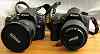
3rd gen/Micro 4/3/mirrorless/etc cameras

aggielawyer

DIS Veteran
Joined
Jan 20, 2009
Messages
576
I am by no means an photography expert, but thought I throw this out to see what others here think. Yesterday I saw Trey Ratcliff's post on what he calls "3rd gen" cameras and why he won't be spending anymore money on DSLRs. You can see his post here: http://www.stuckincustoms.com/2012/01/04/dslrs-are-a-dying-breed-3rd-gen-cameras-are-the-future/

I found the discussion interesting, and then, based on some responses on twitter, it seems that it created quite a firestorm. I'm curious what others here think.

I love my D90, but when I'm in the market for something new this will be the direction that I look. Reading Trey's evaluation I found myself wishing that I didn't have my camera and could be in the market now. The size and weight issue alone are enough to sway me...but again I am not a pro photog that needs super fancy equipment.

Anyway, just thought I'd throw it out there. Scott Bourne posted a response to Trey's post here: http://scottbourne.com/
 
Much of what Trey thinks about these cameras is interesting, but I'm not willing to make the plunge until the new generation of cameras has the features & capabilities I want.

Also, not every technical improvement gets adopted by the market. Sometimes the better technology gets supplanted by better marketing, or by an entrenched user base.

Cameras will continue to evolve and change, but I'm not yet sure that it will happen on the pace that Trey mentioned in his post.
 
I agree with most of what Trey wrote. As a 10 year user of dSLRs (and 30 years of film SLRs before that) I am quite happy with my Panasonic G3. The size and weight are what really closed the deal but the amount of useful information in the viewfinder was a pleasant surprise. The viewfinder is *huge* too, I don't miss the Canon setup at all.

For motor racing I may still use the Canon dSLR, I haven't tried the u43 setup for fast motion yet. I do know that it has some issues with fast motion in low light where an optical viewfinder works better but as Trey notes, this will be corrected in the next generation or two at the most.

Many people are hesitant to leave what they know and love for something new and different, science fiction writers have made a fortune from writing about this! ;) It was the same with the shift from film to digital. Maybe the final word is like Michael Reichmann (Luminous Landscape) notes, " no one who has looked at the photos has mentioned that they wished I had used a camera with a larger sensor...". :)
 
Here was my response yesterday to Trey on G+:

"I agree with a lot of what you said, but I have to admit that I'm surprised to be reading this from you. Well, not too surprised, because it seems you like to stay ahead of the curve (your early-adoption of the site onto which I'm presently typing is evidence-enough of that), but surprised because you are in the business of photography. I would think that given that, you'd want to keep as current as possible, even if you do already some fancy D3 cameras. It seems some of the capabilities of the cameras you're discussing are at least a few years away--are you really willing to "settle" in the meantime as the D4 makes new things possible with its incredible high ISO performance, etc?

Obviously, it's the photographer and not the camera that makes the difference, but there's no denying that certain technical limitations of ones equipment CAN affect the final image. As someone seemingly concerned with always doing things as best as they can be done, I'm a bit surprised you're willing to stagnate for a couple of years while you wait for this technology to develop. Even if you "only" miss a few shots because you don't upgrade to the D4, isn't that a sufficient-enough loss to justify having made the upgrade?

It makes a lot more sense for someone like me to wait. I don't make much money off of photography and can't write off much in the way of taxes. For me, it's an expensive hobby. For you, equipment is a tax write-off."

As for me, I'm taking a wait and see approach. I don't mind carrying a larger camera, but it's not as if I love it either. When it reaches the point where I feel the 3rd generations are accomplishing what DSLRs are accomplishing, I'll leave DSLRs without hesitation. I wouldn't be surprised if that point happens as early as late 2012.
 

He covers his hide by using a lot of future terms in his reasoning to not buy DSLRs and describing how various mirrorless cameras are the new road. It's easy enough to declare these cameras 'the future' when you leave the proposed date of 'the future' empty. Indeed, someday the DSLR may be phased out, but the various mirrorless options still have a long way to go to be able to cover all photography needs for all photographers, and even he admits they're not able to replace DSLRs entirely.

He also uses a very broad brush to describe this 'class' of camera, ranging from semi-pro DSLR hybrids like the huge A77 to the tiny-sensor P&S like design of the Nikon 1. I don't think it's really quite fair to define Sony's SLT cameras as 'not DSLRs' - by technicality they are not, but they remain large bodied, manually controlled, SLR-style designs and essentially maintain the same functionality and ergonomics as DSLRs. Whereas most folks would think of the 'mirrorless interchangeable lens' cameras to be a completely new class of camera from DSLRs..this would seem to be the fairest comparison of systems, and again it's well accepted that none of these cameras can replace DSLRs for all types of photography and all photographers.

I say this as a happy owner of one of these '3rd gen' cameras...I love my NEX, and when it comes to landscape, portrait, night, high ISO, scenic, interior, and many other types of shots, it is the equal of a DSLR, sharing the same size sensor and full slate of manual controls.

At the same time, I remain a happy owner of a DSLR...which I replaced again with another DSLR in October...because there are still clear advantages for certain types of shooting needs. Action, sports, wildlife and birds, panning/tracking, and any shooting with long lenses for me is still better served by a DSLR. What are the areas that still make a DSLR superior FOR ME over the various mirrorless options? Optical viewfinder makes panning/tracking easier, continuous frame rate supported by enormous buffers so it can shoot longer without stoppage, battery life is 4 or 5 times greater, larger body and grip are optimal for balance and handling with long lenses, phase-detect focus system working full time is faster and tracks moving targets better, larger body allows more direct controls on the body with less reliance on double-purpose buttons and menu access for control changes...just to name the key ones.

At the same time, I'm forward thinking enough to enjoy a lot of the new tech and how it can help a photographer...even on my DSLR choice, I went for one that has a real-time live view system with full phase-detect AF and no shutter delay, a tilting LCD screen which helps for odd compositions and angles, multi-frame stacking technology in camera to deal with high ISO noise reduction and HDR merging in-camera and avoiding motion blur, in-body stablization, and main sensor live view mode with night-vision-like gain up to clearly see in the dark far beyond when the optical viewfinder is too dark to see anything for composing and focusing in extreme low light. So even the 'old' DSLR can learn new tricks that help it keep up with the new tech mirrorless cameras, while still retaining clear advantages over the smaller cameras in certain types of shooting.
 
I hear a lot of yammering about needing a full frame camera to be a professional. Like it's the biggest and best out there (umm.. what about medium format?) In the end I really don't think it matters what you use as long as you end up with the images you want.

I don't see mirrorless cameras killing DSLR's. It may lessen their prevalence, but it won't kill them. This idea of a smaller, more compact camera that you can change lenses on is not a new one and the past has proven that there is room in the market for both types of cameras.

Personally I have my eye on a mirrorless for myself. I won't give up my DSLR, but I think the second camera type would add a lot to my current kit.
 
There was a time when the SLR -- film and later digital -- was not particularly popular among amateurs. I think it was in the '80s when autofocus became mainstream that they really started to explode. At no time before that point, as far as I'm aware, were SLRs "dying." I don't think they will die now. They may go back to being a bit more of a niche product, but they'll still be around. Or it may be that a product that duplicates or comes close to simulating the look and feel of an SLR -- both in form factor and mechanics of usage -- will supplant them (Sony's semi-transparent-mirror models could fall into that category).

While I understand the appeal of something lower-weight and easier to carry for long periods, I don't really want a smaller camera in my hand. And when I'm actually shooting, I like the heft of my D300. I'm probably about to order a D7000 for work use, and while I'm looking forward to a lot of what it offers, I do feel some trepidation about the differences in these particular areas. And in order to become proficient in using it, I'm going to have to take it home -- and on vacation -- and use it.

Trey may be right, but I don't think I want to give up my SLR for anything else I've seen so far, or anything similar to them. Sure, the quality of the images these new cameras produce will continue to improve going forward, but so will the images that come out of DSLRs. Those aren't going to stand still while the newer stuff tries to catch up.

Nothing lasts forever. But knowing that and predicting when, why and how changes are going to come is not as easy as some -- even visionaries and forward thinkers -- sometimes allow themselves to believe. "Diffcult to see. Always in motion, the future is."

SSB
 
I read that yesterday as well and have thought about it a lot. I'm not a pro (My pics are proof of that) but I do enjoy using the camera and trying to learn this thing called photography that so many of you are so good with. I love a challenge! Anyway I gotta agree with him, but just like the great Blu Ray HD-DVD war, until someone BIG chooses a format there will be no victor. But as soon as CaNikon begin to pour a big chunk of there R&D money into it everything will be in limbo. Even as competitors they influence the market. How will third party lens makers handle it? I dont think any of them right now make any lenses for the G3, N1, NEX, or Q lines. Is it because of distance from the mount to the sensor?

It just seems that they are all so different right now in sensor size, lens selection, & everything else that they are difficult to give accurate comparisms. Personally I'd be scared to jump into a brand before I knew that they would be able to provide a great lens line up thats at least as good as what I have now...
 
...snip...Anyway I gotta agree with him, but just like the great Blu Ray HD-DVD war, until someone BIG chooses a format there will be no victor. But as soon as CaNikon begin to pour a big chunk of there R&D money into it everything will be in limbo. Even as competitors they influence the market. How will third party lens makers handle it? I dont think any of them right now make any lenses for the G3, N1, NEX, or Q lines...snip...

CaNikon are still the big two but Sony and Panasonic are closing in. Since cameras are becoming little more than electronic boxes that hold lenses it makes sense that two of the largest electronics makers could become leaders in cameras. Nikon has shown their hand with the 1, Canon appears to be gearing up a super G series to go head to head with mirrorless. I see major flaws in both efforts, Nikon has a tiny sensor in a body no smaller than micro 4/3, Canon will have a fixed lens of very limited range. CaNikon have a lot to lose if anything (even their own products) takes away from their lens sales. Because of this I don't think they get it and won't until it is too late, when SonySonic has taken the lead in the market.

Sigma is part of the micro 4/3 group and is getting some lenses ready. Between Panasonic and Olympus micro 4/3 already has the largest lineup of lenses in the mirrorless world, one reason I went with a G3.

Fuji is just launching their X Pro 1 into the fray. Exciting times, these!
 
CaNikon are still the big two but Sony and Panasonic are closing in. Since cameras are becoming little more than electronic boxes that hold lenses it makes sense that two of the largest electronics makers could become leaders in cameras.

I disagree somewhat. Photography isn't just about electronics. It's about physics. The light has to bounce off a subject, reflect through the lens, and land on the sensor. There is surely a role that electronics plays, but it's somewhat limited by the physics involved, which is why smaller sensors are more susceptible to digital noise than larger ones.

However, it's the lens that matters when collecting that light to land on a sensor. Canon and Nikon have a lot of expertise there, where Sony & Panasonic have to outsource.

Basically, cameras are just what you said - electronic boxes that hold lenses. Those lenses, however, are the magical ingredient.
 
How will third party lens makers handle it? I dont think any of them right now make any lenses for the G3, N1, NEX, or Q lines. Is it because of distance from the mount to the sensor?

Actually, they are starting to get onboard. Tamron already has an 18-200mm lens available for the NEX system...has been in stores for a month or so now...and Sigma has released pre-production shots of an upcoming NEX lens. As Bob mentioned, Sigma committed to M4:3 and NEX already, so lenses are likely in both lines from them.
 
However, it's the lens that matters when collecting that light to land on a sensor. Canon and Nikon have a lot of expertise there, where Sony & Panasonic have to outsource.

Basically, cameras are just what you said - electronic boxes that hold lenses. Those lenses, however, are the magical ingredient.

True... glass is important. Panasonic has a deal with Leica. Panasonic does build the lenses but they worked with Leitz and the lenses have to meet Leica standards. There are Zeiss lenses available for the NEX line. I'd put those names up with Canon and Nikon any day. Really, my old Leica lenses are better than my newer Canon lenses.
 
And it's worth mentioning that Sony never had to develop its own lenses for their DSLR line - aside from their Zeiss deal, they also took over Minolta's DSLRs - Sony's first DSLRs were not much more than rebadged Minoltas...and they also inherited the excellent line of Minolta lenses, with nearly all current Sony lenses being evolved Minolta AF lenses (whose heritage goes back to 1986 in AF form). It's not like a Playstation company suddenly started trying to build their own lenses from scratch a few years ago.
 
My biggest issue with 4/3 (or "3rd gen's") is sensor size. Smaller sensors, especially like Nikon's CX and the Pentax Q have 3 big issues; poor noise performance, pixel density and dynamic range. The Q has also proved diffraction issues. The noise levels have gotten better from model to model, but they're still not where current dSLR's are. Same goes for DR. Pixel density is going to be a problem down the line as well. The NEX line looks pretty good, using a APS-C sized sensor and in a year or two, they may be able to fully compete for customers in the dSLR market, but not right now. Along with the above, lens choices are still limited (that holds true for Sony in general) and power usage needs to go down a bit before I'll consider biting. If I ever bite. I'm looking to move to FF and all of it's benefits, not move down and size and lose IQ, DR and high ISO usability.

Quite honestly, I like my big bodies. Every SLR I have ever owned, short of I think my first Nikon body has been a full size or otherwise equipped with a motor drive or vertical grip. I tried both my D100 and D7000 without a grip and I just don't like it. I like having a portrait shutter and I also like the additional length it provides when holding it in landscape.

4/3, u4/3, etc certainly bring a lot of things to the table though. Lack of mirror slap only helps to increase IQ and if they ever get them built to "professional standards", sports photogs are going to love the ever living bajesus out of the stupid high FPS that they are able to achieve. And right now they're not terrible I suppose, if you shoot in great lighting. I don't. In fact, I would guess that 90% of my shots are in terrible indoor lighting (more often than not where I can't use a bounce), concerts or haunted attractions. Fast glass and high ISO performance is very important to me.

Personally, I would like to see a move closer to Sony with translucent mirror technology.
 
In the end I really don't think it matters what you use as long as you end up with the images you want.
Ain't this the truth. :thumbsup2

DS and I added a PEN to our Olympus dSLR line up and it is one nice little camera.
 
I guess it really depends on what you plan to do with the camera. I have both APS-C and M43 and I brought the M43 with me on my last trip to WDW. I welcomed the much lighter weight and I never felt hampered by it's capabilities. When I compare my M43 results to my APS-C results I find them to be close enough. When size and weight are not an issue I do prefer to use APS-C. It seems to operate faster and it has a more solid feel. I have more lenses and flashes for APS-C, it's controls are more advanced than the controls on my M43, it is easier to get a shallow DOF with APS-C, and APS-C has an IQ advantage in some lighting conditions.

The EVF used in M43 is very cool, you can access the full graphical menus right from the EVF. Everything can be set without using the rear LCD. You can also do image playback in the EVF. The end result is the camera does not have to leave your eye when setting, composing, checking results, recomposing, setting focus points, etc. I leave my rear LCD closed and turned off most of the time, I only use it when playing back images for someone.

A297F00EAAD64DDEB8BE2017E9385160.jpg


EC411BEE28AF4C83BB92C3FE3793A99E.jpg


Disney Vacation Planning. Free. Done for You.
Our Authorized Disney Vacation Planners are here to provide personalized, expert advice, answer every question, and uncover the best discounts. Let Dreams Unlimited Travel take care of all the details, so you can sit back, relax, and enjoy a stress-free vacation.
Start Your Disney Vacation
Disney EarMarked Producer


DIS Facebook DIS youtube DIS Instagram DIS Pinterest DIS Tiktok DIS Twitter
Add as a preferred source on Google

Back
Top Bottom