What An Enchanting Place! Saint Augustine Friday, August 16th, 2024 Part 3
Welcome back everyone and I hope everyone is having a Happy New Year and a wonderful start to 2026!

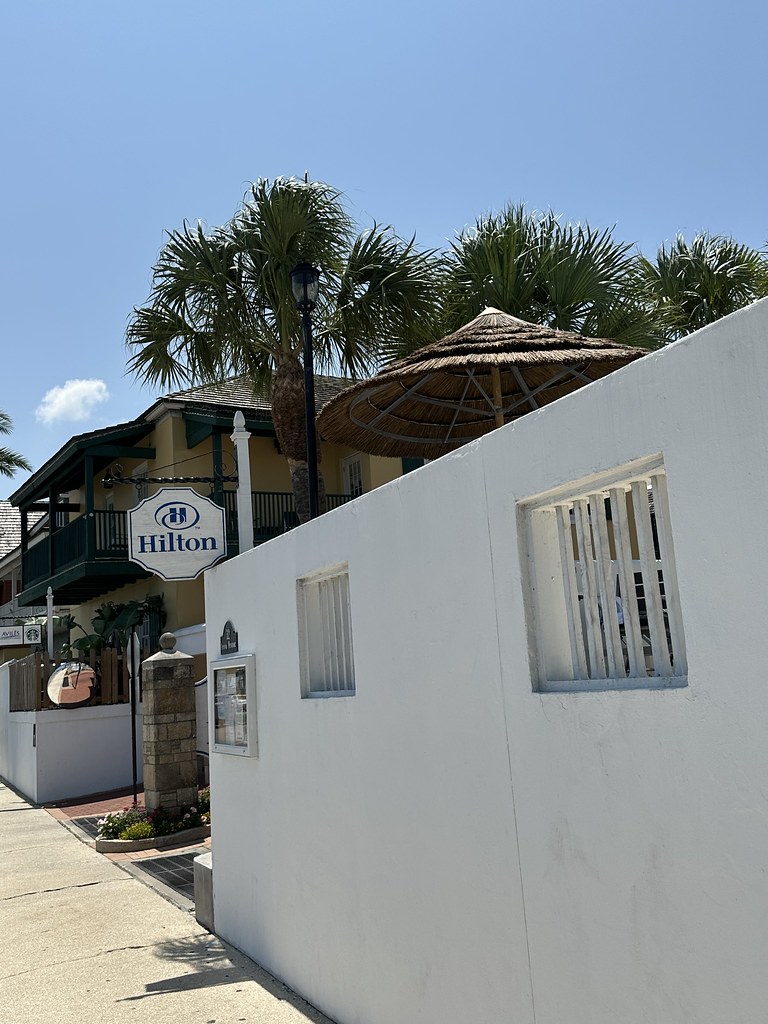
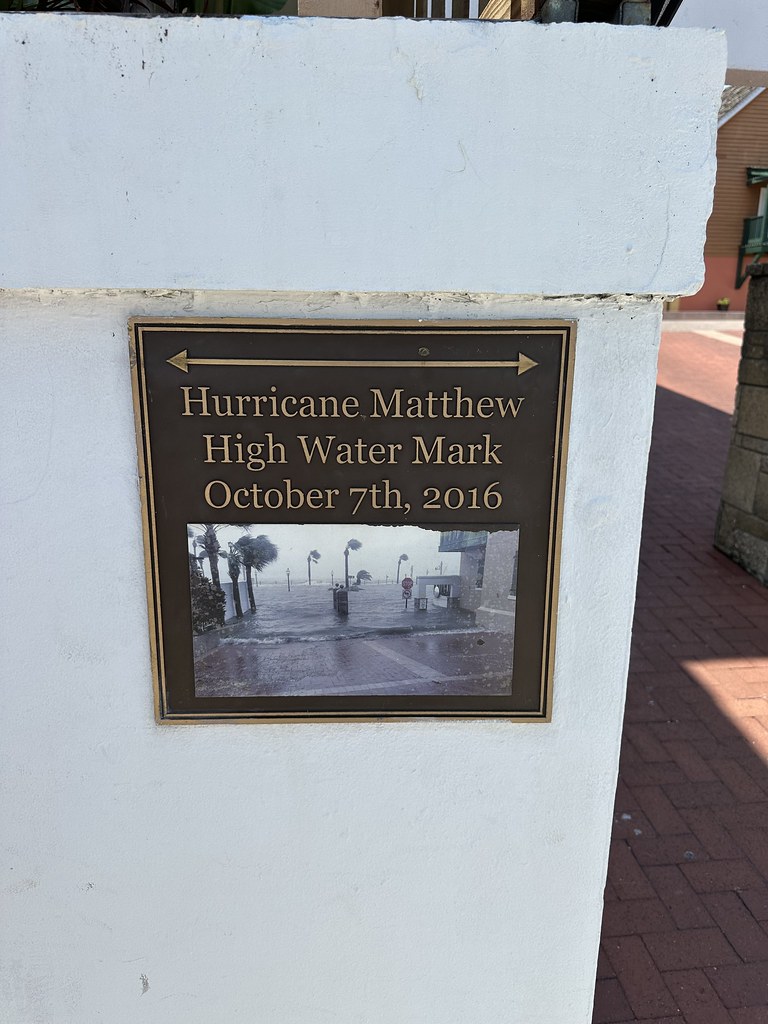
When I last left off, we marveled at the Castillo de San Marcos, the famous Spanish fort that protected Historic Saint Augustine, however, myself and my Mother were in need of a little break from touring before we would head over to our next destination, The Lightner Museum. We were walking southbound on San Marco Avenue to the main drag of Historic Downtown Saint Augustine. We were not sure where we wanted to head to lunch and due to multiple food allergies and preferences, as I mentioned earlier in the TR, my Mother packed her own lunch. I was not too picky about where we would go, but I was fine with simple food. Due to knowing that there would be a greater selection of restaurants near King Street, we continued walking back towards King Street. As always, we loved taking in more of the scenery and as we passed this structure that was a Hilton hotel, something interesting caught our eye. We learned that the entrance acted as a High Water Mark during Hurricane Matthew, which impacted Saint Augustine on October 7th, 2016.
We then turned right onto Cathedral Place to head east, as this short street runs parallel to King Street. As we walked, we passed the Cathedral of St. Augustine. The structure was mainly sand colored, save for the pink Spanish tiles on the roof. Additionally, there were towering pillars on each side of the front entrance and statue work on different parts of the building.
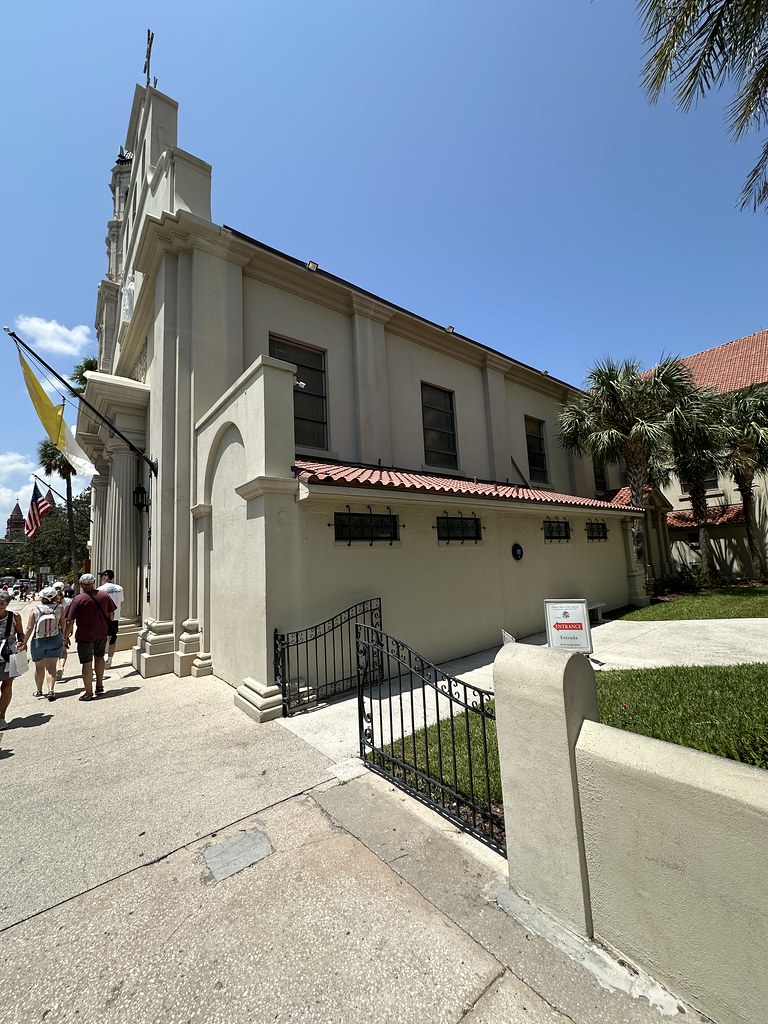
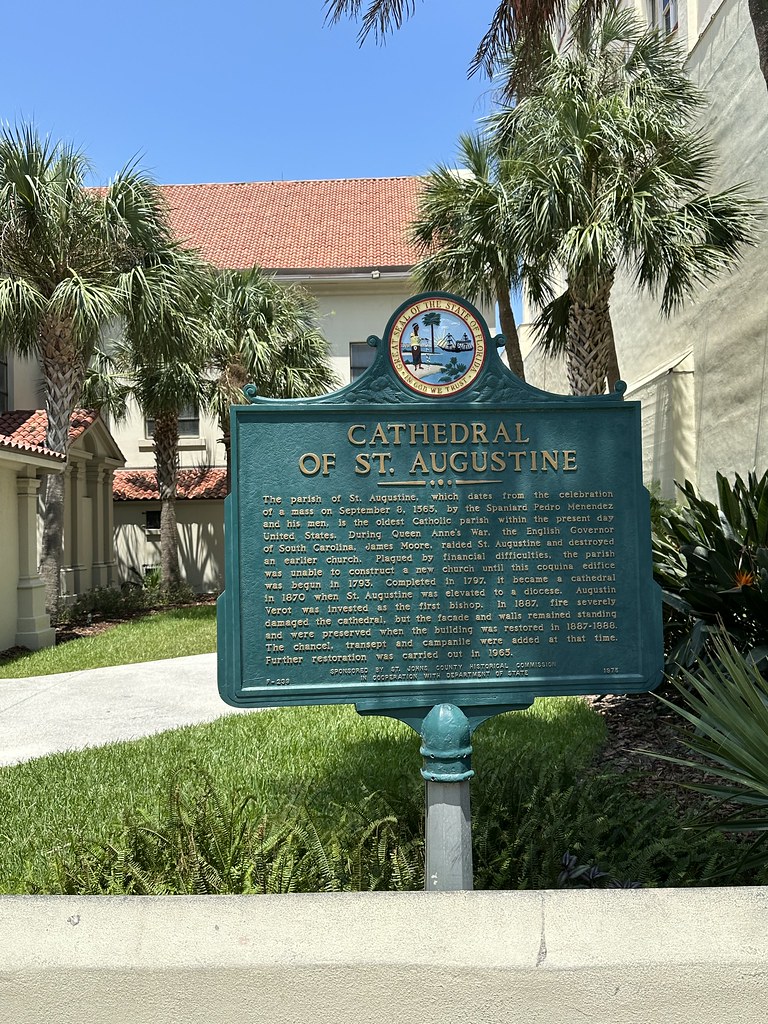
This building houses America's oldest Catholic parish, dating from the celebration of a mass on September 8th, 1565 by the Spaniard Pedro Menendez and his men. James Moore, the English Governor of South Carolina raided St. Augustine and destroyed an earlier church during Queen Anne's War. Due to financial difficulties, the parish had to wait until 1793, when it was able to obtain a coquina edifice. The church was completed four years later in 1797 and years later in 1870, the Cathedral of St. Augustine was elevated to a diocese, with Augustin Verot becoming the first bishop. Unfortunately, the Cathedral of St. Augustine was damaged by a fire in 1887. Thankfully, the facade and walls remained standing and were preserved as the building was rebuilt from 1887-1888. At the same time the Cathedral was rebuilt, the chancel, transept, and campanile were added. The building was restored in 1965 and stands proudly as an important part of St. Augustine's religious history.
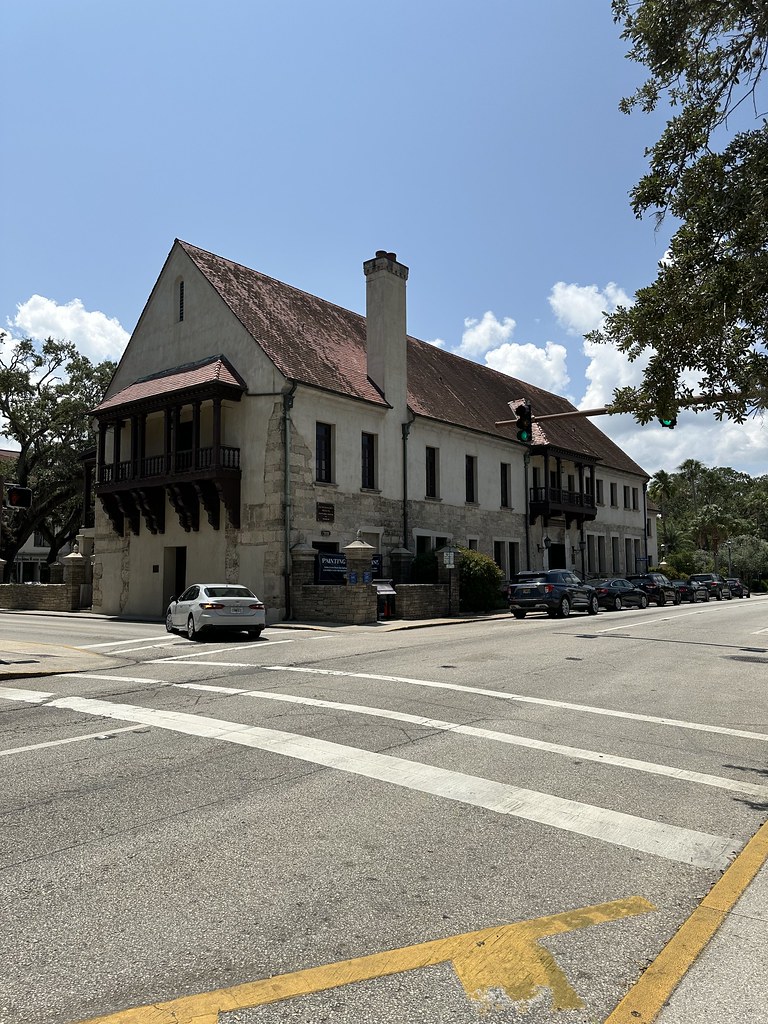
As we turned left at St. George Street to head one block south to King Street, we then saw the Governor's House Cultural Center & Museum. The base of the building appeared to be made of coquina masonry and had a roof of pink shingles, which were brown in spots, likely due to weathering.
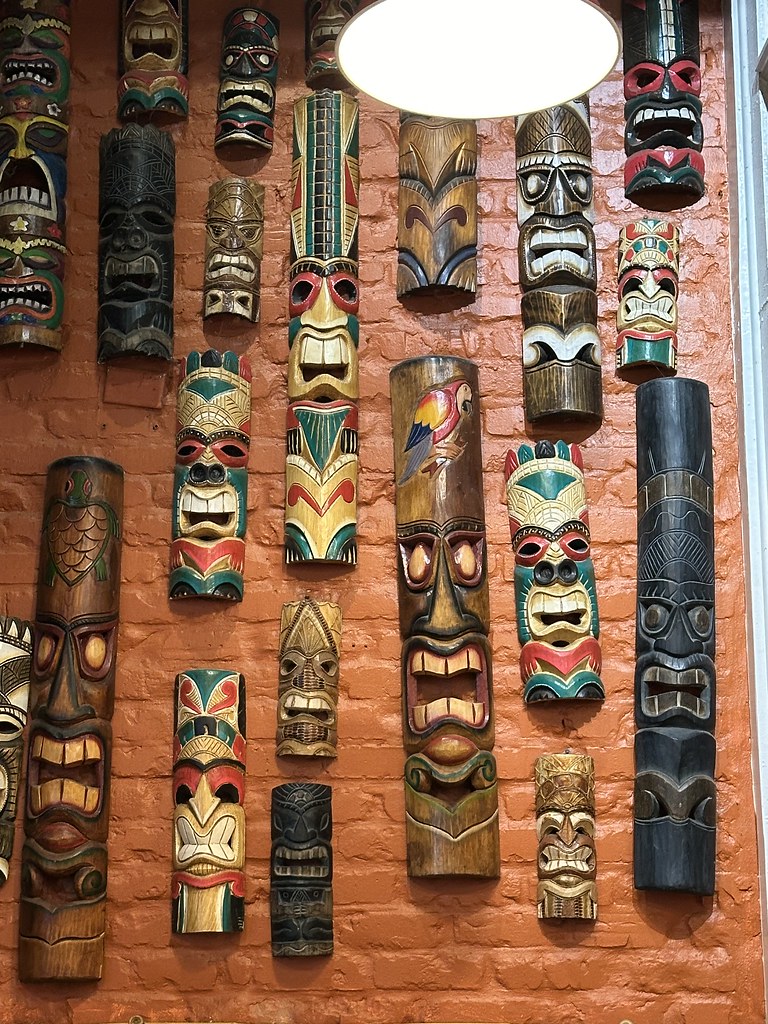
As we were walking, I did some research on a place to go for lunch and based on review apps as well as location, Barefoot Bill's would be a good place to grab a bite thanks to its simple menu, fair pricing, and the fact it would provide some welcome relief from the heat. We got a little lost finding it, but thankfully, we stumbled on a nearby tourist information booth and were pointed in the right direction. It turned out that Barefoot Bill's was located within Heritage Walk Shopping Village, an indoor marketplace with an eclectic collection of shops and restaurants. Although it was on the smallish side, it sort of reminded me of other indoor marketplaces I have visited, like New York's Chelsea Market, Boston's Fanueil Hall, or Jerusalem's Machane Yehuda. We entered Barefoot Bill's and with the time being just before 2:00PM, it was not crowded, so Nikki, our waitress, greeted us warmly and was able to seat us right away! Once we got seated, we took in the atmosphere, which was quiet on the account of being uncrowded and had a tropical feel, on account of the tiki heads festooning the wall.
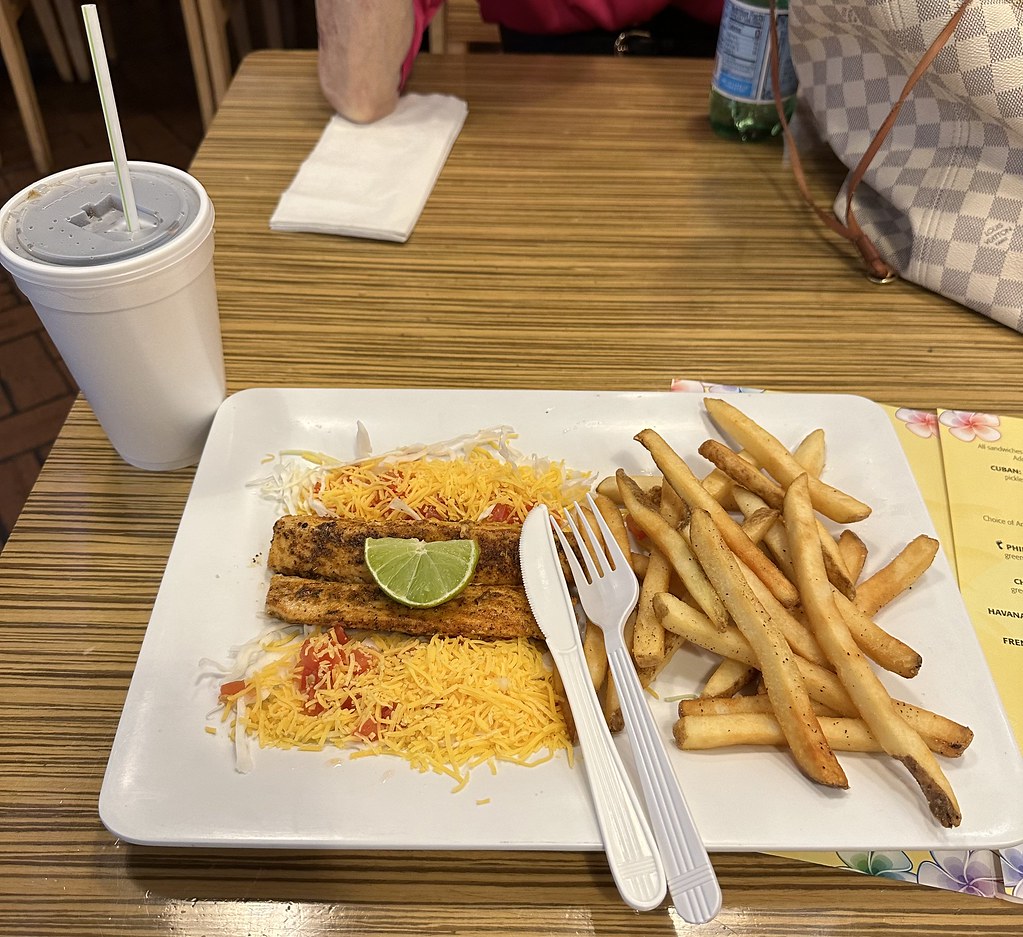
Additionally, the AC was on full blast, providing welcome relief from the heat outside. A few minutes later, Nikki returned to take our drink orders and provide us menus. While my Mother drank a bottle of sparkling water she took with us, I opted for a Diet Coke. I perused the menu and there were many appealing options, ranging from burgers to chicken sandwiches to seafood dishes. Ultimately, I was split between one of the many grilled chicken sandwiches on the menu as well as the Fish Tacos (2) prepared Grilled, Blackened, or Fried. Additionally, they were served with shredded cabbage, tomatoes, onions, cheddar cheese, and Barefoot Bill's chipotle sauce and also served with a side of Fries. I asked Nikki what she would recommend of the two options I was considering and she said that both were excellent, but that she preferred the Fish Tacos, which used Mahi Mahi as the fish. This woke up my appetite, as I love Mahi Mahi and enjoy it grilled or blackened with spices in various preparations. I also informed Nikki that I had allergies to all grains except for corn and rice as well as eggs and right off the bat, her knowledge of the menu and food allergies impressed, as she informed me that the tortillas used for the fish tacos were flour based, which would be a no go! Additionally, although I knew the chipotle sauce was mayo-based, also a no go, Nikki right away knew that she would leave this off as well. Since corn-based tortillas were unavailable, she offered to make a deconstructed plate of fish tacos, which I would be looking forward to. I also opted to have them blackened, as I wanted a little bit of spice to complement the fish. With my order placed, I relaxed with my Mother, already feeling a little bit more recharged, mainly thanks to the air conditioning being in full blast on this scorching day! Additionally, we talked about our day, all of the fun we had, and how we were looking forward to visiting the Lightner Museum after lunch! Not too much later, Nikki came back with my deconstructed Fish Tacos, which despite lacking tortillas, looked fine. I then tucked into my lunch and found it to be OK, but definitely not the best iteration of blackened fish taco or sandwich I have had. I found this to be the case as while the fish tasted ok, especially thanks to the piquant cajun spices used to blacken it, I found the texture of the fish to be overly soggy (maybe it was not dried slightly after cooking?), detracting from the quality of the dish. I did not send the dish back as I was quite hungry and it was otherwise edible, so it may have been a preparation issue? Everything else on the dish was fine, including the sharp cheddar cheese, ripe and savory chopped tomatoes, and mild shredded cabbage. However, the fries were my favorite part of the dish, as they were crispy on the outside and fluffy on the inside with an earthy flavor complemented by piquant cajun spices on the outside.
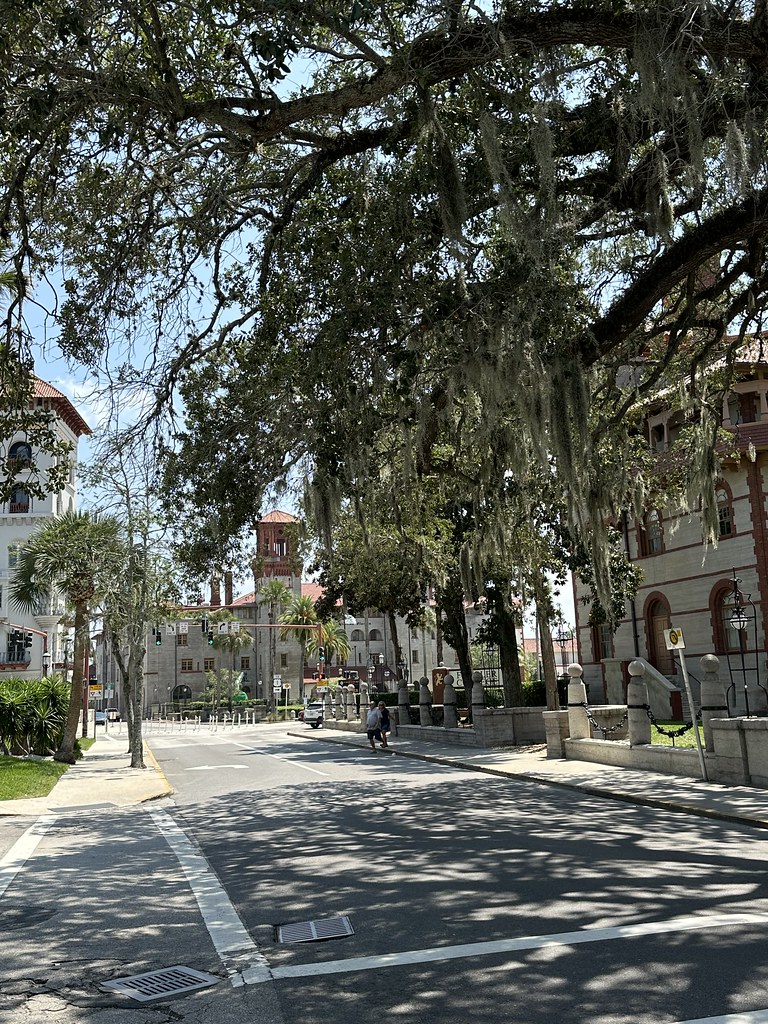
Once we were finished with lunch, I then paid our bill, which was about $20 in change before tip if I remember correctly. Although the price at the face would normally be OK, I thought it was just a bit high due to the fact that I have had larger portions of fish for the price and the fact that the quality was just OK. Although I enjoyed the atmosphere of Barefoot Bill's as well as the warm and efficient service provided by Nikki, I would not be in a hurry to go back to Barefoot Bill's if and when I visit Saint Augustine again as I am confident that there are even better options. Before leaving the restaurant, we used the clean restrooms one last time and after that, we left and began making our way to the Lightner Museum. We exited Barefoot Bill's, turning left to walk southbound along Cordova Street to head back towards King Street. The weather, while hot, was beautiful and the branches of Spanish Moss Trees made it feel like an enchanted forest, even in the middle of this bustling section of town.
Lucky for us, we were not far from the Lightner Museum and all we had to do was cross King Street. After crossing King Street, we were super close to the Lightner Museum, which was located behind Parque de Mendez, a small park on the southbound side of King Street and additionally, the building was between Cordova Street on its eastern side and Granada Street on its western side. After crossing King Street, we continued along Cordova Street, across from the illustrious Hotel Casa Monica and entered Parque de Mendez. Although Parque de Mendez was bordered by buildings built in what appeared to be a Mediterranean style, this park felt quite serene thanks to the many palm trees and other plants surrounding the long, rectangular shaped pool with a fountain in the center.
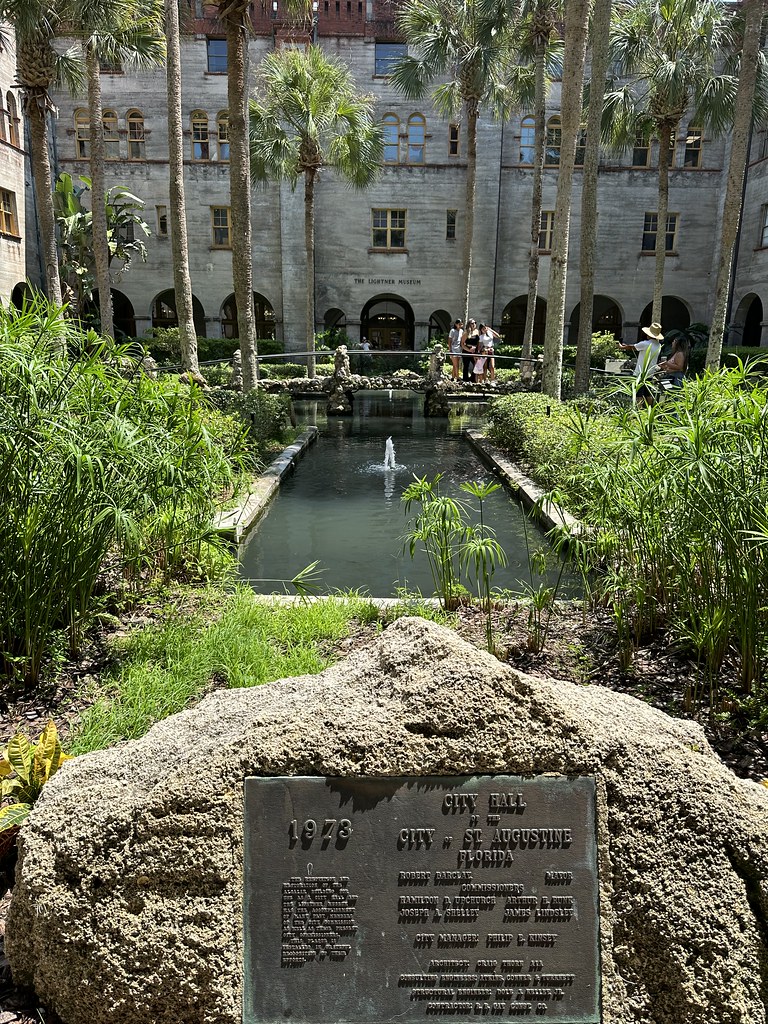
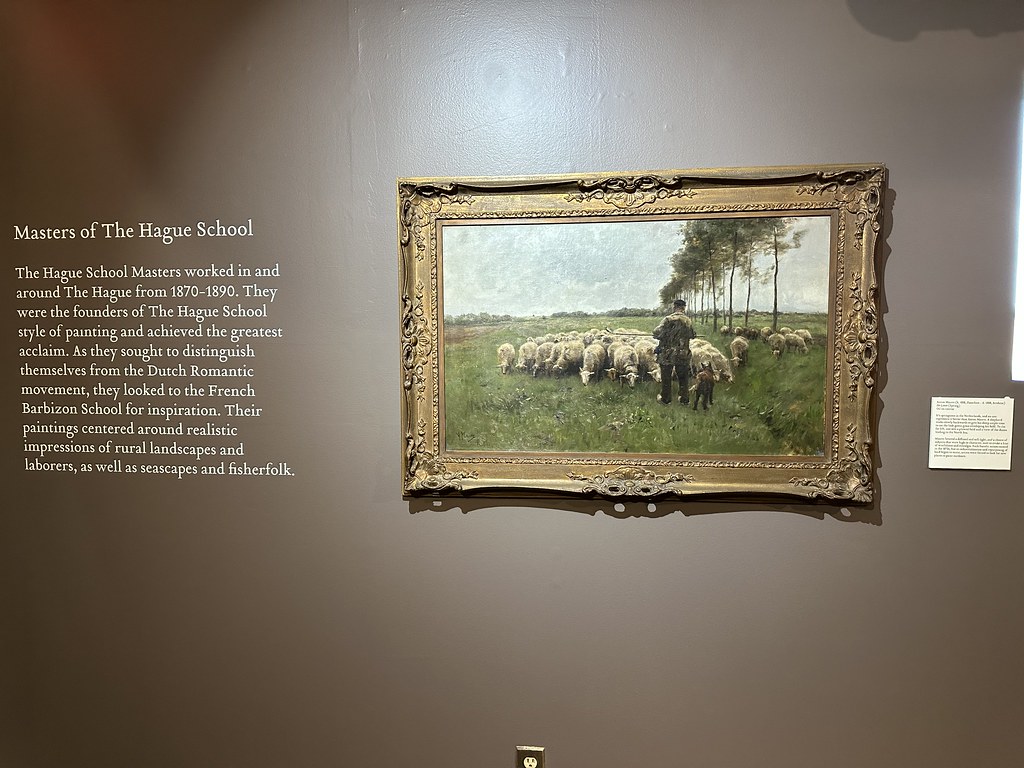
A few minutes later at a little bit before 3:00PM, we entered the Lightner Museum. As expected, the Lobby of the Lightner Museum, which was once the lobby of the Hotel Alcazar, was magnificent! Speaking of the Hotel Alcazar, it was Standard Oil executive Henry Flagler 's second hotel in Saint Augustine, after he built the Hotel Ponce de Leon. Once inside, we went to the ticket window, where we were helped by a kind Ticket Agent. We purchased two Adult Tickets and we were informed that the main exhibit would be one featuring artifacts and art from "The Gilded Age" from the late 1800s through early 1900s. Additionally, the young lady helping us also added to check out the collection of Dutch paintings, piquing our interest further! Tickets now in hand and rip roaring and ready to go, we took in the Lightner Museum's ornate lobby, excited to see the exhibits. On the advice of the Ticket Agent, we started with the Dutch paintings, so we took the elevator to the top floor. Once we got off of the elevator on the Fifth Floor, there was an excerpt about the Masters of the Hague School, who worked in and around The Hague from 1870-1890. The Hague School Masters found The Hague School style of painting, which unlike the Dutch Romantic movement, another common art style, used inspiration from the French Barbizon school. The Hague School Masters achieved this by painting scenes of realistic looking scenes such as rural landscapes and laborers, as well as seascapes and fisherfolk. This oil on canvas of a shepherd with his sheepdog and flock of sheep, was definitely vivid in presentation and beautiful to look at. The painting below was known as "De Lente" (The Spring) by Anton Mauve and in addition to the subject matter, used soft lighting and an emphasis on the subjects. With its classic oil medium, use of light, and the depiction of real life, this painting definitely called my name, but little did I know that it was just the beginning!
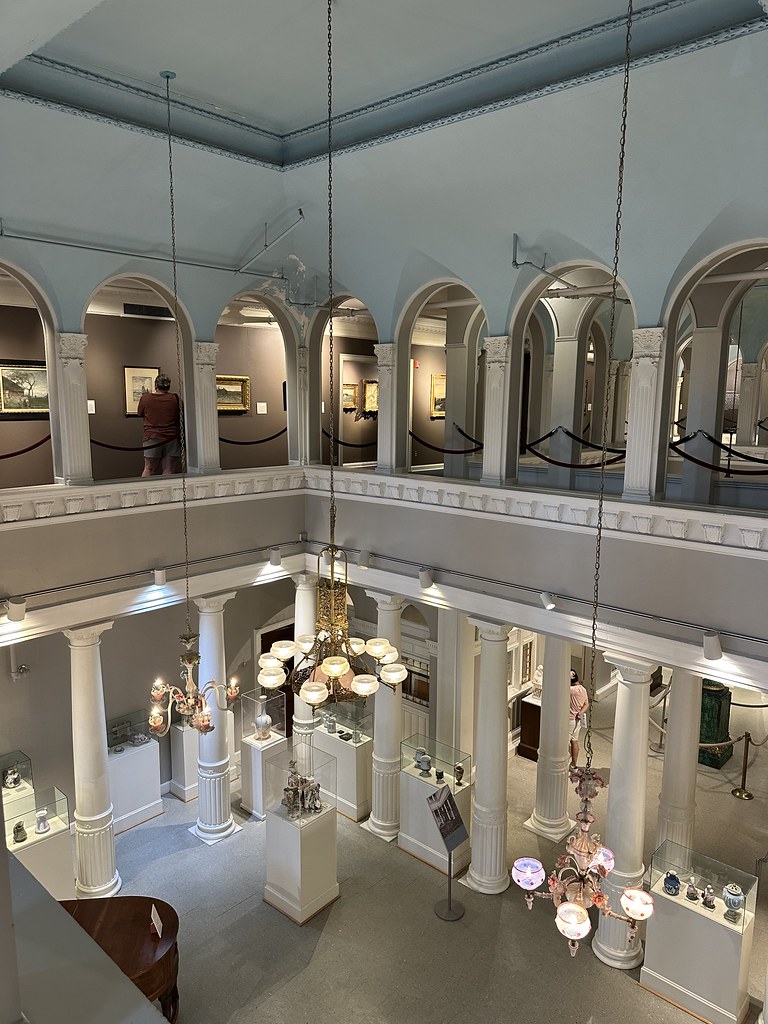
Walking away from where we viewed "De Lente" into more of the exhibit, we looked down to the floor below, which had detailed chandeliers hanging all the way from the ceiling above us. This set up an atrium for the section of Fourth Floor we could see below. Additionally, we could see that there were collections of what appeared to be vases and other sculptures. Also of note, the portions of the Fifth Floor were supported by towering pillars from below and looking across, we appreciated the detail of the multiple arches looking across that acted like windows.
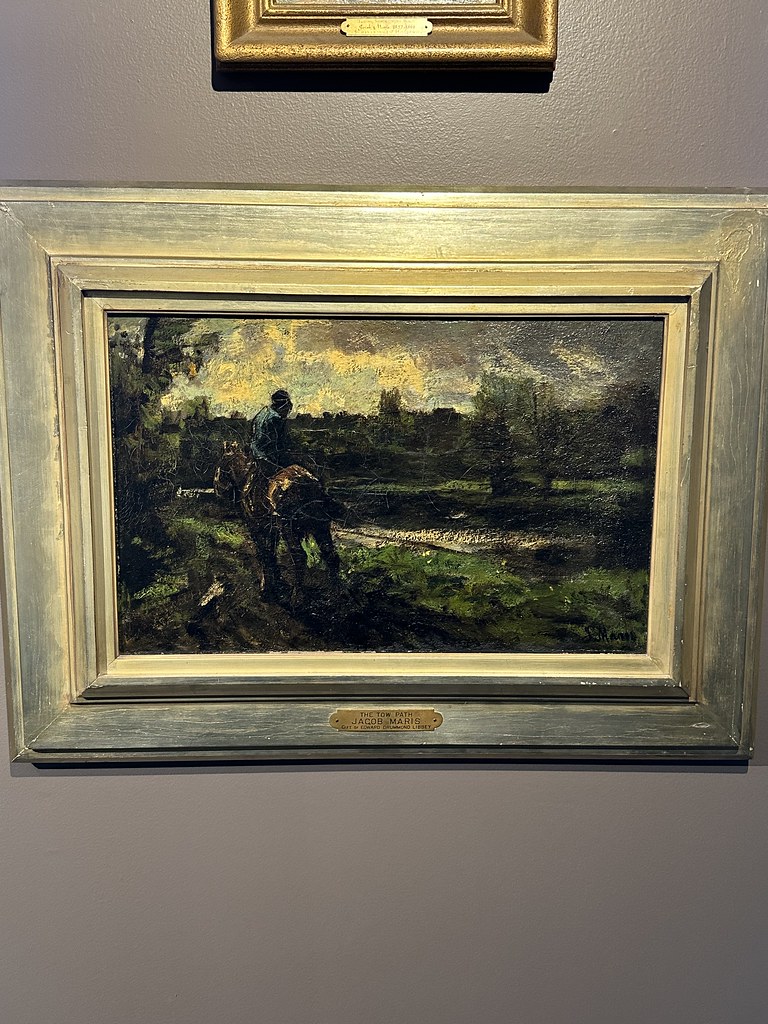
We continued to be impressed by the many oil paintings we saw, like "The Tow Path" by Jacob Maris. Just like "De Lente" earlier, it made use of realistic looking scenes related to nature, which depicted a man on horseback in the sunset. We appreciated the shading techniques, which used multiple shades of yellow mixed with dark blues to depict an evening sky and the outlines of the trees and grass, making this painting pop!
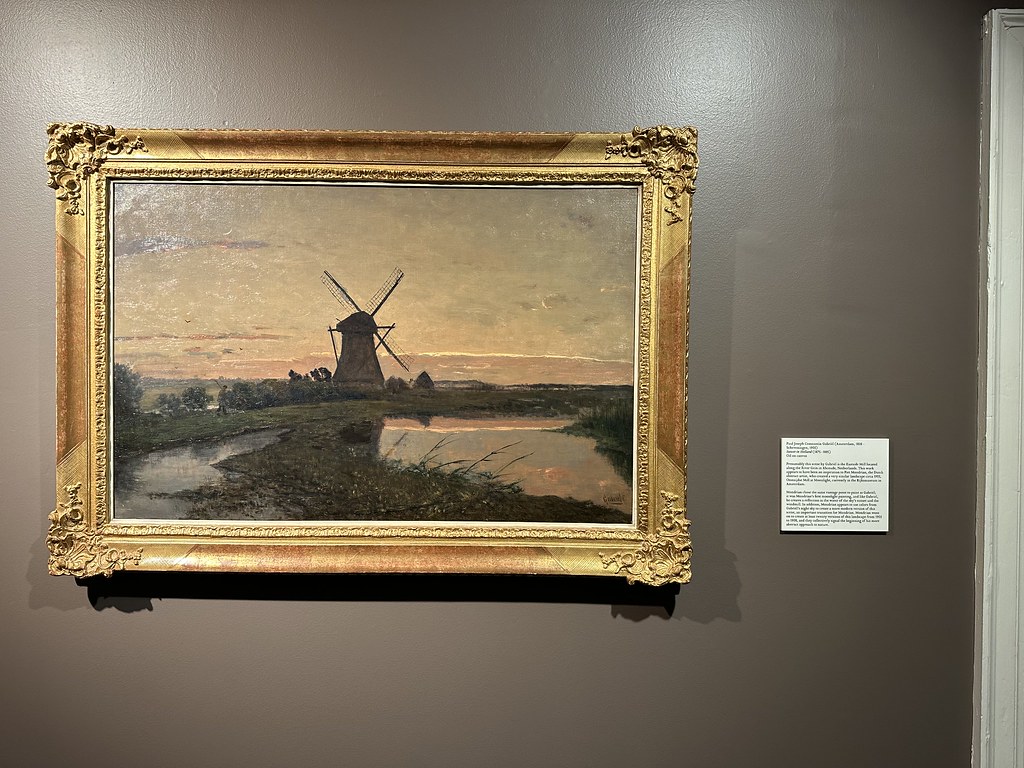
"Sunset in Holland (1875-1885)" by Paul Joseph Constantin Gabriel (Amsterdam, 1828-Scheveningen, 1903), depicting what was likely the Eastside Mill located along the River Gein in Abcoude, Netherlands. This work was significant as it inspired Piet Mondrian, the famous Dutch abstract artist to create a similar painting in 1901. To my eyes, this painting was especially idyllic and looked like something plucked from a storybook!
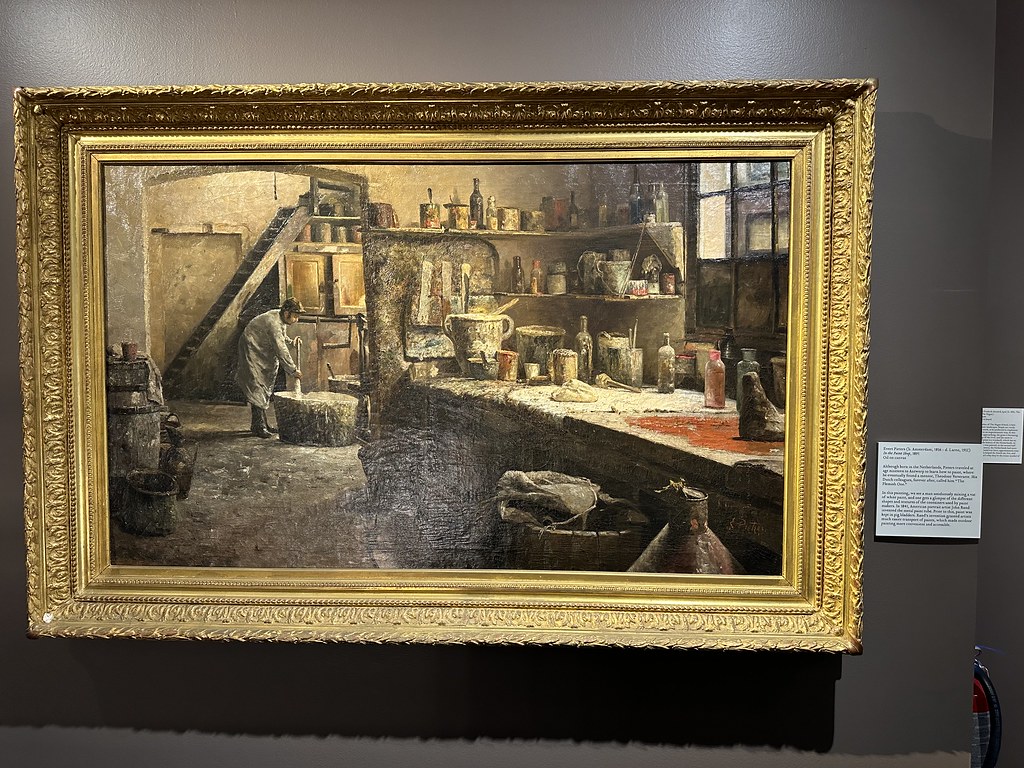
The oil on canvas below, known as "In the Paint Shop, 1891" by Evert Pieters (b. Amsterdam 1856-d. Laren 1932) continued the realism theme we saw in the other paintings so far, but broke from the using an outdoor landscape. This painting gave an examination into the process of how paints were mixed, as the man was mixing white paint in a metal vat. According to the information listed next to "In the Paint Shop," meta paint tubes were used. Metal paint tubes were invented by American portrait artist John Rand in 1841. Before this point, paint was stored in pig bladders. Thanks to John Rand, transporting paints was made far easier and made painting even more accessible!
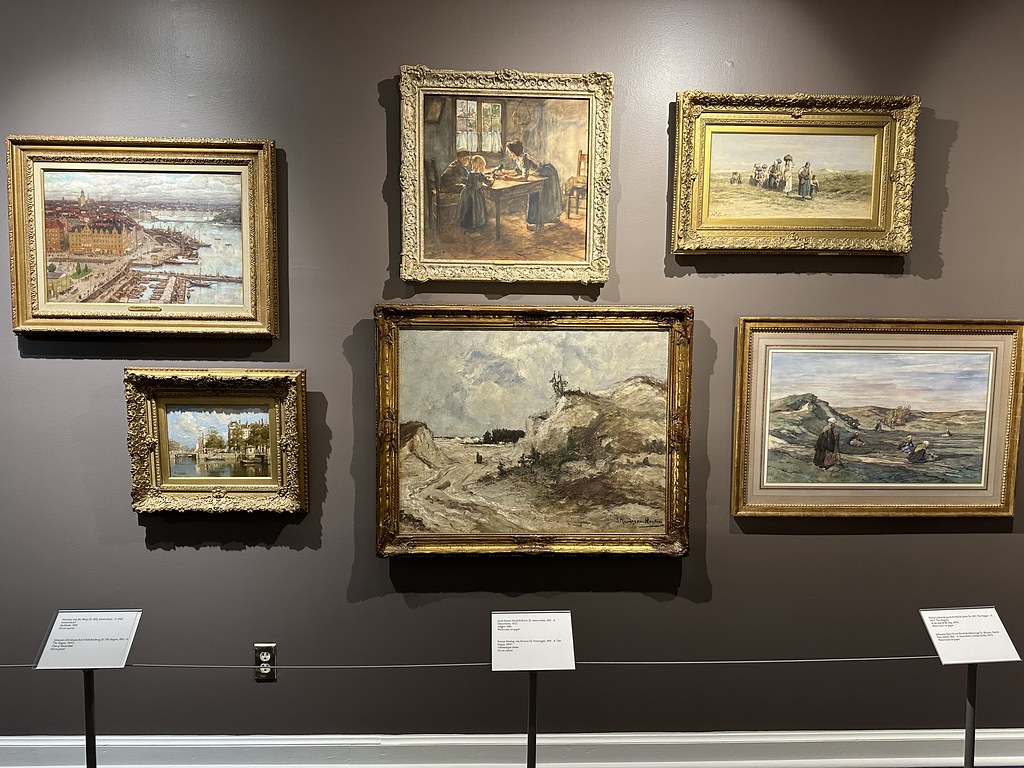
We then saw more oils on canvas with different depictions of real life. From left to right they included what appeared to be: a painting of a cityscape, another painting of a cityscape emphasizing the river, a Mother with her children, some hills, which although looked kind of barren did make neat use of shading, a family walking through a field, and women gathered in the mountains. All of these paintings had terrific detail and we loved their depictions of real life!
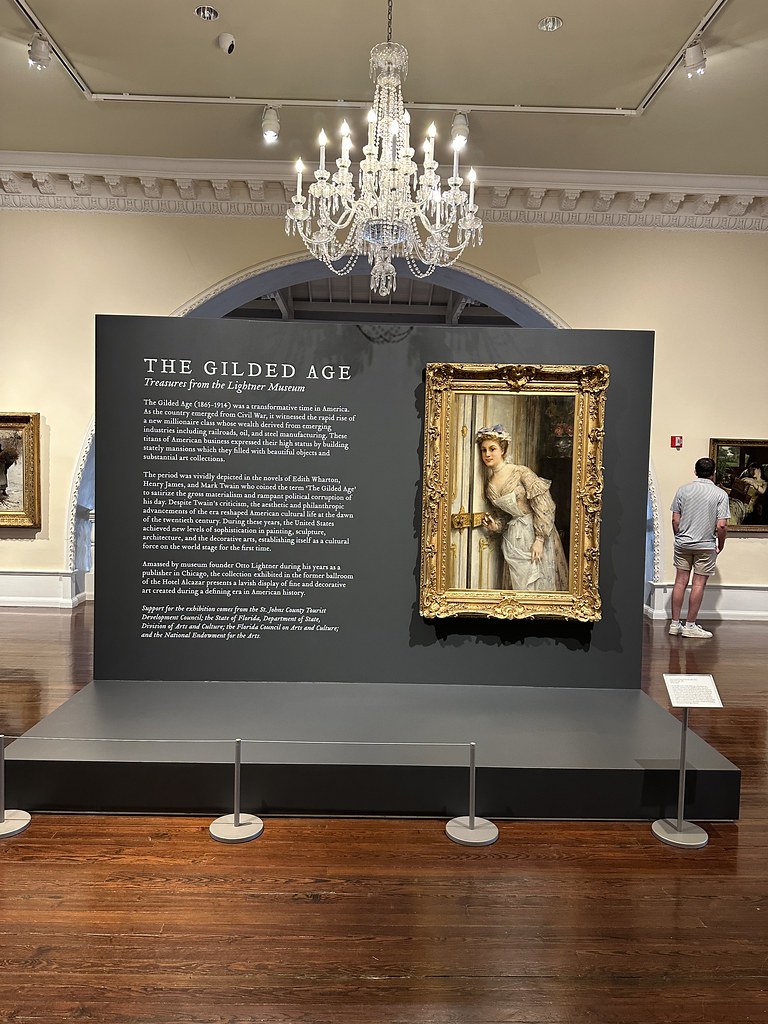
After taking in the oil paintings, we then headed down to the Third Floor, as we wanted to check out the exhibit on The Gilded Age. According to the information below, The Gilded Age, which took place from 1865-1914, gave birth to a new millionaire class which came to fruition thanks to the rise of industrialization in the United States. Important industries during this time in our nation's history included railroads, oil, and steel manufacturing. With their new wealth amassed, these magnates would express their status through building stately mansions, which they would fill with beautiful objects and massive art collections! How did the term 'The Gilded Age' come to life? It was coined by American author Mark Twain, as he used the term to satirize the gross materialism and rampant political corruption of this time period. However, there was no denial that this point in our nation's history reshaped America's status as a cultural force thanks to new levels of sophistication in painting, sculpture, architecture, and decorative arts. This particular exhibit was amassed by Otto Lightner, the museum founder during his years as a publisher in Chicago. His collection, consisting of paintings and other artifacts, were exhibited in what was once the former ballroom of the Hotel Alcazar, where we now standing on this very day!
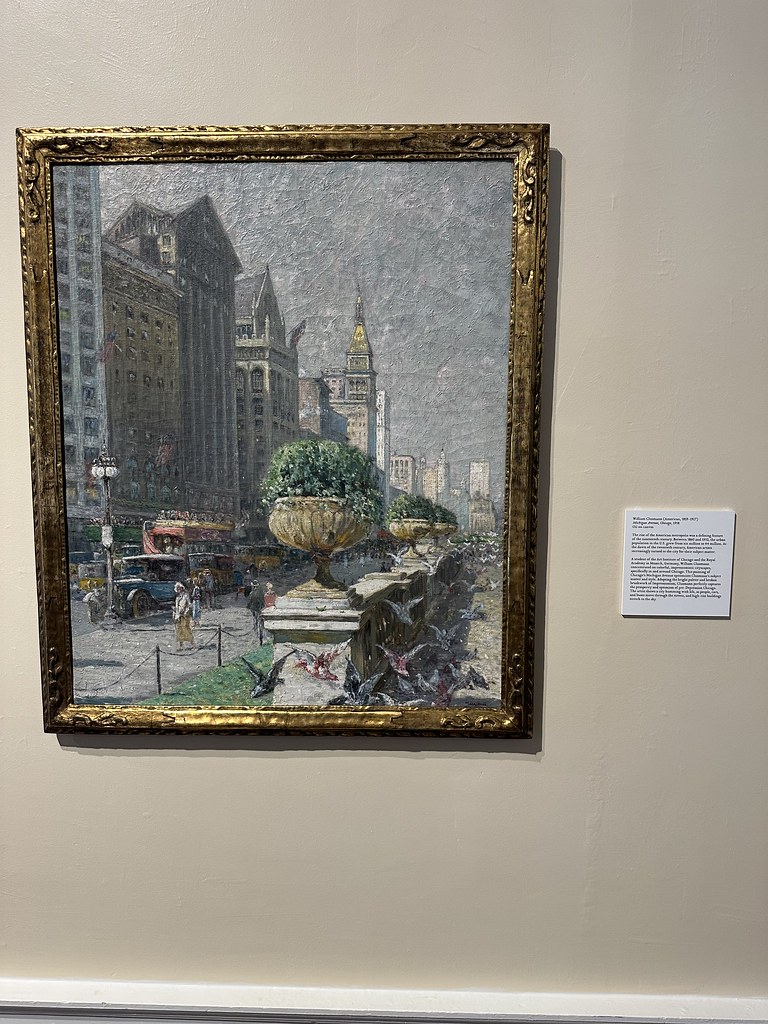
Starting with the perimeter of the exhibit closest to where we entered, this oil on canvas, known as "Michigan Avenue, Chicago, 1918" by American artist William Clussmann (1859-1927), was eye catching for sure! This cityscape depicted Chicago's Michigan Avenue, which was bustling with life in the early 1900s. According to the information listed next to the painting, Clussmann was a student of the Art Institute of Chicago and the Royal Academy in Munich. His main study was impressionistic cityscapes, which explained this painting's depiction of hustle and bustle, bright colors, and broken brushwork.
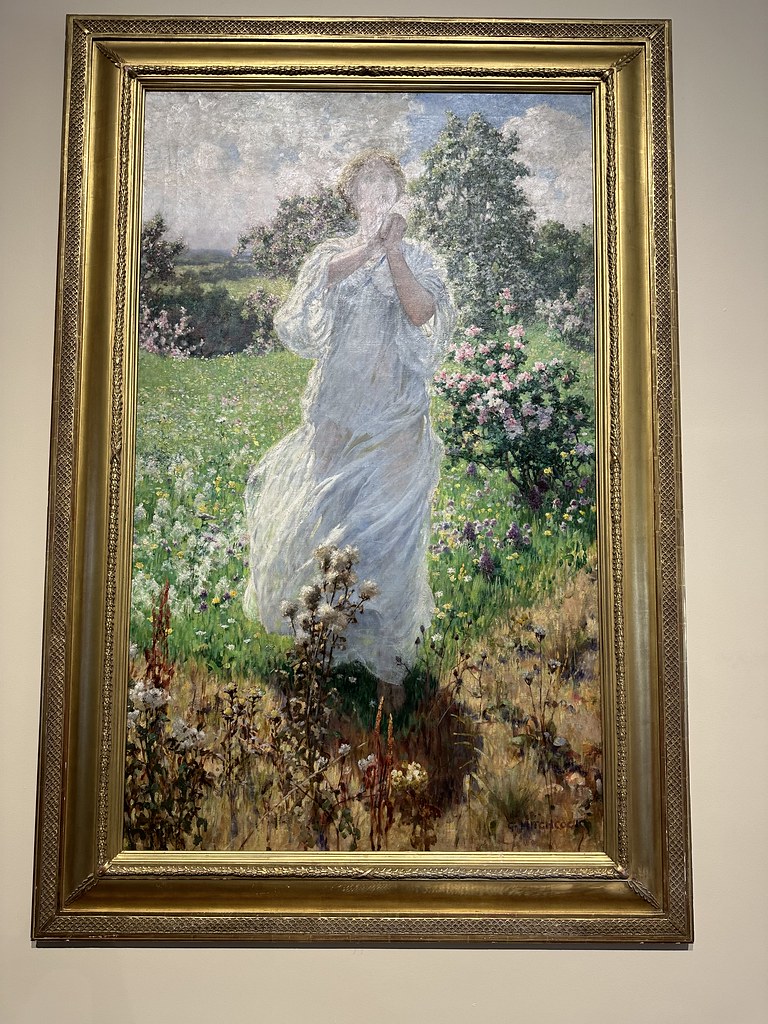
The following oil on canvas we viewed depicted a woman, clad in a white robe in a forest and/or field surrounded by trees in the background and what appeared to be dandelions in the foreground. Just like many of the Dutch oils on canvas we viewed earlier, this painting's subject matter depicted a realistic scene of nature.
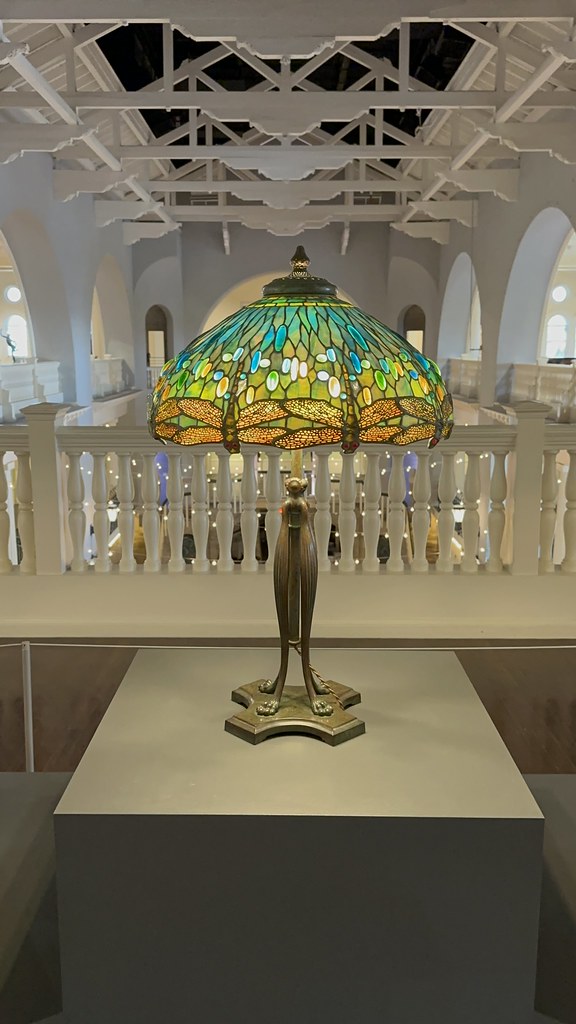
Walking more towards the center of the exhibit, this lamp, which used what appeared to be multicolored stained glass for its dome, caught my eye and had me waxing nostalgic, as my late grandparents used to have a beautiful lamp or two that looked similar to this one in their winter home in Highland Beach, FL. I am not sure what happened to them, as the apartment where they lived was sold in late 2012, so its possible they were sold as well?
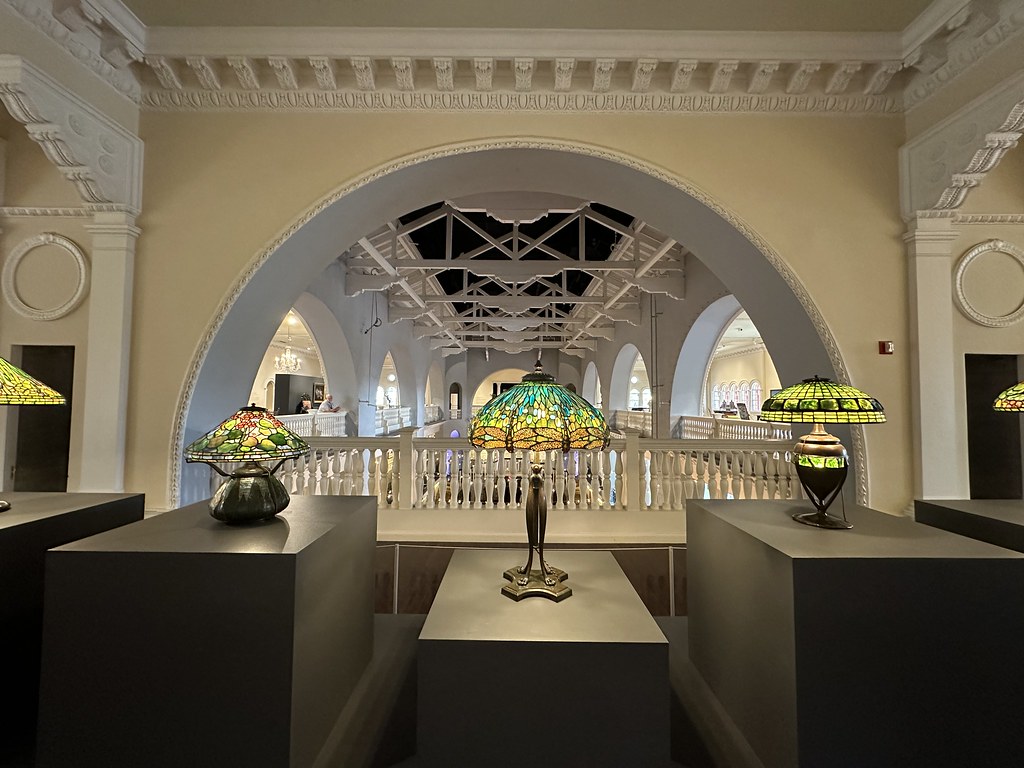
The lamp I just saw with more lamps
With the Lightner Museum's incredible collection of art we had seen so far, we were having an incredible time and I was especially grateful my Mother had decided to make this the main attraction we would see in beautiful Saint Augustine. What other treasures would we see? Find out soon!


Boston is very cool too and it is also pretty amazing that we both work in travel related industries, especially as you mentioned working for Starwood, which was taken over by Marriott sometime in the late 2010s if I am not mistaken. How did you like working at Logan Airport and at the hotel? I love working in front-facing customer service at my hotel!